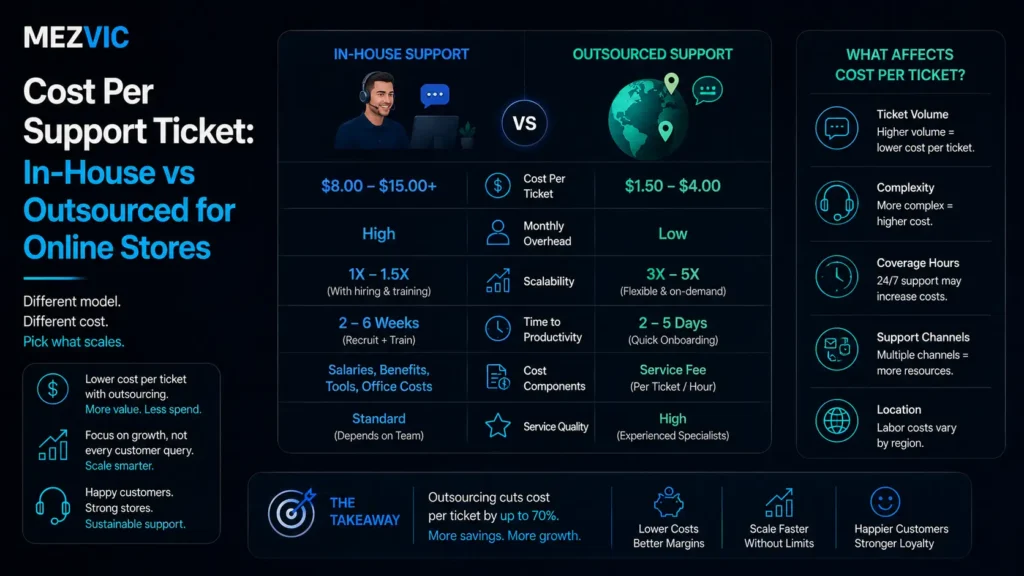
Almost nobody who outsources support knows their real cost per support ticket beforehand.
They know the agent’s salary. They rarely know the software, the management time, the training, or the tickets that come back and get handled twice.
So a vendor quotes $4.50 a ticket, it sounds cheap against a $38,000 salary, and the decision gets made on two numbers that were never comparable.
Cost per support ticket is the only figure that makes the comparison honest, and once you build it properly the answer is less obvious than the sales deck suggests.
Below: the full in-house cost per support ticket calculation, the same for outsourcing including the parts vendors leave out, and the single number that decides which one wins.
Key Takeaways
- A $38,000 agent costs about $51,040 a year once employer costs, software, management, training and equipment are counted.
- That works out around $7.14 per ticket at a realistic capacity of 7,150 tickets a year per agent.
- Outsourcing wins on raw cost at almost every volume, at roughly $4.72 per ticket once you reach 20,000 a year.
- The break-even is an escalation rate of about 46%. Above that, rehandling wipes out the entire saving.
- Channel matters more than headcount. A phone call costs roughly 50 times a self-service article.
- Deflection beats both options. The cheapest ticket is the one a good help page prevented.
What an In-House Agent Really Costs
Any honest cost per support ticket starts with salary and adds the six things that never appear next to it.
| Line | Annual | Why it counts |
|---|---|---|
| Base salary | $38,000 | The only number most people compare |
| Employer costs at 15% | $5,700 | Taxes, pension and insurance are not optional |
| Management time | $3,800 | Someone supervises, reviews and covers absence |
| Training, amortised | $1,500 | Ramp-up plus whatever turnover costs you |
| Equipment and space | $1,200 | Laptop, desk, phone, however modest |
| Helpdesk licence | $840 | Per seat, per month, forever |
| Loaded total | $51,040 | 34% above the salary you budgeted |
Arithmetic, not a study. Substitute your own salary and the 34% uplift holds roughly steady.
Now divide by what one person can actually handle to get the cost per support ticket.
Five tickets an hour is a fair mixed average across email and chat. Six and a half productive hours a day, 220 working days after holiday and sickness.
That is 7,150 tickets a year, which puts the cost per support ticket at $7.14.
The number people carry in their heads is $38,000 divided by 7,150, which is $5.31. That gap is why outsourcing quotes look better than they are, and also why in-house looks cheaper than it is.

The Two Cost Stacks, Side by Side
Same volume, same year, both cost per support ticket stacks built the same way. The shapes are almost opposite.
7,150 tickets a year, both ways
In-house on the left, outsourced on the right. Four of the six lines vanish when you outsource, and two new ones appear.
The rework bar on the right is the one vendors do not quote.
Six percent of tickets coming back is a good outcome, not a bad one. It still costs $3,063 a year, and it is paid in your own team’s time rather than on an invoice.
The management bar matters too. Outsourcing does not remove management, it changes who you are managing, and four hours a month is a realistic floor rather than a ceiling.
How that engagement gets structured, and what a sensible service level looks like, is covered on our eCommerce customer service outsourcing page.
The Number That Actually Decides It
Volume is the wrong axis for a cost per support ticket decision. Everyone models volume, and volume favours outsourcing at almost every level.
At 20,000 tickets a year you would need three in-house agents plus a supervisor, which is $173,120, or $8.66 per ticket.
The same volume outsourced at a $4.50 rate is $90,000 plus $4,320 of vendor management, which is $4.72 per ticket.
So outsourcing wins by $3.94 a ticket. Then escalation starts eating it.
Every escalated ticket is handled twice: once by the vendor and once by your specialist at your fully loaded rate. Work out where those two lines meet and you get a threshold.
$4.72 plus (escalation rate x $8.66) equals $8.66 when the escalation rate hits 46%.
That is the whole decision in one figure. Below 46% escalation, outsourcing is cheaper. Above it, you are paying twice for half your queue and in-house wins.
Most stores selling simple physical products sit at 5% to 15%. Businesses selling configurable, regulated or technical products routinely sit above 40%, and some are past 60%.
Measure yours before anyone quotes you. It is the single most useful number in this entire decision and almost nobody tracks it.

Channel Changes Everything
Before optimising who handles tickets, look at how they arrive, because channel drives cost per support ticket more than staffing does. The spread between channels is far larger than the spread between staffing models.
What one contact costs, by how it reaches you
Modelled at the in-house loaded rate. A phone call is not slightly more expensive than a help article, it is about fifty times more.
Arithmetic, not a study: handling time per channel multiplied by the loaded hourly rate, with self-service amortised over its annual readership.
That top bar is the reason deflection beats every staffing decision on this page.
Moving 1,000 contacts a year from phone to a genuinely good help article saves roughly $12,150. That is a quarter of an agent, achieved by writing eight pages properly.
The trap is measuring deflection by ticket count alone. If your help centre deflects easy email questions and leaves the phone queue untouched, cost per support ticket goes up rather than down.
Deflect the expensive channels first. Write for the questions people currently ring about, not the ones that are easiest to document.
A first line of automated triage helps here too, provided handover to a person is fast and obvious, which is what an AI support layer should be doing rather than trying to resolve everything itself.
How the Answer Changes With Volume
Cost per support ticket behaves very differently at three sizes, and the reason is that you cannot buy a third of a person.
Under 2,000 tickets a year. In-house is terrible on paper. A full agent costs $51,040 and handles 2,000 tickets, which is a cost per support ticket of $25.52.
In practice nobody hires a full agent for that. Support gets absorbed by someone doing another job, which hides the cost rather than removing it and quietly damages the other job.
Between 5,000 and 10,000 tickets. This is the genuine grey zone, and it is where most growing stores sit. One or two agents, roughly $6 to $7 a ticket either way.
At this size the decision should be made on product complexity rather than money, because the money is close enough not to matter.
Above 20,000 tickets. Outsourcing pulls clearly ahead, at roughly $4.72 against $8.66, because vendors get volume discounts and you get a supervisor’s salary.
That $3.94 gap across 20,000 tickets is $78,800 a year, which is the point at which this stops being an operational preference and becomes a board conversation.
Ticket volume rarely scales linearly with orders either. Adding a marketplace channel usually adds proportionally more support, which is worth modelling before you expand rather than after. That is part of what marketplace management absorbs.
The Quality Measures Worth Contracting
A cheap cost per support ticket with poor resolution is not a saving, it is a deferred cost that lands in refunds and repeat contacts.
Four measures belong in any contract, and only one of them is speed.
- Repeat contact rate. The share of issues that generate a second message. This is the single best quality proxy and it maps directly onto cost.
- First contact resolution. Solved without escalation or a handover. Pay a bonus against this rather than against closure speed.
- Escalation accuracy. Of the tickets escalated to you, how many genuinely needed it? Over-escalation transfers work back without transferring the fee.
- First response time, by channel. One number across all channels hides a chat queue that nobody is watching.
Escalation accuracy is the one nobody contracts and the one that decides whether the model works. A vendor escalating 60% of tickets has effectively sold you a switchboard.
Tie some portion of the fee to first contact resolution and the incentives line up immediately. Without it, per ticket pricing rewards volume rather than outcomes.
Response time expectations are worth setting the same way across every channel your customers use, including social, which we set out in our breakdown of what social media management costs.
The Hybrid That Usually Wins
Framing cost per support ticket as in-house against outsourced is the mistake. The arrangement that beats both is a split by ticket type rather than by headcount.
Send the repetitive, well documented, high volume queue to a vendor. Where is my order, how do I return this, do you ship to this country.
Keep the complex, judgement heavy, revenue affecting queue in-house. Product selection, complaints, anything where a good answer changes whether the customer stays.
That split works because it puts the expensive escalation rate where it costs least. The outsourced queue has near zero escalation by construction, and the in-house queue never pays a vendor for work it will redo.
Modelled at 20,000 tickets with a 70-30 split, the blended cost per support ticket lands near $5.90, below either pure option, because each queue is handled by whoever is cheapest at that specific work.
The requirement is accurate routing at stage two, which is a tooling problem rather than a staffing one, and it is where a little process automation genuinely earns its cost.
Reduce the Queue Before You Reprice It
Every hour spent negotiating a rate is an hour not spent removing the reason people contact you.
On most stores, three question types account for well over half the queue: order status, returns, and delivery timing.
All three are answerable without a person. Shopify’s self-serve returns let customers request a return or cancellation from the order status page, so the merchant only reviews and approves rather than fielding the question.
Proactive dispatch and delivery notifications remove most of the rest, which is one of the quiet arguments for the post-purchase flows in our guide to the nine workflows worth building.
Do the arithmetic before dismissing this as small. Removing 4,000 email contacts a year at $5.50 saves $22,000, which is more than most vendor negotiations will ever recover.
And it improves the experience rather than degrading it, which is the opposite of what cost cutting usually does to support.
Once volume is down, revisit the staffing question with the smaller, harder queue in front of you. The answer often flips back toward in-house, because what remains is exactly the work outsourcing handles worst.
If order and stock problems are generating the tickets in the first place, that is an operations fix rather than a support one, and it usually sits with choosing the right 3PL.
Where the Cost Actually Enters
Cost per support ticket suggests a single event. A ticket is not one. It is a loop, and money joins at five points rather than one.
Five stages, five places cost enters
Most cost reduction targets stage three. The cheapest wins are almost always at stage one and stage five.
Stage two is the quiet one. A misrouted ticket costs a full handling before anyone has helped the customer.
Stage two deserves more attention than it gets. Misrouting is invisible in reporting because the ticket eventually gets resolved, so nothing looks broken.
It still consumed a full handling before the customer received anything useful, and it is the cheapest thing on this diagram to fix.
Stage five is the other underrated one. A follow-up that confirms the fix worked prevents the second contact about the same issue, and second contacts are pure duplicated cost.
Everyone optimises stage three, because that is where the visible metrics live. It is also the stage where an outsourced team is already efficient, which limits how much you can improve it.

How Vendors Price, and What to Ask
Vendors price cost per support ticket three ways, and they behave very differently as volume moves.
| Model | Typical rate | Suits | How it goes wrong |
|---|---|---|---|
| Per ticket | $3.50 to $8.00 | Predictable, simple queues | Rewards closing fast, not solving properly |
| Per hour | $12 to $25 per agent hour | Complex or variable work | No incentive to be quick, so you must watch throughput |
| Dedicated seat | $1,600 to $3,200 per month | High volume, deep product knowledge | You pay for idle time in quiet months |
Per ticket pricing is the most common and the most gameable. The fix is a quality measure in the contract, not a lower rate.
Per ticket pricing has an obvious incentive problem. A vendor paid per closed ticket is rewarded for closing, not for the customer never needing to write again.
That is not dishonesty, it is what the contract asks for. Fix it by paying on resolution rather than closure, and by measuring repeat contact rate.
Four questions worth asking before signing anything.
- What counts as a ticket? If three emails in one thread bill as three tickets, your cost per support ticket is not what you were quoted.
- What happens to escalations? Who decides, how fast, and is the escalated ticket still billed?
- What is the repeat contact rate? Ask for it from an existing client. Refusal is itself an answer.
- How many accounts does each agent cover? An agent on six brands will never know your products well.
The first question changes the number more than any negotiation on rate will. Thread counting versus ticket counting can swing an invoice by 40%.
Once support is running smoothly, the same team usually touches order issues and returns, which is why it tends to sit alongside day to day store operations rather than separately.
Where the Tickets Come From
Support volume is a symptom. Reading it as a staffing problem treats the symptom and leaves the cause alone.
Four causes account for most avoidable contacts, and none of them are fixed by hiring.
Unclear product information. If the size, compatibility or contents are ambiguous, people ask. Better product listings remove the question permanently rather than answering it repeatedly.
Delivery uncertainty. Vague dispatch timing generates the single largest category of contacts on most stores, and it is usually a dispatch visibility problem rather than a courier one.
Checkout friction. People who cannot complete an order often contact you instead of leaving, which looks like support volume and is really a conversion issue with a helpdesk attached.
Repetitive qualification. If half your inbox is the same three questions before a purchase, that is work an AI chatbot handles well, provided handover to a person is quick.
Fix those four and the queue shrinks before you have negotiated anything. The remaining tickets are harder on average, so watch the cost per support ticket rise even as total spend falls.
That rise is not a failure. It means the cheap tickets are gone, which is exactly what you wanted, and it is why total support cost is the better headline measure once deflection is working.
Run the totals against your margin rather than in isolation, since support cost per order matters more than cost per ticket at the point you set prices. Our margin calculator gives you the denominator.
Frequently Asked Questions
What is a typical cost per support ticket?
In-house runs about $7 to $9 per ticket once salary, employer costs, management, training, equipment and software are counted. Outsourced typically lands between $4.50 and $6.50 all in.
How do I calculate cost per support ticket?
Add every annual cost of running support, including management time and software, then divide by tickets resolved in the year. Most people forget the 34% that sits above salary.
How many tickets can one agent handle?
Around 7,150 a year for mixed email and chat, based on five an hour across 6.5 productive hours and 220 working days. Phone heavy queues are considerably lower.
Is outsourcing customer service cheaper?
On raw cost per ticket, usually yes, by roughly 15% to 45% depending on volume. That advantage disappears once your escalation rate passes about 46%.
What is a good escalation rate?
Simple physical product stores sit at 5% to 15%. Configurable, technical or regulated products often exceed 40%, which is the point where outsourcing stops saving money.
Which support channel is most expensive?
Phone, at roughly $12.40 per contact against $5.50 for email. A self-service article costs about $0.25 per use, which is why deflection beats every staffing change.
How much does a helpdesk tool cost?
Around $70 per agent per month for mainstream platforms, so $840 a year per seat. It is a small line but it belongs in the calculation.
Should I outsource support for a small store?
Below roughly 2,000 tickets a year, outsourcing is usually cheaper than a full salary, since you cannot buy a third of a person. Check the minimum monthly commitment first.
What is repeat contact rate and why does it matter?
It is the share of customers who write again about the same issue. It is the best proxy for quality, and it directly inflates cost per support ticket because you handle the same problem twice.
How should an outsourcing contract be priced?
Per ticket for simple predictable queues, per hour for complex work, and dedicated seats at high volume. Whichever you choose, define what counts as one ticket in writing.
Does AI reduce cost per support ticket?
It reduces volume rather than unit cost, by resolving repetitive questions before a person sees them. Treat it as deflection, and expect the remaining tickets to be harder and more expensive each.
How long does it take to move support to a vendor?
Six to twelve weeks including documentation, training and parallel running. Expect quality to dip for the first month while the vendor learns your products.
The Bottom Line
Build your real cost per support ticket first. Salary divided by tickets is not it, and comparing that figure to a vendor quote is how bad decisions get approved.
Then measure your escalation rate, because that single percentage decides the answer more than volume, headcount or hourly rate.
And before choosing between two ways of answering tickets, spend a week reducing how many arrive. Deflection is the only option on this page that improves cost and experience at the same time.
If you want your own figure calculated properly before you talk to a vendor, send us your ticket volume and channel split and we will build the comparison with your numbers in it.