The email arrives without warning. Your account is deactivated, your listings are down, and your payouts are on hold.
Revenue stops that same hour. Meanwhile the platform’s message tells you almost nothing about what you actually did wrong.
A marketplace account suspension feels personal, but it is usually an automated enforcement action following a pattern you can decode and reverse.
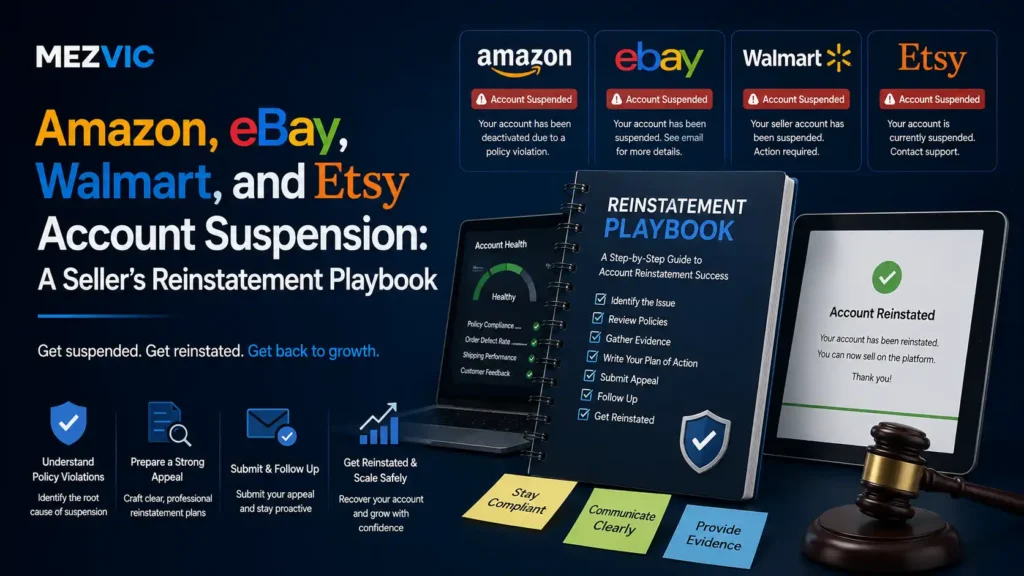
This playbook covers why suspensions happen on Amazon, eBay, Walmart, and Etsy, what to do in the first 24 hours, how to write an appeal that works, and how to avoid a second one.

What Is a Marketplace Account Suspension?
A marketplace account suspension is an enforcement action where a platform disables your ability to sell, usually because a metric slipped or a policy was breached.
It is rarely a human decision at first. Automated systems flag the account, and a person only reviews it once you appeal.
That matters, because it tells you what the appeal actually needs to do. You are not arguing with someone who is angry at you.
You are giving a reviewer the evidence they need to safely tick a box and switch you back on.
Key Takeaways
- A marketplace account suspension is usually automated enforcement, not a personal judgment.
- Diagnose the real root cause before writing anything. That single step decides the outcome.
- Use the three part Plan of Action: root cause, corrective action taken, preventive measures.
- Evidence persuades. Never alter a document, since that converts a suspension into a ban.
- Never open a second account to keep trading during a suspension.
- Selling on more than one channel turns a future suspension into an inconvenience.
The First 24 Hours: What to Do Immediately
What you do on day one has an outsized effect on whether you get reinstated. Here is the order that works.
- Do not send an angry appeal. Emotional first responses are the most common reason a straightforward case drags on for weeks.
- Read the notice properly. The exact policy or metric named in it is the thing your appeal must address.
- Check your performance dashboard for the underlying numbers and any linked notifications.
- Gather evidence such as invoices, supplier details, tracking data, and customer messages.
- Diagnose the real root cause honestly, not the one that is most comfortable.
- Then write the appeal, once and properly, rather than firing off three weak ones.
Why Marketplaces Suspend Sellers
Almost every suspension traces back to one of five categories, whichever platform you sell on. Late dispatch and cancellations cause more of these than policy breaches do, which makes it a fulfilment problem at root.
- Performance metrics: late shipping, cancellations, defect rates, or poor feedback.
- Product authenticity: counterfeit claims, or items you cannot document a supply chain for.
- Listing violations: restricted items, inaccurate condition, or prohibited claims.
- Account issues: linked accounts, verification failures, or mismatched business details.
- Intellectual property: brand, trademark, or copyright complaints from rights owners.
Identifying which bucket you are in is the whole game. The appeal for a metrics problem looks nothing like the appeal for an authenticity complaint.

How Each Platform Differs
The principles are shared, but the culture of enforcement varies a lot between marketplaces. Walmart is the strictest on dispatch and tracking, where these are account health metrics rather than service levels: see Walmart fulfilment.
| Platform | Enforcement style | What the appeal needs |
|---|---|---|
| Amazon | Strict, process driven, heavily automated | A formal Plan of Action with root cause and preventive steps |
| eBay | Metric and policy led, somewhat more flexible | Clear evidence plus a concrete corrective plan |
| Walmart | Performance focused, high standards | Operational fixes and proof of improvement |
| Etsy | Policy and authenticity focused | Documentation of handmade or sourcing compliance |
Amazon is the most formal, which is why the Plan of Action format below is worth learning even if you sell elsewhere.
For a platform specific walkthrough, our guide to eBay account reinstatement goes deeper on that marketplace’s process.
The Plan of Action Framework
A Plan of Action is the standard appeal format, and it has three parts. Reviewers look for all three.
Part 1: Root cause
State plainly what went wrong and why. Take ownership, even when circumstances were partly outside your control.
“Our supplier changed without notice and we did not verify the new stock” beats “we believe this was a mistake by your system”.
Part 2: Immediate corrective action
Explain what you have already done, in the past tense. Removed the listings, refunded affected buyers, ended the supplier relationship.
Actions already taken carry far more weight than promises about the future.
Part 3: Preventive measures
Describe the systems that make a repeat impossible. Weekly metric reviews, supplier verification, stock buffers, an approval step before listing.
Be specific. “We will be more careful” tells a reviewer nothing and reads as a risk.
How to Write an Appeal That Gets Read
Reviewers process a large volume of appeals. Yours should be easy to approve.
- Keep it factual and unemotional, however unfair the suspension feels.
- Use short paragraphs and clear headings so it can be skimmed.
- Address the exact policy named in the notice, not a general defense.
- Attach evidence and reference it directly in the text.
- Avoid blaming the platform, buyers, or a competitor.
- Never threaten legal action in a first appeal.
Think of it as a compliance document, not a letter. The tone that feels satisfying to write is almost always the tone that fails.
What Documents You Will Need
Evidence is what converts a plausible story into an approved appeal. Gather these before you write.
- Supplier invoices showing product source, quantities, and dates.
- Business verification documents matching your account details exactly.
- Tracking and delivery data for shipping related cases.
- Buyer correspondence where it supports your account of events.
- Authorization letters from brands where authenticity is questioned.
Invoices must be genuine and verifiable. Submitting altered documents turns a recoverable suspension into a permanent ban.

Where sellers lose a reinstatement
The platform review is the part you cannot speed up. Everything before it is entirely yours.
Timings vary by platform and suspension type and are indicative, not guaranteed. The sequence is the part that holds.
How Long Does Reinstatement Take?
Timelines vary by platform and by how clean your appeal is.
A straightforward metrics case with a strong first appeal can resolve within days. Authenticity and intellectual property cases usually take longer.
The biggest variable is not the platform. It is whether your first appeal was good enough to avoid a cycle of rejections.
This is why rushing the first submission usually costs more time than it saves.
What to Do If Your Appeal Is Rejected
A rejection is not the end, but repeating yourself louder will not help.
Read the rejection carefully. It usually signals which of the three parts was weak, most often a vague root cause.
Strengthen that section with harder evidence, then resubmit once. Do not simply reword the same document.
If two properly built appeals fail, get specialist help. At that point the issue is usually something structural you cannot see from inside your own account.
That is the point where dedicated account reinstatement support tends to pay for itself quickly.
Protecting Your Cash Flow During a Suspension
Nobody talks about this part, and it is often what actually kills the business. Model what a frozen fortnight actually costs with our profit margin calculator before committing that money elsewhere.
Payouts are usually held during a suspension, sometimes for weeks after reinstatement. Plan for the gap rather than assuming funds will release.
Keep fulfilling any orders you are still able to fulfil, since cancelling them makes your metrics worse right when you need them to improve.
Pause inbound stock and ad spend for that channel, and push volume to whatever other channels you have running.
Preventing the Next Suspension
Once you are back, the goal is never to do this again. Prevention is mostly boring routine, which is why it gets skipped. Most of the recurring causes are inbox and dispatch failures, which is why customer service cover pays for itself here.
- Review your seller metrics weekly, not when something breaks.
- Set internal thresholds well above the platform’s minimums.
- Keep supplier invoices filed and retrievable within minutes.
- Verify new products against restricted category lists before listing.
- Respond to buyer messages inside the platform’s stated window.
- Never operate a second account without explicit permission.
Automated alerts on your key metrics turn this from a memory problem into a system, and automation handles that monitoring well.
The Real Lesson: Diversify Your Channels
Every suspended seller learns the same lesson at the worst possible moment. One platform should never be your whole business. Adding a channel properly means one shared catalogue and stock number, not a second spreadsheet: that is product listing work.
If a single marketplace can switch off your entire revenue with one automated email, that is a structural risk, not bad luck.
Sellers who run two or three channels plus their own store treat a suspension as a bad week, not an emergency.
Spreading across marketplaces and your own site is a core part of sensible eCommerce management, and it is far cheaper than a recovery.

Mistakes That Make Things Worse
These are the moves that turn a recoverable suspension into a permanent one. Inaccurate listings drive the not-as-described claims behind many metrics suspensions, so listing accuracy is prevention.
- Opening a new account to keep trading. This is the fastest route to a permanent ban.
- Submitting invoices that have been edited in any way.
- Sending daily appeals and support messages.
- Blaming the platform instead of naming a root cause.
- Ignoring the actual policy cited and defending something else entirely.
- Going quiet for weeks, then appealing with no evidence.
The instinct behind most of these is understandable. That does not make them survivable.
When revenue stops overnight, acting fast feels like the right instinct. In a marketplace account suspension, acting carefully beats acting fast every single time.
When to Get Professional Help
Many suspensions are genuinely a do it yourself job, especially simple metrics cases with obvious causes. For Amazon specifically the appeal route differs, covered on Amazon account reinstatement.
Get help when the account represents most of your revenue, when intellectual property or authenticity is involved, or when two solid appeals have already failed.
Also get help if you are too close to it to write calmly. That is a real and common reason appeals fail.
You can see how these recoveries play out in our case studies.
A Worked Example: Metrics Suspension
Abstract advice only goes so far, so here is what a strong root cause section actually reads like.
Weak version: “Our late shipment rate went up because of issues with our courier during a busy period.”
Strong version: “Our late dispatch rate rose to 12% in March. We had set handling time to one day across all listings, including three products shipped directly by a supplier who needed three days.”
The strong version names a number, a date, and a specific operational error. A reviewer can verify it and see that you understand it.
The weak version blames an outside party and could have been written by any seller about any problem.
That difference in specificity is, more than anything else, what separates approved appeals from rejected ones.
Warning Signs Before a Suspension
Suspensions feel sudden, but the conditions usually build for weeks. These are the signals worth watching. Watching those numbers daily across every channel is marketplace management.
- Policy warnings or listing removals that you dismissed as minor.
- Metrics drifting toward the threshold rather than sitting comfortably above it.
- A rise in A to Z claims, disputes, or negative feedback.
- Verification requests you have not fully completed.
- New suppliers or products added without documentation checks.
Any one of these is a free warning. Acting on it costs an afternoon, while ignoring it can cost your whole channel.
Handling Intellectual Property Complaints
Intellectual property cases work differently, and sellers often waste weeks appealing to the wrong party. On Amazon, brand ownership changes what you can defend, which is Brand Registry work.
When a rights owner files a complaint, the marketplace is largely acting as a middleman. It will not usually overrule them for you.
The fastest route is often to contact the rights owner directly and ask them to retract, once you can show you are selling genuine, authorized stock.
A retraction from the complainant carries far more weight than any argument you make to the platform.
If the complaint is valid, remove the listings, say so plainly, and focus your appeal on preventing a repeat.
Your Suspension Readiness Checklist
The best time to prepare for a suspension is while you do not have one. Work through this now.
- Supplier invoices filed and retrievable in under ten minutes.
- Business details identical across every platform and document.
- Seller metrics reviewed on a set day each week.
- Internal alert thresholds set above platform minimums.
- A second sales channel live, even if small.
- Enough cash reserve to survive held payouts.
- One named person responsible for compliance.
Sellers who can tick every box recover from a marketplace account suspension in days. Sellers who cannot often take months.
Suspension vs Restriction vs Ban
These three words get used interchangeably, but they mean very different things for your recovery odds. If TikTok Shop is one of your channels, its compliance rules differ again: see TikTok Shop management.
A restriction limits part of your account, such as a single listing or category, while the rest keeps trading. These are usually the easiest to resolve.
A suspension disables selling but leaves the door open to appeal. This is what most sellers face, and most are recoverable.
A permanent ban follows serious or repeated breaches, such as document fraud or running duplicate accounts. Appeal routes here are narrow.
Read your notice carefully to work out which one you actually have. The wording drives how urgently and how formally you should respond.
Sellers often assume the worst and give up on a case that was merely a restriction. Others assume the best and under-respond to a serious one.
Frequently Asked Questions
What is a marketplace account suspension?
A marketplace account suspension is when a platform such as Amazon, eBay, Walmart, or Etsy disables your selling privileges, usually because performance metrics dropped below standard or a policy was violated. Listings come down and payouts are typically held.
Can a suspended seller account be recovered?
Yes, most suspensions are reversible with a well built appeal. Success depends on correctly identifying the root cause, providing genuine supporting evidence, and submitting a clear Plan of Action rather than repeated emotional appeals.
How long does reinstatement take?
A clean metrics case with a strong first appeal can be resolved in days. Authenticity and intellectual property cases take longer. The main factor is appeal quality, since weak submissions cause rejection cycles that add weeks.
Should I open a new account while suspended?
No. Creating a second account while suspended breaches the rules on every major marketplace and is one of the fastest routes to a permanent ban, including the loss of any held funds.
Will I get my held payouts back?
Funds are usually released after reinstatement, though often on a delay. Continuing to fulfil orders you can still ship, and avoiding further violations, gives you the best chance of a clean release.
Can I keep selling on other marketplaces while suspended?
Yes, and this is exactly why channel diversification matters. A suspension on one platform does not automatically affect the others, so sellers with a second and third channel keep trading while they appeal. Sellers with everything on one marketplace lose their entire revenue on the day the email arrives, which turns a solvable policy problem into a cash crisis.
Do I need a lawyer to appeal a marketplace suspension?
Almost never. These are policy decisions made by internal review teams, not legal proceedings, and a letter written in legal language usually performs worse than a plain plan of action. The exception is a genuine intellectual property dispute with a rights owner, where the fastest route back is often getting that complainant to retract, and that is a conversation where legal help can earn its fee.
How long should a plan of action be?
One page is usually enough, and shorter is better than longer. Reviewers read a high volume of these and are scanning for three things: what caused the problem, what you have already changed, and what stops it recurring. Background about how long you have been selling, how much the account means to you, or how unfair the decision feels adds length without adding a single point in your favour.
What if the suspension was genuinely a platform error?
Say so once, calmly, and supply the evidence that proves it, then move on to what you will do differently anyway. Reviewers see a great many appeals insisting a mistake was made, so the claim alone carries no weight. Evidence does. Framing it as a correction rather than a complaint also keeps the tone on your side, which matters more than sellers expect.
Will a suspension affect my seller rating after reinstatement?
The metrics that triggered it usually remain in your performance window for a period after you return, so the account comes back fragile rather than fresh. Plan for a cautious restart: keep dispatch times conservative, avoid launching risky new lines immediately, and let the bad numbers age out before you scale volume again.
The Bottom Line
A marketplace account suspension is frightening, but it is a process, and processes can be worked.
Stay calm, find the real root cause, gather genuine evidence, and submit one strong appeal instead of five weak ones.
Then build the routines and the extra channels that mean the next automated email is an inconvenience rather than a crisis.
Suspended right now and unsure what to do next? Book a free strategy call and we will review your notice and map the fastest realistic route back.