You sold a $25 item. eBay took $5.25.
That is 21% of your item price, not the 13.6% you were expecting.
Nothing went wrong. No penalty, no mistake, no hidden charge. That is just how eBay seller fees are built.
Most sellers price their stock using one number, the headline percentage, and then wonder every month where the money went.
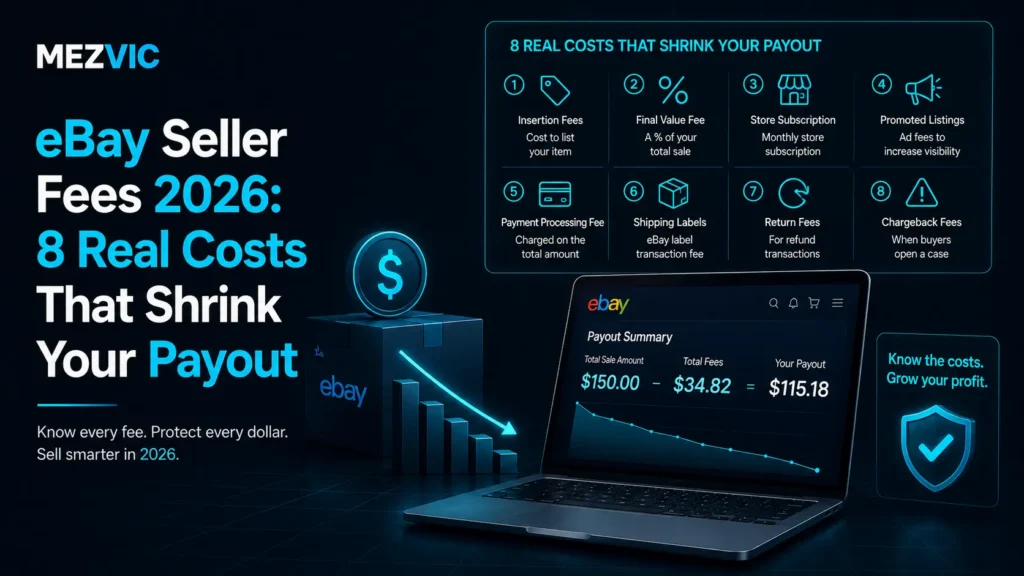
This guide pulls apart all eight costs. Every figure below comes straight from eBay’s own fee pages, and I have linked them so you can check.
Nothing here is secret. eBay seller fees are published in full. They are just spread across four separate help pages, and hardly anyone reads all four.
In this guide, you will learn:
- What the 13.6% is actually charged on (it is not your item price)
- The one cent that costs you ten cents
- Exactly how much you must sell before an eBay Store pays for itself
- The four fees that stack on top of each other in a bad month
- Which categories quietly charge far less than 13.6%
Key Takeaways
- The standard final value fee is 13.6% on the first $7,500 of a sale, then 2.35% above that.
- That percentage is charged on the total order: item price, handling, buyer-paid shipping and sales tax.
- On a $25 item with $8 shipping, that works out to about 21% of your item price.
- There is also a per-order fee: $0.30 on orders of $10 or less, $0.40 on anything above.
- You get 250 free listings a month, then $0.35 each, charged per category and on every relist.
- Good ‘Til Cancelled listings renew monthly and use up a free slot every single month.
- A Basic Store cuts most categories to 12.7%. It pays for itself at roughly $3,106 a month in sales.
- A Starter Store gives you no discount at all on the final value fee.
- Below Standard sellers pay an extra 6% of the sale, rising to 7% after four months.
- Selling abroad adds 1.65%, and listing on a foreign eBay site adds a 3% currency charge.
- Promoted Listings ad rates run from 2% to 100% of the total sale amount.
- Every payment dispute you lose costs a flat $20.
- All the eBay seller fees below are current US rates, taken straight from eBay’s own help pages.
Why eBay Seller Fees Feel Higher Than the Advertised Rate
Because they are charged on a bigger number than you think.
eBay’s fee page is clear about it. The total amount of the sale includes “the item price, any handling charges, any shipping costs collected from the buyer, sales tax, and any other applicable fees”.
Read that list again. Sales tax is in it, which means eBay seller fees are charged on money you never keep.
You never see that tax money. eBay collects it and sends it to the state. You still pay commission on it.
Here is the same $25 sale, all the way through.
| Line | Amount |
|---|---|
| Item price | $25.00 |
| Shipping charged to buyer | $8.00 |
| Sales tax collected (8%) | $2.64 |
| Total amount of the sale | $35.64 |
| Final value fee (13.6% of $35.64) | $4.85 |
| Per-order fee | $0.40 |
| Total eBay fee | $5.25 |
| Fee as a share of your $25 item price | 21.0% |
The rate you quote vs the rate you pay
Same $25 item, $8 shipping, 8% sales tax. Both bars are eBay’s fee measured against your item price.
Arithmetic, not a study. Rates from eBay’s selling fees page. The gap narrows on higher-priced items and widens on cheap ones with heavy shipping.
The lesson is not “eBay is greedy”. The lesson is that eBay seller fees are charged on a base most sellers never put in their spreadsheet.
If you price by gut feel, run a batch through our profit margin calculator first. The results are usually humbling.

The 8 eBay Seller Fees That Shrink Your Payout
Some of these eBay seller fees you already know about. At least two of them surprise almost everybody.
1. The Final Value Fee (13.6%, But Check Your Category)
This is the big one, and the largest of all the eBay seller fees. eBay takes a cut when your item sells, and payment processing is already baked in.
For most categories that is 13.6% on the first $7,500 of a sale, then 2.35% on anything above.
But “most categories” hides a lot. Some categories are much cheaper. One is noticeably worse.
| Category | Rate on the first $7,500 |
|---|---|
| Most categories | 13.6% |
| Books, Magazines, Movies & TV, Music | 15.3% |
| Jewelry & Watches (up to $5,000) | 15% |
| Women’s Bags & Handbags (up to $2,000) | 15% |
| Coins & Paper Money, sports cards, comics, CCGs | 13.25% |
| Athletic Shoes priced $150 or more | 8%, and no per-order fee |
| Guitars & Basses | 6.7%, and no insertion fee |
| Heavy equipment, printing presses, food trucks | 3% (with a $20 insertion fee) |
Two things jump out of that table.
Media sellers pay the most. Books, DVDs and CDs sit at 15.3%, which is brutal on items that often sell for under $10.
Sneakers and guitars are the bargains of the site. Trainers over $150 pay 8% with no per-order fee. Guitars pay 6.7% with free listings. eBay wants that inventory badly enough to subsidise it.
So before you assume your rate, go and read your exact category. Sellers lose real money by guessing, and choosing the right category affects both your fee and how well you rank in search.

2. The Per-Order Fee (And the Cent That Costs You a Dime)
On top of the percentage, every order carries a flat fee. It is the smallest of the eBay seller fees and the one that does the most damage to cheap items.
Orders of $10.00 or less pay $0.30. Orders above $10.00 pay $0.40.
Forty cents sounds like nothing. On a small order it is not nothing at all.
| Order total | Per-order fee | What that fee alone costs you |
|---|---|---|
| $5.00 | $0.30 | 6.0% |
| $10.00 | $0.30 | 3.0% |
| $10.01 | $0.40 | 4.0% |
| $25.00 | $0.40 | 1.6% |
| $100.00 | $0.40 | 0.4% |
Look at rows two and three. Selling at $10.01 costs you ten cents more than selling at $10.00.
Somewhere in eBay’s billing code there is a greater-than sign, and it has opinions.
There is a catch that catches people out, though. The threshold is on the order total, and the order total includes shipping.
So a $6 item with $5 postage is an $11 order. You are in the $0.40 band whether you meant to be or not.
What to do about it:
- Bundle small items. One order of five items pays one per-order fee. Five separate orders pay five.
- Set a sensible minimum. Under about $8, the flat fee plus the percentage eats most thin margins alive.
- Watch your price points. If you keep landing at $10.20, either drop under $10 or push properly past it.
3. Insertion Fees, and the Renewal Nobody Notices
Insertion fees are the eBay seller fees you pay whether or not anything sells. You get 250 free listings a month. After that, each listing costs $0.35.
Simple enough. Then you read the small print, and four rules change the picture.
- Charged per category. List one item in two categories and you pay twice.
- Charged on every relist. An item that takes four attempts to sell costs four insertion fees.
- Non-refundable if it never sells. The fee buys the listing, not the outcome.
- Good ‘Til Cancelled listings renew every calendar month, and each renewal is charged again.
That last one is the quiet killer.
Say you have 400 Good ‘Til Cancelled listings sitting there. On renewal day, 250 of them use your free allowance and the other 150 cost $0.35 each.
That is $52.50 a month, every month, before you list a single new thing. And your free allowance is already gone by the time you want to use it.
They renew like a gym membership: quietly, monthly, and long after you stopped thinking about them.
Dead stock is what makes this hurt.
If a listing has not sold in a year, it is not inventory. It is a subscription you pay for the privilege of storing something nobody wants.
A proper cull is the least glamorous job in running an eBay store, and one of the most profitable.
One more line item lives here: optional listing upgrades.
Bold text is $2.00 on an auction and $4.00 on a fixed price listing. A subtitle runs $1.50 to $6.00.
A reserve price is the one to watch. It costs $5.00 or 7.5% of the reserve, whichever is greater, and you pay it whether or not the item sells.
4. The Store Subscription (The Fee That Is Supposed to Save You Money)
A Store subscription is the one line among your eBay seller fees that you volunteer for. It is a monthly bill that lowers your other bills, and whether that trade works depends entirely on your sales volume.
Here is the part almost nobody checks before subscribing.
| Store level | Monthly cost | Final value fee, most categories |
|---|---|---|
| No Store | $0 | 13.6% |
| Starter | $7.95 | 13.6% (no change) |
| Basic | $27.95 | 12.7% |
| Premium | $74.95 | 12.7% |
| Anchor | $349.95 | 12.7% |
Read the Starter row twice.
A Starter Store pays $7.95 a month and gets the exact same 13.6% as somebody paying nothing. It buys a cheaper insertion fee and a storefront, not a discount on sales.
The real jump is Basic. That is where most categories drop to 12.7%, a saving of 0.9 percentage points.
So the question becomes simple: how much do you need to sell for 0.9% to cover $27.95?
How much you must sell before a Basic Store pays for itself
A Basic Store saves 0.9 percentage points on most categories. Divide the subscription by that saving and you get your break-even.
Arithmetic, not a study. Uses the 13.6% to 12.7% drop that applies to most categories; your category may differ, and Store insertion-fee savings push the break-even lower if you list heavily.
That is the whole decision, on one line: about $3,100 a month in sales.
Under it, you are paying for a badge. Over it, you are leaving money on the table by not subscribing.
And here is the bit that saves people from overspending: Premium and Anchor do not lower your final value fee any further. They buy you more free listings and cheaper insertion fees, nothing more.
So upgrade past Basic only when your listing count demands it, never because you assume bigger means cheaper commission.
5. Promoted Listings Ad Fees (2% to 100%)
Of all the eBay seller fees, this is the one sellers control most and understand least.
With a general campaign, you pick an ad rate between 2% and 100% of the total sale amount. You pay it only when a promoted item sells.
Sounds risk-free. There is a detail in eBay’s own documentation that changes the maths.
You are charged when a buyer clicks your ad and then buys any of your promoted items within 30 days. Not just the one they clicked.
So a shopper clicks a $9 phone case, ignores it, comes back three weeks later and buys a $300 promoted camera. You pay the ad fee on the camera.
That is a 30-day memory, and it is why sellers see ad fees on orders they would swear were organic.
Stack a 5% ad rate onto 13.6% and you are at 18.6% before shipping.
That can still be a great trade. It only turns bad when nobody is watching.
Which is the usual state of affairs with Promoted Listings campaigns left on their default setting for a year.
Three rules that keep ad spend honest:
- Never promote everything. Items that already sell well do not need paying for twice.
- Treat the suggested rate as a suggestion. It is designed to win placements, not to protect your margin.
- Judge campaigns on profit, not on sales. Ad-driven revenue at a loss is just an expensive way to move boxes.
Done properly, the numbers can be excellent. Our eBay Canada case study covers an account that reached C$11,572 largely through Promoted Listings.
6. The International Fee (1.65%) and the Currency Charge (3%)
These are the eBay seller fees that only show up once you sell across a border. There are two of them, and people mix them up constantly.
The international fee is 1.65% of the total sale. It applies when the delivery address is outside the US, or when the buyer’s registered address is outside the US, even if they ship domestically.
That second half surprises people. A parcel that never leaves Ohio can still carry the fee, purely because the buyer’s account is registered abroad.
There is a way out. If you use eBay International Shipping on eligible listings, the international fee is not charged at all.
The currency conversion charge is 3%, and it is a different animal. It applies when eBay has to convert your money, for example because you listed on eBay.de and got paid in euros.
Three percent is the toll for the sentence “I’ll just list it on the German site as well”. Worth paying if that market works for you. Worth knowing about first.
If you sell across borders regularly, the shipping side is where the bigger money sits. Getting fulfilment and postage costs right usually saves more than the 1.65% ever costs you.

7. Performance Surcharges (The Ones That Really Hurt)
Every other cost so far is the price of doing business. This one is a penalty, and it is the most expensive of the eBay seller fees on this page.
eBay checks your account on the 20th of each month. If you are rated Below Standard, you pay an extra 6% on sales for the whole of the following month.
eBay states plainly that additional final value fees are “calculated as a percentage of the total amount of the sale”. So 13.6% becomes 19.6%.
And it escalates.
| Situation | Extra fee |
|---|---|
| Below Standard | +6% of the sale |
| Below Standard for 4 or more months in a row | +7% |
| “Item not as described” returns rated Very High | +5% in those categories |
| Very High for 4 or more months in a row | +6% |
Here is why this matters more than the number suggests. A Below Standard rating usually arrives at the worst possible moment, when you are already dealing with late shipments or a run of returns.
So your costs jump 6 points in the exact month your sales are wobbling. It is a tax on having a bad quarter.
Worse, the same metrics that trigger the surcharge are the ones that trigger restrictions. Sellers who ignore a Below Standard warning often end up needing help getting the account restored a few months later.
If you have already had a restriction, our walkthrough of how eBay account reinstatement actually works covers the appeal side in detail.
8. The $20 Dispute Fee
The last of the eBay seller fees is a flat one. If a buyer disputes a payment with their bank and you are found responsible, eBay charges $20 per dispute.
That is on top of losing the item and the money.
On a $30 order, a chargeback you lose costs you the $30, the stock, and another $20. You would have been better off never making the sale.
Most disputes are won or lost before they happen:
- Always use tracked postage. Untracked delivery is an unwinnable argument.
- Photograph anything unusual before it goes out, especially high value or damaged-box items.
- Answer messages fast. Most chargebacks start as a question nobody replied to.
- Describe flaws honestly. “Item not as described” is the most expensive four words in this article.
What eBay Seller Fees Look Like When Everything Stacks
Individually, eBay seller fees are reasonable. The problem is that they add together, and nothing on your dashboard shows you the combined number.
Here is a seller having a rough month: rated Below Standard, shipping abroad, running a 5% ad rate.
How four fees turn 13.6% into 26.25%
Each bar adds to the one above it. All four are charged on the total amount of the sale.
Arithmetic, not a study. Uses eBay’s published US rates and a mid-range ad rate. Most sellers never hit all four at once, which is exactly why it goes unnoticed when they do.
Twenty-six percent in eBay seller fees. On a product with a 30% gross margin, that leaves almost nothing.
And notice which three of the four you fully control. Only the international fee is genuinely outside your hands.
A 7-Point Audit to Cut Your eBay Seller Fees This Month
None of this needs new software. Set aside an hour, work down the list, and most sellers find their eBay seller fees drop without a single change to what they sell.
- Check your actual category rate. Not the headline. Yours might be 15.3%, or it might be 8%.
- Count your Good ‘Til Cancelled listings. Anything unsold for twelve months is costing you monthly and earning nothing.
- Do the Store maths. Above roughly $3,100 a month in sales, Basic pays for itself. Below it, you are donating.
- Pay yearly if you are staying. Basic drops from $27.95 to $21.95, which is $72 a year for a decision you already made.
- Open your Promoted Listings report. Sort by ad fees paid. Anything expensive that was selling fine before gets turned off.
- Look at your seller dashboard before the 20th. That is the date the surcharge is decided. Afterwards is too late.
- Reprice anything landing between $10.00 and $11.00. That band pays the higher flat fee for almost no extra revenue.
Most sellers find two or three of these apply. Together they usually cut more from your eBay seller fees than a month of chasing new listings would add in revenue.
If your listings are also underperforming in search, fixing titles and item specifics compounds with this work. That is the point of proper eBay search optimisation: the same order costs the same fee whether it took you one listing or four to get there.
Frequently Asked Questions
What are eBay seller fees in 2026?
The main ones are a final value fee of 13.6% on most categories, plus a per-order fee of $0.30 on orders up to $10 and $0.40 above that. On top of those sit insertion fees after your first 250 listings, optional Store subscriptions, Promoted Listings ad rates, a 1.65% international fee, a 3% currency conversion charge, performance surcharges and a $20 dispute fee.
Does eBay charge fees on shipping?
Yes. The final value fee is calculated on the total amount of the sale, which includes any shipping and handling charges you collect from the buyer. This is the single biggest reason eBay seller fees feel higher than the advertised rate. Free shipping does not avoid this, it just moves the cost into your item price where the same percentage still applies.
Does eBay really take a fee on sales tax?
Yes. eBay’s fee page lists sales tax as part of the total amount of the sale that the final value fee is calculated on. You never receive that tax money, but it still forms part of the fee base.
How do I calculate my real eBay fee percentage?
Add your item price, shipping charged and sales tax together, multiply by your category rate, then add the per-order fee. That total is your real eBay seller fees for the order. Divide that total by your item price alone. That last number is your true cost, and it is almost always higher than the headline rate.
Is an eBay Store worth it?
A Basic Store pays for itself at roughly $3,106 a month in sales on monthly billing, or about $2,439 on yearly billing. Below that you are paying more than you save. A Starter Store never pays for itself on commission, because it carries the same 13.6% rate as having no Store at all.
Which eBay categories have the lowest fees?
Your category is the biggest single factor in your eBay seller fees. Guitars and basses are the cheapest at 6.7% with no insertion fee. Athletic shoes priced at $150 or more pay 8% with no per-order fee. Select heavy equipment categories pay 3%, though they carry a $20 insertion fee. Books, movies and music are the most expensive at 15.3%.
Why did I get charged an insertion fee when I have free listings left?
Usually because your Good ‘Til Cancelled listings renewed first. They renew once per calendar month and each renewal counts against your free allowance, so a large back catalogue can use it all up before you list anything new. Listing in two categories also charges you twice.
Why am I paying Promoted Listings fees on items I did not promote?
With a general campaign, eBay charges you when a buyer clicks any promoted ad of yours and then buys any of your promoted items within 30 days. The item they bought does not have to be the one they clicked, which is why ad fees appear on orders that felt organic.
How much extra does a Below Standard rating cost?
An additional 6% of the total sale amount on every sale in the following calendar month, which turns a 13.6% category into 19.6%. If you stay Below Standard for four or more consecutive months, it rises to 7%. Your status is set on the 20th of each month.
Can I avoid the eBay international fee?
Yes, in one specific way. If your registered address is in the US and you use eBay International Shipping on eligible listings, the 1.65% international fee is not charged when those items sell. Shipping abroad yourself means you pay it.
Do I get eBay fees back if I refund a buyer?
Most eBay seller fees can come back to you. You may be eligible for fee credits when you refund a buyer or cancel a sale, under eBay’s fee credits policy. Insertion fees are a different story: those are non-refundable whether or not your item ever sells.
Are eBay fees lower than Amazon or Etsy?
Usually not by much once everything is counted, and the comparison depends heavily on category. eBay seller fees look high next to Etsy’s headline rate and low next to Amazon’s referral fee plus fulfilment. The more useful question is what each channel costs you per dollar of profit after ads, returns and fulfilment, which is the calculation most sellers skip when they add a second marketplace.
The Bottom Line
eBay seller fees are not really hidden. They are just spread across four different help pages, and almost nobody reads all four.
The three that cost sellers the most are the easiest to fix: the wrong Store tier, Promoted Listings left on autopilot, and a pile of Good ‘Til Cancelled listings quietly renewing every month.
Fix those three and your eBay seller fees fall without you selling a single extra item.
Then price using your real eBay seller fees, not the headline rate. Twenty-one percent is a very different business to thirteen.
Want someone to run that audit with you? Book a free 30 minute call and we will go through your last month of fees line by line. If you would rather hand the whole thing over, that is what our eBay account management service is for.