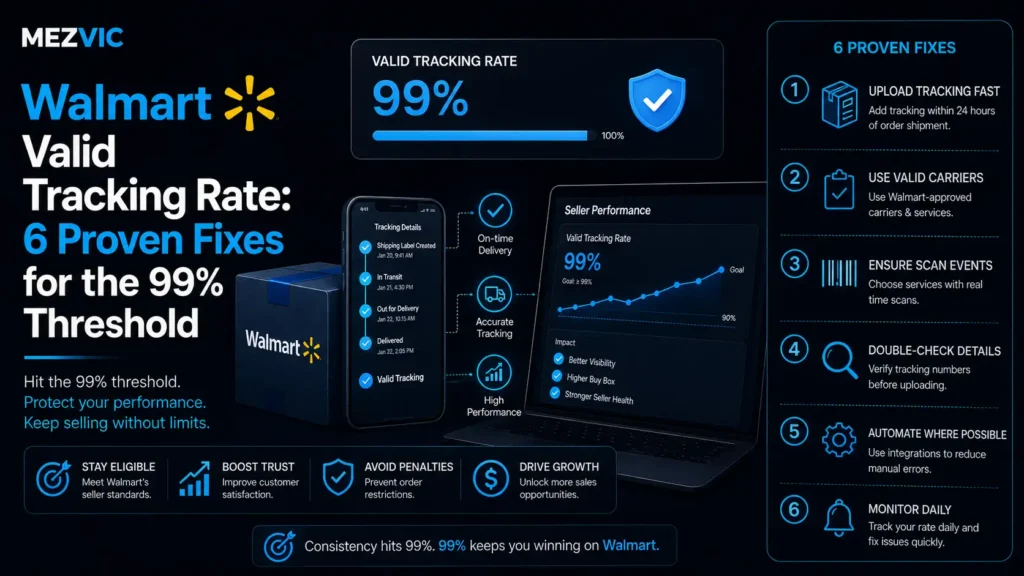
Most seller metrics give you room to be human. Walmart’s tracking standard does not.
Your Walmart valid tracking rate has to sit at 99% or above. That is one percentage point of margin for every mistake, every carrier hiccup and every typo, across your entire order book.
Miss it and Walmart is blunt about what follows: suppression, suspension or termination.
The good news is that this metric is almost entirely mechanical. It is not about how good your products are or how happy your customers feel. It is about whether a number in a field passes a check.
Mechanical problems have mechanical fixes, and there are six of them.
Everything below comes from Walmart’s own policy pages, because the Walmart valid tracking rate is one of those metrics where third-party articles quote figures that were true two years ago.
In this guide, you will learn:
- Exactly what Walmart accepts as a valid tracking number
- The five ways tracking fails validation, in Walmart’s own words
- Why small sellers fail this standard far more easily than large ones
- The one habit that causes most avoidable failures
- Where this sits among Walmart’s other seven standards
Key Takeaways
- The standard is 99% or above, measured over the last 30 or 60 days.
- A valid tracking number needs correct formatting, no special characters, and at least one carrier scan.
- It cannot be the same as the purchase order or sales order number.
- You must authorise your carrier to share tracking data with Walmart before you ship.
- Only send tracking to Walmart after the parcel is tendered to the carrier, not when you print the label.
- Walmart names five failure drivers: no carrier scan, invalid tracking ID, invalid tracking URL, misleading tracking and non-integrated carrier.
- Stamps and prepaid envelopes are not allowed. Every order needs real tracking.
- Non-approved carriers can trigger suppression, because Walmart cannot validate the tracking.
- At 50 orders a month, one untracked order drops you to 98% and fails the standard.
- At 1,000 orders, the same single mistake leaves you at 99.9% and nobody notices.
- Walmart Fulfillment Services meets most performance metrics for you, except Negative Feedback Rate.
- On-Time Delivery only needs 90%, so tracking is by far the strictest shipping standard.
How Little Room 99% Actually Gives You
Percentages hide things. Look at how much room the Walmart valid tracking rate actually leaves you.
Everything below 99% is a failing grade
The dial runs from 90% to 100%. Almost all of it is the fail zone. The needle shows a seller sitting at 97.4%, which feels fine and is not.
Thresholds from Walmart’s Seller Performance Standards, last updated July 2026. The dial is scaled 90 to 100 so the passing band is visible at all.
That is the whole point of this article in one picture.
Walmart will accept one late delivery in ten. It will accept one untracked parcel in a hundred.
No other standard on the account is set that tightly, which is why the Walmart valid tracking rate is the one that catches good sellers out.
Why Small Sellers Fail This Standard First
Here is something nobody warns new sellers about, and it is pure arithmetic rather than policy.
The same single mistake is fatal at low volume and invisible at high volume.
What one untracked order does to your rate
Exactly one order without valid tracking, at five different monthly volumes. Only the red column fails.
Arithmetic, not a study: 49 of 50, 99 of 100, 249 of 250, 499 of 500, 999 of 1,000. The axis starts at 97.5% so the gaps are visible.
Read the first two columns together, because that is the trap.
At 100 orders a month, one miss lands you on exactly 99%, which scrapes through. At 50 orders a month, that same miss puts you at 98% and you are below standard.
So the sellers with the least experience, the fewest systems and the smallest margin for error are held to the tightest tolerance.
It is one of several reasons a new Walmart account needs tighter processes than a mature one, and a large part of what running several marketplaces actually involves day to day.
That is not Walmart being cruel. It is just what percentages do to small numbers. But it does mean a new seller cannot afford one sloppy dispatch, and almost nobody realises that on day one.
What Walmart Accepts as a Valid Tracking Number
Four requirements, taken straight from the policy. All four must be true or the order counts against your Walmart valid tracking rate.
- Correct formatting for the carrier you selected.
- No special characters. Walmart lists them explicitly, including hyphens, underscores, slashes, quote marks and the rest.
- At least one valid carrier scan on record. A number with no scan behind it does not count.
- Not the same as the purchase order or sales order number.
The third one breaks otherwise careful operations, and we will come back to it.
The fourth sounds absurd until you have watched a badly configured integration paste the sales order number into the tracking field for a fortnight. It happens, and it is completely silent.
The 5 Ways Tracking Fails Validation
Walmart publishes the exact drivers it holds you accountable for. Knowing them turns a vague metric into a checklist.
5 ways an order counts against you
These are the seller-accountable causes Walmart lists for this metric. Each one has a different fix.
validation
Drivers listed on Walmart’s Seller Performance Standards page.
6 Proven Fixes for Your Walmart Valid Tracking Rate
In order of how much damage they prevent. Work down the list and your Walmart valid tracking rate takes care of itself.
1. Stop Marking Orders Shipped Before They Ship
This is the big one. If you fix nothing else about your Walmart valid tracking rate, fix this.
Walmart’s guidance is precise: share tracking with Walmart only after the package has been tendered to the carrier.
Most sellers do the opposite. They print labels in the morning, mark everything shipped, and hand the parcels over at four o’clock.
For six hours those tracking numbers exist with no carrier scan behind them. If Walmart validates in that window, the order counts against you, and it never gets a second chance.
It gets worse on a Friday. Print on Friday afternoon, hand over Monday morning, and you have created a 60-hour window where a valid label has no scan behind it.
The fix, in one sentence: print labels whenever you like, but push the shipped status to Walmart after the courier has physically taken the parcels.
In practice that means one batch update at the end of the day rather than a running commentary all morning. It is less satisfying and it is the difference between 98% and 100%.
The same discipline pays off across every channel you sell on, because dispatch timing feeds delivery estimates everywhere. If yours keeps slipping, eCommerce fulfilment is where we fix it at the root.

2. Authorise Your Carrier to Share Data With Walmart
A step buried in the policy that a surprising number of sellers have never done, and it silently caps your Walmart valid tracking rate at whatever the carrier is willing to share.
Before shipping, you need to give your carrier authorisation to provide shipment tracking data to Walmart.
Without it, your tracking numbers can be perfectly real, perfectly formatted and perfectly scanned, and Walmart still cannot see the scan.
This produces the most maddening version of the problem: you check the number yourself, it tracks beautifully on the carrier’s website, and Walmart still marks it invalid.
If that is happening to you, stop debugging your labels and go and check the data-sharing authorisation with your carrier account manager.
3. Use a Walmart-Approved Carrier, Always
Walmart names “non-integrated carrier” as one of its five failure drivers, and its position on this is unambiguous.
Asked directly whether you can ship with a carrier that is not Walmart-approved, the answer in the policy is no, and it warns that doing so may result in suppression, suspension or termination, because the tracking cannot be validated.
That matters most in two situations sellers treat as harmless.
- The cheap local courier you use for regional deliveries because it saves a dollar an order.
- The one-off oversized item sent by a freight company you found for that single shipment.
Both feel like sensible commercial decisions. Both can quietly cost you the account, which makes that saved dollar the most expensive dollar in your business.
Before you optimise postage costs anywhere, work out what each order actually leaves you. Our profit margin calculator makes that a two-minute job.
If your carrier mix is genuinely hard to standardise, that is a fulfilment design problem rather than a tracking problem, and worth fixing at the root with your Walmart fulfilment setup.
4. Ban Stamps, Prepaid Envelopes and Anything Untracked
Walmart answers this one in a single word.
Can you use stamps or prepaid envelopes to ship orders? No. All orders must have a valid tracking number.
This catches sellers of small, light, cheap items hardest, because untracked post is often cheaper than the product itself. A $6 item with $4 tracked postage feels absurd.
The maths is still simple though. Tracked postage costs you a few dollars per order. A failed Walmart valid tracking rate costs you the channel.
If tracked postage genuinely destroys the margin on an item, that item does not belong on Walmart. Raise the price, bundle it, or delist it. Those are the three honest options.
5. Clean Up the Tracking Number Itself
The unglamorous data-hygiene fix, and the one most likely to be broken by software rather than people. It quietly ruins the Walmart valid tracking rate of otherwise well-run accounts.
Walmart requires correct formatting and no special characters. Its banned list is long and includes the characters that copy-paste loves to bring along.
Where the mess usually comes from:
- Copying from a carrier portal and bringing a trailing space or a line break with it.
- Spreadsheets that helpfully insert hyphens, or convert long numbers into scientific notation.
- Integrations that write a tracking URL into a field expecting an ID, which Walmart lists separately as “invalid tracking URL”.
- Mismatched carrier selection, where the number is fine but the carrier dropdown is wrong.
Walmart’s own troubleshooting advice for an invalid tracking error is exactly this: check for typos and make sure the correct carrier is selected.
And the rule that catches integrations: your tracking number must not be the same as the purchase order or sales order number. If a developer ever mapped those fields for convenience, every order since has been failing.
6. Check the Dashboard Weekly, Not Monthly
Because the Walmart valid tracking rate is measured over the last 30 or 60 days, a bad week stays on your record for a month or two.
That cuts both ways, and the good half is worth knowing.
A rolling window means you cannot fix a bad month overnight, but it also means the damage ages out on its own once the underlying process is right.
The Performance dashboard in Seller Center shows your current standing, the number of affected customers, the drivers behind the score, and lets you download the affected orders. Walmart also exposes this through the Seller app and Seller Performance APIs.
Download the affected orders. Do not guess at causes when Walmart is handing you the list.
Read it alongside your fee report too, since carrier choice drives both this metric and your margin. Our breakdown of what a marketplace really charges sellers works through that trade-off on eBay.
Set a weekly reminder. Ten minutes on a Monday beats a suspension email on a Thursday, and this is exactly the kind of routine that managing a Walmart account properly is built around.
Where This Sits Among Walmart’s Other Standards
The Walmart valid tracking rate is one of eight standards, and seeing them together explains why it feels so unforgiving.
| Standard | What it measures | Threshold |
|---|---|---|
| Valid Tracking Rate | Orders with valid tracking provided | 99% or above |
| Seller Response Rate | Inquiries answered within 48 hours | 95% or above |
| On-Time Delivery Rate | Delivered on or before the expected date | 90% or above |
| Late Shipment Rate | Orders shipped after the expected ship date | 5% or below |
| Cancellation Rate | Orders you cancel after receiving them | 2% or below |
| Item Not Received Rate | Orders never delivered to the customer | 2% or below |
| Negative Feedback Rate | One or two star ratings, past 60 days | 2% or below |
| Return Rate | Delivered orders returned by the customer | 6% or below (9% for Resold) |
Line them up and the hierarchy is obvious.
Walmart tolerates one late delivery in ten. It tolerates one cancellation in fifty. It tolerates one missing tracking number in a hundred.
The reason is worth understanding, because it tells you how Walmart thinks. A late parcel annoys a customer. A parcel with no tracking creates a customer who does not know where their order is, contacts support, and cannot be answered.
One is a bad day. The other is an unanswerable question, and unanswerable questions are what marketplaces hate most.
Amazon applies the same logic in a different form, suppressing listings that fail its data requirements rather than its service ones. We covered that in our guide to fixing a suppressed Amazon listing.
There is one shortcut worth knowing. Walmart states that if you use Walmart Fulfillment Services, most performance metrics are met for you, with the exception of Negative Feedback Rate. If tracking compliance is genuinely beyond your operation, that is a legitimate answer to it.
The Weekly 10-Minute Routine
Small, boring, and it keeps your Walmart valid tracking rate permanently solved.
- Open the Performance dashboard and read the current rate, not last month’s memory of it.
- Download the affected orders if anything failed. The list tells you the driver.
- Check which driver repeats. One bad carrier or one bad integration usually explains everything.
- Confirm nothing shipped with an unapproved carrier, especially oversized or regional orders.
- Spot-check five tracking numbers for stray characters and correct carrier selection.
- Confirm your team is still batching the shipped update after handover rather than at label printing.
Step six is the one that decays. Everyone follows the rule for a fortnight after a scare, then a busy Friday arrives and somebody marks everything shipped at lunchtime.
Make it the process rather than the policy. Processes survive busy Fridays. Policies do not.
The simplest version of the whole routine is one question asked at the end of each day: has every parcel we marked shipped today actually left the building? If the answer is yes, your Walmart valid tracking rate will look after itself.
If your listings are also fighting for visibility while you sort this out, the operational and commercial sides do connect. A suppressed account ranks nowhere, which is why listing work and performance work belong in the same weekly review.
Frequently Asked Questions
What is a good Walmart valid tracking rate?
Walmart requires a valid tracking rate of 99% or above. There is no comfortable band below that, because anything under 99% is treated as below standard and can lead to suppression, suspension or termination. Most healthy sellers run at 99.5% or higher rather than sitting on the line.
How is the valid tracking rate calculated?
The Walmart valid tracking rate is the rate of orders with valid tracking information provided, evaluated over the last 30 or 60 days. An order counts as valid when the tracking number is correctly formatted, free of special characters, has at least one carrier scan on record, and is not the same as the purchase order or sales order number.
Why is my tracking number showing as invalid?
Usually the number does not match the selected carrier or the required format. Walmart’s advice is to check for typos and confirm the correct carrier is selected. The other common cause is submitting tracking before the carrier has scanned the parcel, so no scan exists yet.
When should I mark a Walmart order as shipped?
After the package has been tendered to the carrier, not when you print the label. Walmart states tracking should only be shared once the parcel is with the carrier, because a number without a scan behind it cannot be validated.
Can I ship a Walmart order with any carrier?
No. Walmart says shipping with a non-approved carrier is not recommended and may result in suppression, suspension or termination, because the tracking information cannot be validated. Use a Walmart-approved parcel or freight carrier for every order, including one-off oversized shipments.
Can I use stamps for small Walmart orders?
No. Walmart’s policy states that stamps and prepaid envelopes are not permitted and all orders must have a valid tracking number. If tracked postage makes an item unprofitable, the item is not suited to the channel at that price.
How long does it take to recover a bad tracking rate?
Because the Walmart valid tracking rate runs over the last 30 or 60 days, poor performance ages out of the window rather than being erased. Fix the process today and the rate climbs as bad days drop off, typically over one to two months rather than one to two days.
Does the tracking number have to be different from the order number?
Yes. Walmart states the tracking number cannot be the same as the purchase order number or the sales order number. This most often goes wrong inside an integration where somebody mapped those fields together, which then fails silently on every order.
Why do my tracking numbers work on the carrier site but fail at Walmart?
Usually because your carrier has not been authorised to share shipment tracking data with Walmart. Walmart requires you to give that authorisation before shipping. Without it the scans exist but Walmart cannot see them, so the order fails validation despite looking perfect to you.
Does Walmart Fulfillment Services fix this metric?
Largely, yes. Walmart states that with WFS most performance metrics will be met for you, with the exception of Negative Feedback Rate. If tracking compliance is a persistent problem for your operation, moving fulfilment across is a legitimate structural answer.
What happens if I stay below 99%?
Walmart notifies you by email and inside Seller Center with recommendations, and you cannot unsubscribe from those messages. If performance does not improve, the stated consequences are suppression, suspension or termination of the account.
Is valid tracking rate the same as on-time delivery?
No, and the thresholds are very different. The Walmart valid tracking rate measures whether tracking information was provided and validated, and needs 99% or above. On-Time Delivery Rate measures whether the parcel arrived by the expected date, and only needs 90% or above.
The Bottom Line
Your Walmart valid tracking rate is the least interesting metric in your account and one of the most dangerous.
It does not measure quality, service or judgement. It measures whether a string of characters passed a check, which means it can be solved permanently by process rather than effort.
Push the shipped status after handover. Authorise your carrier. Use approved carriers only. Track everything. Keep the numbers clean. Look at the dashboard on Mondays.
Do those six things and the Walmart valid tracking rate stops existing as a worry, which is the highest praise any compliance number can earn.
And if you are running 50 orders a month, remember the arithmetic. You do not get a mistake. That is worth knowing before it costs you the channel rather than after.
Want someone to audit your dispatch process before Walmart does? Book a free 30 minute call. If your account has already been restricted, our marketplace suspension playbook covers how appeals actually work.