On day 270, storing 100 units costs you $11.40 a month.
On day 271, the same 100 units cost $31.15.
Nothing happened. Nobody moved anything. A date passed, and the surcharge rate jumped from $1.50 per cubic foot to $5.45.
That cliff is the single most expensive thing about Amazon FBA storage fees, and almost nobody knows the exact day it arrives.
Every rate below is taken from Amazon’s own fee pages, including the aged inventory changes that took effect on 16 January 2026. I have linked them so you can check, because Amazon FBA storage fees are quoted wrongly across most of the internet.
In this guide, you will learn:
- The exact day your storage cost jumps 3.6 times
- Why the same stock can cost eleven times more to hold
- The second surcharge that has nothing to do with age
- The one date each month that decides your bill
- The rule that quietly works in your favour
Key Takeaways
- Base storage is $0.78 per cubic foot for standard-size items from January to September.
- From October to December that base jumps to $2.40, roughly three times higher.
- Oversize runs $0.56 off-peak and $1.40 in peak season.
- The aged inventory surcharge starts at 181 days and is charged on top of base storage.
- At 271 days the surcharge leaps from $1.50 to $5.45 per cubic foot overnight.
- Since 16 January 2026 there is a new tier: 456 days or more at $7.90 per cubic foot.
- Aged inventory is assessed on a snapshot taken on the 15th of each month.
- A separate storage utilization surcharge punishes holding too much versus what you ship.
- That surcharge can add up to $1.88 per cubic foot on standard-size items.
- Inventory age is calculated first in, first out across the whole network, which helps you.
- The same 100 units can go from $3.90 to $43.40 a month purely by not selling.
- Storage fees are billed between the 7th and 15th, aged surcharges between the 18th and 22nd.
The Base Rate Is the Easy Part
Start here, because every other part of Amazon FBA storage fees is stacked on top of this one.
Amazon charges by volume, not by unit. It measures the daily average cubic feet your inventory occupies, using the size of a properly packaged unit.
| Period | Standard-size | Oversize |
|---|---|---|
| January to September | $0.78 per cubic foot | $0.56 per cubic foot |
| October to December | $2.40 per cubic foot | $1.40 per cubic foot |
Base monthly storage rates for non-dangerous goods, from Amazon’s monthly inventory storage fees page. Dangerous goods are charged at different rates.
Amazon’s own worked example is usefully small: 100 average units at 0.05 cubic feet each, at the July rate, comes to 100 × 0.05 × $0.78, or $3.90 for the month.
That is nothing. Amazon FBA storage fees are genuinely cheap when stock moves.
Storage is only one line in the total cost of the channel. Our breakdown of what Amazon FBA management costs covers the rest of them.
Which is exactly why sellers stop thinking about Amazon FBA storage fees, and why the rest of this article exists.

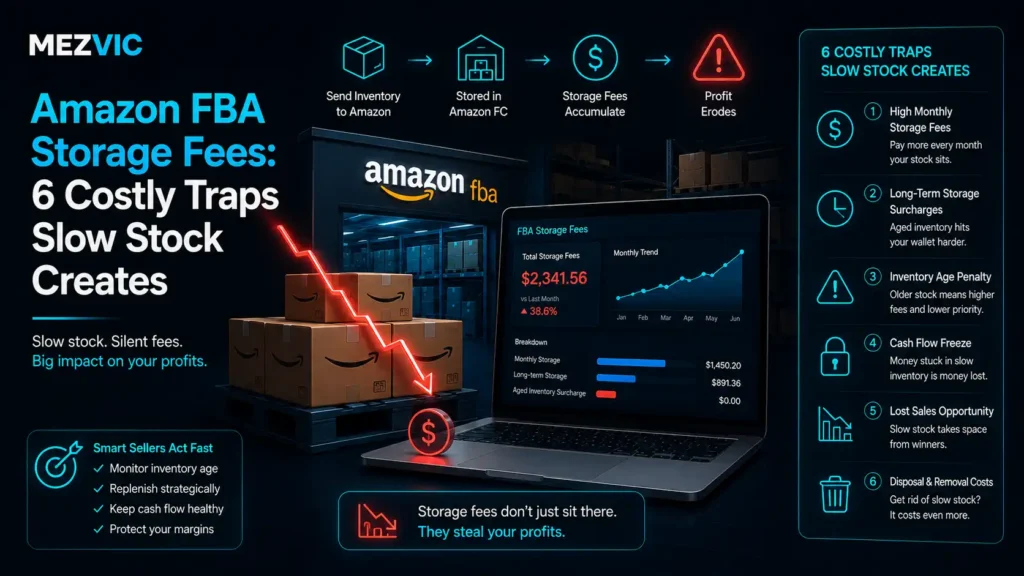
6 Traps That Slow Stock Creates
6 ways slow stock costs you more than storage
Each one is charged separately, and several of them stack on the same units in the same month.
stopped selling
Rates and mechanics from Amazon’s monthly storage and aged inventory surcharge pages.
Trap 1: The Cliff at 271 Days
This is the part of Amazon FBA storage fees that starts gently and then stops being gentle very suddenly.
It applies to anything stored for 181 days or longer, and it is charged in addition to your normal monthly storage fee rather than instead of it.
| Inventory age | Surcharge per cubic foot | Change from previous tier |
|---|---|---|
| 181 to 210 days | $0.50 | Starts here |
| 211 to 240 days | $1.00 | Doubles |
| 241 to 270 days | $1.50 | Up 50% |
| 271 to 300 days | $5.45 | Up 3.6 times |
| 301 to 330 days | $5.70 | Up 5% |
| 331 to 365 days | $5.90 | Up 4% |
| 366 to 455 days | $6.90, or $0.30 per unit | Whichever is greater |
| 456 days or more | $7.90, or $0.35 per unit | New tier from 16 Jan 2026 |
From Amazon’s aged inventory surcharge page, including the rates effective 16 January 2026. Some items are excluded from the first three tiers.
Look at row four. Everything before it moves in sensible steps of fifty cents or so.
Then day 271 arrives and the rate goes from $1.50 to $5.45, a jump of 3.6 times for a single day of additional storage.
That is the design. Amazon FBA storage fees are not gently discouraging slow stock at that point, they are telling you to take it away.
So day 240 is your real deadline, not day 271. That gives you a month to discount, bundle, advertise or remove before the expensive tier lands.
Discounting only works if the listing converts once people arrive, which is where listing optimisation earns its keep on stock you need gone.
Anyone who has ever left a decision until the day before a deadline knows why this matters.
What the Same 100 Units Cost as They Age
Take Amazon’s own example: 100 standard-size units at 0.05 cubic feet each, so five cubic feet in total. Here is the monthly bill as those units get older, at off-peak rates.
Monthly cost of 100 units as they age
Five cubic feet of standard-size stock at off-peak rates. Base storage plus the aged inventory surcharge for each tier.
Arithmetic, not a study: 5 cubic feet multiplied by the base rate of $0.78 plus each tier’s surcharge. The 366+ and 456+ tiers bill the greater of the cubic-foot or per-unit rate, and at 100 units the cubic-foot figure wins.
Three things about Amazon FBA storage fees are worth pulling out of that chart.
The first four bars are cheap. Under 271 days, storage on this quantity is under twelve dollars a month. It is a rounding error and you should not lose sleep over it.
The fifth bar is nearly triple the fourth. That is the cliff, and it arrives without warning unless you are watching the age report.
It never comes back down. Every month after that, you pay the higher rate again, and then a higher one, for stock that has already proved it does not sell.
Run these numbers against your own catalogue with our Amazon FBA calculator before you decide what to do with anything.

Trap 2: Peak Season Multiplies the Base Rate
From October to December, Amazon FBA storage fees for standard-size items go from $0.78 to $2.40 per cubic foot.
That is fair enough for stock you are about to sell into the busiest quarter of the year. It is painful for stock that has been sitting since spring.
Our 100 units cost $3.90 a month in July. The same units cost $12.00 a month in November, before any age surcharge is added.
And the two stack. Slow stock in peak season pays the higher base and whatever aged tier it has reached.
So the calendar matters. Clearing dead stock in August is cheap housekeeping. Clearing it in November means you have already paid peak rates to store something you were always going to remove.
September is the month to do this. Every year. Put it in the calendar and treat it like a tax deadline.
It is also when a listing needs to be visible, so check nothing has been quietly hidden from search. Our guide to fixing a suppressed Amazon listing covers the compliance rules that do exactly that.
Trap 3: The Surcharge That Ignores Age Entirely
This part of Amazon FBA storage fees catches sellers who thought they had solved the problem by keeping inventory fresh.
The storage utilization surcharge is not about how old your stock is. It is about how much you hold compared with how much you ship.
Amazon calculates a storage utilization ratio: your average daily inventory volume divided by your average daily shipped volume over the past 13 weeks. The result is expressed in weeks of supply.
Hold more than 22 weeks of supply and a second charge appears on top of your base rate.
| Weeks of supply held | Standard surcharge | Standard total, off-peak | Oversize total, off-peak |
|---|---|---|---|
| Below 22 weeks | None | $0.78 | $0.56 |
| 22 to 28 weeks | $0.44 | $1.22 | $0.79 |
| 28 to 36 weeks | $0.76 | $1.54 | $1.02 |
| 36 to 44 weeks | $1.16 | $1.94 | $1.19 |
| 44 to 52 weeks | $1.58 | $2.36 | $1.32 |
| Over 52 weeks | $1.88 | $2.66 | $1.82 |
All figures per cubic foot, from Amazon’s monthly inventory storage fees page. Peak-period totals are higher again.
At the top of that table, your effective base rate is $2.66 rather than $0.78. That is more than three times the cost for holding stock you are not shipping fast enough.
The good news is that it does not apply to everyone. Amazon lists four conditions, and all must be true:
- You have a Professional selling account
- Your first US fulfilment centre shipment was more than 365 days ago
- Your average daily inventory volume for that size tier is 25 cubic feet or more
- Your storage utilization ratio for that size tier is above 22 weeks
So new sellers and small sellers are exempt. If you are under 25 cubic feet of daily average volume, this trap is not yours to worry about yet.
Note the ratio is worked out separately for standard-size and oversize. You can be perfectly efficient on one and penalised on the other, which is a detail that confuses people reading a single number on the dashboard.
Restock cadence is the lever here, and it is a core part of any serious fulfilment operation rather than a spreadsheet afterthought.
Trap 4: The Snapshot on the 15th
This is the most actionable thing anyone can tell you about Amazon FBA storage fees, and it takes one sentence.
Amazon assesses the aged inventory surcharge using an inventory snapshot taken on the fifteenth day of each month.
Whatever is sitting there on the 15th gets charged. Whatever left on the 14th does not.
So if you have units about to cross into the $5.45 tier, the removal needs to have completed before that snapshot, not been requested the day before it.
Removals take time to process. Submitting on the 14th and hoping is not a plan, it is optimism with a fee attached.
If you sell the same stock elsewhere, a removal can become a transfer rather than a loss, which is one of the quieter advantages of running several marketplaces.
Work backwards from the 15th, every month. That single habit is worth more than any amount of clever repricing.
Worth knowing the billing dates too, because they are different: storage fees land between the 7th and 15th of the following month, and aged inventory surcharges between the 18th and 22nd.

Trap 5: Getting Out Costs Money Too
Escaping Amazon FBA storage fees is not free either, which creates a genuinely awkward decision.
You are choosing between paying to keep something that is not selling, or paying to get rid of it. Neither option returns your original outlay.
The arithmetic is still usually clear once you look at it honestly. Removal is a one-off cost. Storage on aged stock is a recurring one that escalates through tiers and never improves.
Three options, in the order most sellers should try them:
- Sell it, even badly. A steep discount that clears stock beats storing it at $5.45 per cubic foot.
- Remove it to your own premises if it genuinely will sell elsewhere or later.
- Dispose of it if the honest answer is that nobody wants it at any price.
Option one is emotionally hardest and usually correct. Selling at a loss feels like failure, but the loss already happened when you bought the stock. Everything after that is just deciding how much more to spend on it.
Work out what a discount actually leaves you before you set it. Our profit margin calculator will tell you how far you can go.
Advertising can clear stock quickly, provided you understand what the campaign actually costs against the margin left. Our comparison of ACoS and TACoS covers how to judge that properly.
Trap 6: The Cost That Never Appears on the Invoice
Every Amazon FBA storage fees trap so far has been a line item. This one is not, and it is usually the biggest.
Money sitting in stock that does not sell is money not buying stock that does. Our case studies are mostly stories about that one idea.
If you have $8,000 tied up in units aged past 300 days, that is $8,000 unavailable for the product you found last week that turns over every three weeks.
Amazon FBA storage fees on that dead stock might be $60 a month. The opportunity cost of not deploying $8,000 into working inventory is considerably larger, and it appears on no report anywhere.
This is why sourcing discipline and storage costs are the same conversation. Every unit you should not have bought becomes a storage problem eventually, and the place to prevent it is before the purchase. Learning to read the demand history properly is the cheapest storage fee reduction available.
The Rule That Works in Your Favour
One piece of genuinely good news about Amazon FBA storage fees, and it is more useful than it first sounds.
Amazon calculates inventory age first in, first out, across the entire fulfilment network. Units that are sold or removed are deducted from the oldest inventory you have, regardless of which physical unit actually shipped.
Amazon’s own example makes it plain: if a picker grabs a unit that arrived last week, it is still deducted from your oldest stock.
That has a real consequence. Every sale reduces your oldest inventory first, so a product that keeps selling steadily will rarely trip the aged surcharge even if you have been restocking it for years.
Which reframes the whole problem. The aged surcharge is not really a tax on old stock. It is a tax on stock that stopped selling, and those are very different things.
A line you have restocked twelve times and sold through every month is safe. A line you bought once, eleven months ago, that shifts two units a quarter is the one generating the bill.
Which means the fix is upstream. Better organic visibility keeps stock moving on its own, and that is the whole argument for Amazon SEO over permanent discounting.
A Monthly Routine That Prevents All of This
Twenty minutes once a month keeps Amazon FBA storage fees under control, ideally in the first week so you have time to act before the 15th.
- Open the inventory age report and sort by days in the network.
- Flag everything past 210 days. That is your action list, not your worry list.
- Anything past 240 days gets a decision this week. Discount, advertise, remove or dispose.
- Check your storage utilization ratio on the FBA dashboard, separately for each size tier.
- Submit removals with time to complete before the snapshot on the 15th.
- In September, be ruthless. Anything doubtful should leave before peak rates begin in October.
Step two is where the discipline lives. Flagging at 210 days rather than 271 gives you two months of options, and options are what make the difference between discounting and disposing.
Advertising is the fastest of those options, provided the numbers work. Amazon PPC can clear a slow line in weeks when the margin allows it.
None of this is complicated. It is a recurring calendar entry and the willingness to admit a purchase did not work, which is the harder of the two.
If you would rather this ran without you thinking about it, that rhythm is a standard part of FBA management.
Frequently Asked Questions
How much are Amazon FBA storage fees?
Amazon FBA storage fees start with base monthly storage of $0.78 per cubic foot for standard-size items from January to September and $2.40 from October to December. Oversize is $0.56 and $1.40 respectively. Aged inventory surcharges and a storage utilization surcharge can be charged on top of those rates.
When does the aged inventory surcharge start?
At 181 days in the fulfilment network. It begins at $0.50 per cubic foot, rises to $1.00 at 211 days and $1.50 at 241 days, then jumps sharply to $5.45 at 271 days. It is charged in addition to your normal monthly storage fee.
Why did my storage bill suddenly triple?
Most likely inventory crossed the 271-day mark, where the aged surcharge jumps from $1.50 to $5.45 per cubic foot. The other common cause is the calendar turning to October, when base rates rise to peak-season levels for the rest of the year.
What day does Amazon check inventory age?
Amazon assesses the aged inventory surcharge using an inventory snapshot taken on the fifteenth of each month. Stock removed before that snapshot is not charged for that month, so removals need to complete before the 15th rather than being requested on it.
What is the storage utilization surcharge?
A separate charge based on how much inventory you hold relative to how much you ship, measured over the past 13 weeks. Above 22 weeks of supply it adds from $0.44 up to $1.88 per cubic foot on standard-size items, on top of the base rate.
Am I subject to the storage utilization surcharge?
Only if all four of Amazon’s conditions apply: a Professional selling account, a first US fulfilment centre shipment more than 365 days ago, average daily inventory volume of at least 25 cubic feet for that size tier, and a storage utilization ratio above 22 weeks. New and smaller sellers are exempt.
Does selling a new unit reduce my aged inventory?
Yes. Amazon calculates age on a first-in, first-out basis across the whole network, so any unit sold or removed is deducted from your oldest stock regardless of which physical unit shipped. Steady sellers therefore rarely trigger aged surcharges even after years of restocking.
What changed on 16 January 2026?
Amazon updated the rates for the oldest inventory. There is now a separate tier for items aged 456 days or more at $7.90 per cubic foot or $0.35 per unit, whichever is greater, and the 366 to 455 day band sits at $6.90 per cubic foot or $0.30 per unit.
Is it cheaper to remove stock or keep storing it?
Almost always cheaper to remove, because removal is a one-off cost while aged Amazon FBA storage fees recur monthly and escalate through tiers. The exception is stock you can genuinely clear within weeks, where discounting and selling usually beats paying to ship it back to yourself.
When are storage fees actually billed?
Monthly storage fees are charged typically between the 7th and 15th of the month following the one in which they were incurred. The aged inventory surcharge is charged separately, typically between the 18th and 22nd.
How is the cubic footage calculated?
Amazon FBA storage fees are based on the daily average volume your inventory occupies, using the dimensions of a unit that is properly packaged and ready to ship. Volume is longest side multiplied by median side multiplied by shortest side, so excess packaging costs you every month it sits there.
What is the best month to clear slow inventory?
September, without much doubt. It is the last month before peak base rates begin in October, so anything you clear then avoids three months of storage at roughly triple the rate, plus whatever aged tier it would have reached by then.
The Bottom Line
Amazon FBA storage fees are cheap for stock that sells and brutal for stock that does not. That is the entire design, and once you see it the rest is scheduling.
Three dates control your Amazon FBA storage fees. Day 240 is when a decision becomes urgent. The 15th is when the snapshot is taken. September is when everything doubtful should leave.
Nothing here requires software or cleverness. It requires opening one report each month and being honest about what is not working.
The sellers who pay large aged inventory surcharges are almost never the ones who did not know the rates. They are the ones who knew, and hoped the product would turn around.
It usually does not. That is what the chart above is really showing you, and why Amazon FBA storage fees punish hope more reliably than they punish ignorance.
Want someone to go through your inventory age report with you? Book a free 30 minute call and we will find what is about to get expensive. If you would rather hand the whole operation over, Amazon account management is where this lives day to day.