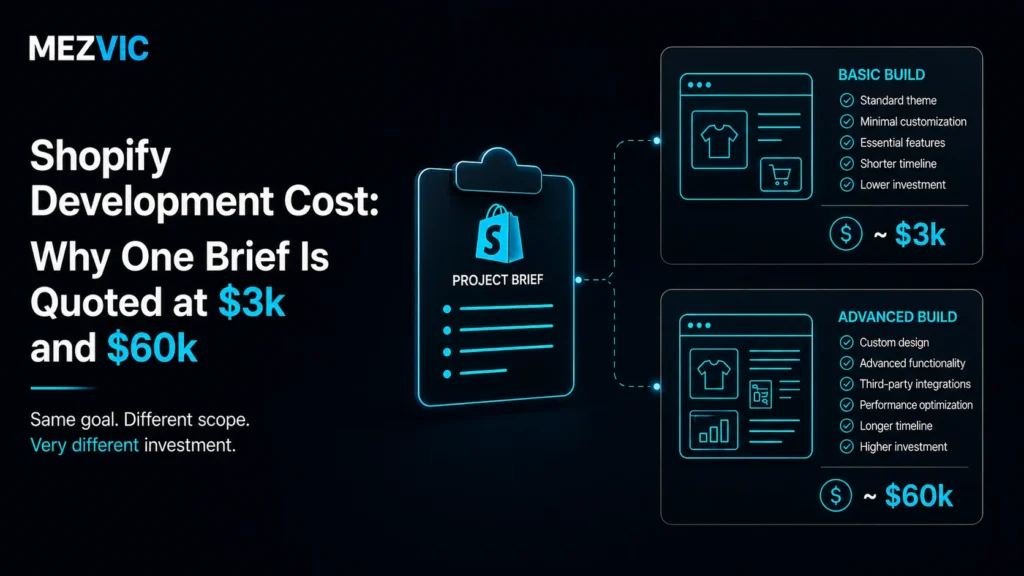
Same brief. Same twelve page document. Three quotes: $3,200, $18,400 and $61,000.
The $61,000 agency was not trying to rob anyone. The $3,200 one was not cutting corners either.
All three read the same brief and imagined three completely different projects, because the brief did not say which one it wanted.
Shopify development cost is not really a price question. It is a scope question wearing a price question’s clothes.
Below: what each Shopify development cost tier genuinely includes, where the hours go, the four costs that never appear on a quote, and why a cheap build that fails can still beat an expensive one over three years.
Key Takeaways
- Shopify development cost runs from about $1,500 to $80,000, and the tier you need is decided by integrations and custom features, not by how big your brand feels.
- Most stores should buy a theme and customise it. A $6,000 to $20,000 customised theme covers the overwhelming majority of real requirements.
- Custom features are the single biggest line. On a typical $18,000 build they take 48 of the 164 hours, more than design and setup combined.
- Four costs are routinely missing from quotes: app subscriptions, data migration, content production and post launch QA.
- Shopify plan fees are small next to build costs. Basic is $25 a month, Grow $65, Advanced $399, and Plus starts at $2,300.
- The uncomfortable arithmetic: a $6,000 theme build that fails and gets rebuilt for $20,000 in year two still costs less at month 36 than a $28,000 custom build.
How Much Does Shopify Development Cost?
Shopify development cost typically ranges from $1,500 for a themed setup to $80,000 or more for a custom Plus build, with most serious stores landing between $6,000 and $25,000.
The word doing all the work in that sentence is “development”. Shopify development cost covers two jobs that share nothing but a name. Installing a theme and building a headless storefront are both called Shopify development.
| Build type | Typical cost | Hours at $110 | Who it suits |
|---|---|---|---|
| Theme setup | $1,500 to $5,000 | 14 to 45 | First store, standard products, no integrations |
| Customised theme | $6,000 to $20,000 | 55 to 180 | Most established brands. The sensible default |
| Custom theme build | $20,000 to $50,000 | 180 to 450 | Distinct UX needs, complex merchandising |
| Shopify Plus build | $40,000 to $150,000 | 360 to 1,360 | Multi store, B2B, checkout customisation |
| Headless build | $60,000 and up | 545 and up | Teams with in-house engineers to maintain it |
| Migration onto Shopify | $3,000 to $30,000 | 27 to 270 | Priced by data complexity, not catalogue size |
Hours use a $110 blended rate. Divide any Shopify development cost by a rate you believe and the scope stops being abstract.
Two rows in that Shopify development cost table deserve a warning label.
Headless is chosen far more often than it is needed. It is a decision about your engineering team, not your storefront, and it moves maintenance in-house permanently.
And migration is priced by how messy your data is. A 200 product store with fifteen years of order history is harder than a clean 8,000 SKU catalogue, which is why Shopify migration is scoped from the export rather than the product count.
If you are moving between platforms rather than building fresh, the mechanics matter more than the price, and we covered them in our guide to a platform migration that keeps your rankings.
Freelancer, agency or Shopify Partner?
Who you hire changes the Shopify development cost by roughly half, in both directions.
A capable freelancer bills $45 to $95 an hour and is excellent for a defined build. The risk is availability: one person with flu is your whole delivery team.
An agency bills $90 to $180 and buys you continuity, a project manager and someone to call when it breaks at 2am on Black Friday.
Shopify Plus Partners sit at the top of that range and are genuinely required for some Plus work, though the badge alone does not make a build better.
For a first store, a freelancer is usually the right Shopify development cost. For a store already taking orders, downtime risk is worth paying an agency to remove.

Why the Same Brief Is Quoted at $3k and $60k
Five things decide your Shopify development cost. Everything else is negotiation.
the price
Ask a quote to price these five separately. Suddenly three proposals become comparable.
1. Where the design comes from
A premium theme costs $200 to $400 once. Original design costs $4,000 to $15,000 in labour before a line of code is written.
That single choice is often the whole gap between a $6,000 and a $20,000 quote.
Original design is worth paying for when your merchandising is genuinely unusual. It is rarely worth it because the founder dislikes the theme’s homepage, which is a styling job.
Where a distinct look genuinely earns its money is covered on our Shopify store design page.
2. How many custom features you actually need
This is the biggest line in any Shopify development cost, and the least examined.
A product bundler, a subscription flow, a configurator, a trade pricing tier: each is roughly 15 to 60 hours depending on how many edge cases it has.
Before commissioning any of them, check whether a $20 a month app already does it. It usually does, and it is maintained by someone else.
3. What has to talk to what
Integrations are where Shopify development cost estimates go wrong, because the work depends on the other system, not on Shopify.
A modern accounting tool with a real API is a day. A twenty year old ERP that exports CSVs overnight is three weeks and a support contract.
Name every system in the brief. “Integrates with our systems” is how a $6,000 project becomes $24,000 in month two.
4. How messy your data is
Products, variants, customers, orders, reviews, redirects. Each adds to the Shopify development cost separately. Each one is a separate job with its own failure modes.
Catalogues that grew organically over a decade carry duplicate SKUs, inconsistent option names and half finished products nobody deleted.
Cleaning that is not glamorous and it is not optional. It is also the cheapest thing you can do yourself before quotes go out.
5. Who owns it after launch
A build handed to a team that cannot maintain it is a depreciating asset.
Custom code needs someone to update it when Shopify changes. Themes get that for free from the theme developer, which is a real and underrated saving.
Decide who holds the wrench before you decide how complicated the engine is. Ongoing upkeep is priced separately on our Shopify maintenance page.
Where the Money Actually Goes on an $18,000 Build
An $18,000 Shopify development cost at a $110 blended rate is about 164 hours. Here is a realistic split.
Arithmetic, not a study: $18,000 divided by $110 is 164 hours. Custom features take more than design and theme setup put together.
Twenty two hours of QA looks generous until launch week, when it is the first thing cut and the first thing regretted.
Notice how small the design bar is relative to the custom column. Most people budget the opposite way round.
Speed is decided during that build, not afterwards. Every extra app and script added in these hours is paid for later in load time, which is why Shopify speed optimisation so often becomes a separate project.

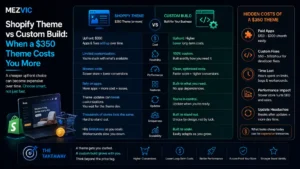
Theme, Customised Theme or Custom Build
Almost every buyer overestimates which of these they need, and pays the Shopify development cost of the tier above. Here is the honest comparison.
| Factor | Theme as-is | Customised theme | Custom build |
|---|---|---|---|
| Typical cost | $1,500 to $5,000 | $6,000 to $20,000 | $20,000 to $50,000 |
| Time to launch | 2 to 4 weeks | 6 to 10 weeks | 12 to 24 weeks |
| Shopify updates | Handled by theme developer | Mostly handled, your changes need checking | Entirely yours to maintain |
| Design freedom | Settings only | High, within the theme’s structure | Total |
| Risk if the agency leaves | Low, anyone can pick it up | Low to medium | High, undocumented code is expensive |
| Honest verdict | Right for a first store | Right for roughly 80% of brands | Right when the UX is the product |
The middle column is the answer far more often than anyone selling the third column will tell you.
The row people skip is “risk if the agency leaves”. It is the one that costs the most when it happens.
The same rule applies to any custom web development, but on a storefront it hurts sooner. Undocumented code from an agency you no longer work with is the most expensive asset in eCommerce. The next developer quotes a rebuild because reading it costs more than replacing it.
If your requirements genuinely exceed a theme, that work sits on the Shopify development services page, and it should come with documentation as a deliverable.
The Four Costs Nobody Puts in the Quote
These sit outside the quoted Shopify development cost and are not hidden fees. They are real costs that sit outside the build, and quotes rarely mention them because they are not the agency’s revenue.
| Cost | Typical amount | Why it gets missed |
|---|---|---|
| App subscriptions | $60 to $400 per month | Recurring, so it never appears in a one off build quote |
| Product content | $8 to $40 per product | Everyone assumes the existing copy and photos will do |
| Data cleanup | $500 to $6,000 | Nobody looks at the export until the migration starts |
| Post launch fixes | 10 to 20% of build | Real traffic finds things no test plan did |
Budget the fourth row before launch. Every build has one, and pretending otherwise just makes it an argument.
App subscriptions deserve special attention because they compound quietly.
Fourteen apps at $29 a month is $4,872 a year, which is most of a customised theme build, spent annually, forever.
They also slow the storefront down, so you pay twice: once on the invoice and again in conversion rate. Check what your current stack is costing you with our bulk pagespeed checker. Run the sums on your own margin with our eCommerce profit margin calculator.
Shopify’s own plan fees are the least of it. Basic is $25 a month billed monthly, Grow is $65, Advanced is $399, and Plus starts at $2,300.
Those figures come from Shopify’s published pricing page and drop to $19, $49 and $299 on annual billing.
The Three Year Total, Including the Rebuild You Are Afraid Of
Here is the arithmetic that changes how people think about Shopify development cost.
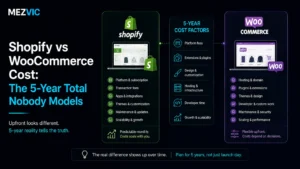
Take a $6,000 customised theme that goes wrong, and gets fully rebuilt for $20,000 in month 18. Compare it against a $28,000 custom build that works first time.
Arithmetic, not a study: custom is $28,000 plus $399 a month. Theme path is $6,000 plus $215 a month, with $20,000 added at month 18. Totals at month 36: $42,364 versus $33,740.
The green line never crosses the red one.
Even in the scenario where the cheaper build fails completely and is thrown away, the theme path is $8,624 behind at month 36.
That is not an argument for buying badly. It is an argument for starting smaller than feels right, learning what your store needs from real customers, and spending the difference on traffic and conversion work.
The exception is when the rebuild costs you a trading season rather than money. That risk is real, and it is the honest case for spending more upfront.
Spending the difference on demand rather than pixels usually wins, which is the whole logic behind pairing a modest build with Shopify SEO from month one.

When Shopify Plus Changes the Maths
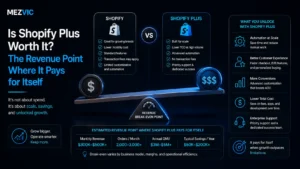
Plus starts at $2,300 a month, which is $27,600 a year on top of any Shopify development cost.
It earns that back through checkout customisation, multiple storefronts, B2B pricing and higher API limits. None of those matter to most stores.
The clean test: if you cannot name a specific Plus feature that unblocks revenue you are currently losing, you are buying a badge.
Lower payment fees on third party gateways help at volume too, dropping from 2% on Basic to 0.2% on Plus. On $4m of gateway volume that is a real number.
The build itself is also different work, since checkout and multi store logic are involved, which is why Shopify Plus development is quoted separately from a standard build.
Six Red Flags in a Shopify Development Quote
You will not spot a bad agency from a proposal. You can spot a badly priced project.
These six show up again and again in a Shopify development cost that is about to go wrong.
- One number and no phases. A single figure with no hours behind it cannot be compared to anything, and cannot be renegotiated when scope changes.
- “Integrations” as one line item. Each system is a separate risk. Grouping them hides which one is the problem until you are three weeks in.
- No data migration line at all. Either they have not looked at your export, or they intend to charge for it later. Both are bad.
- Design and build quoted together. You want the option to approve design before committing to build hours. Bundling removes that exit.
- Custom code with no documentation deliverable. Undocumented work quietly transfers the Shopify development cost to whoever you hire next.
- Accounts opened in the agency’s name. Your Shopify admin, domain and app subscriptions should be yours from day one, not transferred as a favour later.
None of these mean an agency is dishonest. Most are just how proposals get written when nobody pushes back.
Pushing back is free, and it happens before you sign, which is the only moment you hold any leverage.
One more worth adding: ask what happens in the two weeks after launch. If the answer is a new invoice, budget for it now rather than discovering it during your first busy weekend. Ongoing cover sits on our website maintenance page.
How to Brief a Build So the Quotes Are Comparable
You cannot compare three Shopify development cost quotes for three different projects. Force them to price the same thing.
Four lines in a brief. They routinely move quotes by tens of thousands, in your favour.
Then ask every agency for the same three numbers: total hours, blended rate, and hours by phase.
A firm that will not give you hours is not protecting a methodology. It is protecting a margin you are not allowed to see.
Once the store is live, the operating rhythm matters more than the build did, and we set that out in our guide to managing a Shopify store.
For a sense of what a build plus ongoing work looks like end to end, the HeySilkySkin case study covers a store built and grown from zero.
Frequently Asked Questions
How much does Shopify development cost for a small store?
Between $1,500 and $5,000 for a themed setup. That covers theme configuration, up to about 50 products, payment and shipping setup, and basic launch checks.
Can I build a Shopify store myself?
Yes, and for a first store you probably should. A paid theme and a weekend gets you trading, and real orders will teach you what to brief a developer on later.
How much does a Shopify theme cost?
Premium themes are a one off $200 to $400 in the Shopify theme store. Free themes are genuinely usable, and the paid ones mostly buy you more layout sections.
Why do Shopify development quotes vary so much?
Because each agency assumed a different scope. The main variables are whether design starts from a theme, how many custom features are involved, and how many systems must be integrated.
How long does a Shopify build take?
Two to four weeks for a theme setup, six to ten weeks for a customised theme, and twelve to twenty four weeks for a custom build. Data migration usually adds two to four weeks.
What is the monthly cost of running a Shopify store?
Plan fees start at $25 a month on Basic and $65 on Grow, and apps typically add $60 to $400. Most small stores land between $150 and $500 a month all in.
Is a custom Shopify build worth it?
Only when the interface is genuinely part of your product, such as a configurator or an unusual merchandising model. For most brands a customised theme reaches the same commercial outcome for a third of the price.
How much does it cost to migrate to Shopify?
Between $3,000 and $30,000, priced by data complexity rather than catalogue size. Orders, customer records and URL redirects drive the cost far more than product count does.
Do I need Shopify Plus?
Only if you can name the specific feature you need, usually checkout customisation, multiple storefronts or B2B pricing. Plus starts at $2,300 a month, so the feature has to unblock real revenue.
Should I pay a fixed price or hourly for a Shopify build?
Fixed price for a well defined build, hourly for exploratory work. If the brief is vague, a fixed price simply means the agency has priced in the risk you refused to remove.
What happens if I change the scope halfway through?
It gets expensive, because earlier decisions were made around the original scope. Changes after design sign off routinely cost two to three times what the same request would have cost in week one.
Who owns the code when the project ends?
You should, and it should be in the contract. Ask for the theme repository, documentation for every custom feature, and admin access in your own name rather than the agency’s.
The Bottom Line
Shopify development cost is set by five things, and four of them are decided in your brief rather than by the agency.
Start from a theme unless you can name the reason not to. Price custom features individually. Name every system. Send the real data.
And remember the three year arithmetic. Starting smaller is recoverable. Spending your entire budget on a build and having nothing left for traffic usually is not.
If you want a quote broken into hours by phase instead of one number on a page, send us the brief and we will price it that way.