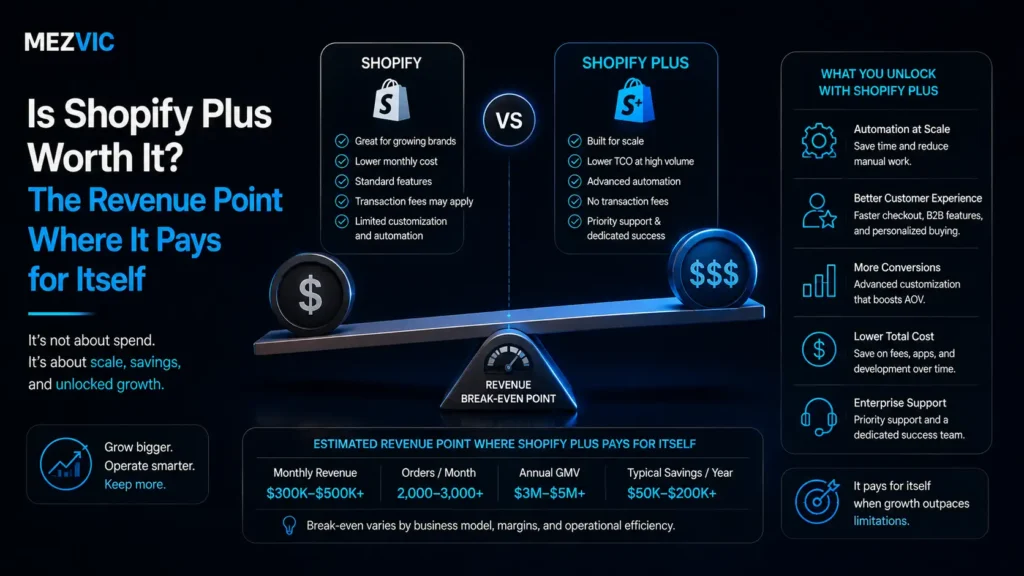
Shopify Plus starts at $2,300 a month. Advanced costs $299 a month on annual billing.
So the real question is not what Plus costs. It is what the extra $24,012 a year has to produce before it stops being a bad decision.
Most answers to is Shopify Plus worth it are written by agencies who sell Plus builds, which is worth remembering while you read them.
Is Shopify Plus worth it? It depends on one number and one named requirement, and if you cannot supply both, the answer is no.
Below: what the fee costs you in orders, what Shopify itself says you get, the four routes the money can come back through, and the three tests worth running before anyone quotes you.
Key Takeaways
- The upgrade costs about $24,012 a year over Advanced on annual billing. That is the number to judge, not the $2,300.
- At a $60 order and 40% margin, that is 1,000 extra orders a year just to stand still. Roughly 83 a month.
- Shopify leads on B2B, international and headless, not on the checkout customisation most agencies pitch it on.
- The gateway saving is real and computable. Third-party fees drop from 0.6% to 0.2%, which is $9,600 a year on $2.4m.
- Around $2m to $3m in sales is where it usually starts making sense, but only with a named feature you will actually use.
- The deciding test is capacity, not revenue. Plus gives you capability, and capability nobody has time to use is just a larger invoice.
What the Upgrade Actually Costs You
Is Shopify Plus worth it is easier to answer in orders than in money.
Take a store with a $60 average order and a 40% gross margin, so $24 of gross profit per order.
What $24,012 a year looks like in orders
Every square is 10 orders. All 100 squares are what the upgrade costs before it has earned anything.
Eighty three extra orders a month, every month, purely to break even. That is the real form of the question is Shopify Plus worth it.
That framing kills most upgrade conversations on the spot, and it should. If nobody can explain where those orders come from, the honest answer to is Shopify Plus worth it is not yet.
Run it with your own numbers rather than mine. Order value and margin move that square count enormously, and our profit margin calculator will give you the gross profit figure to divide by.
At a $200 order value with the same margin, the same fee is 300 orders rather than 1,000. High ticket stores clear this bar far earlier than the revenue rules of thumb suggest.

What Shopify Says You Get
Before answering is Shopify Plus worth it, read Shopify’s own list rather than an agency’s, because the two differ in an interesting way.
Shopify’s Plus page leads with B2B commerce, omnichannel, international expansion across “over 150 countries”, headless commerce, and throughput of “10K+ checkouts per minute” supporting “over one million products and variants”.
Notice what is not at the front of that list. Checkout customisation, the feature most Plus pitches are built on, does not lead their own marketing.
That tells you something about who Plus is now built for. It is an expansion product, not a design product.
| Capability | Who genuinely needs it | Who thinks they need it |
|---|---|---|
| B2B and wholesale | Anyone with account specific pricing or purchase orders | Nobody. This one is usually real |
| International expansion | Selling in three or more markets with local pricing and tax | Stores shipping abroad occasionally |
| Headless commerce | Teams with in-house engineers who will maintain it | Brands who want a faster site and were sold a rebuild |
| Checkout throughput | Drops, flash sales, anything with a queue | Stores with steady daily traffic |
| Catalogue scale | Six figure SKU counts and heavy variant use | Stores with a few thousand products |
| Lower gateway fee | Anyone on a third party processor at volume | Stores using Shopify Payments, where it does not apply |
The last row catches people out. If you use Shopify Payments, the gateway saving is worth nothing to you.
The right hand column is where most answers to is Shopify Plus worth it go wrong.
Test your own templates with our pagespeed checker before assuming the plan is the ceiling. Throughput is the clearest example. Ten thousand checkouts a minute is genuinely impressive and completely irrelevant to a store taking forty orders a day.
It matters enormously on the four days a year you run a drop, and not at all on the other 361. Whether that trade is worth $24,012 depends entirely on how big those four days are.
Where the build work itself differs is a separate question, and it is priced separately for good reason on our Shopify Plus development page.
The Four Routes the Money Comes Back Through
Is Shopify Plus worth it only if you can name where the fee returns from. There are four honest routes, and most stores have one or two rather than four.
Where $27,600 a year has to come from
Modelled on a store doing $2.4m with a third party payment gateway. Ribbon width is how much of the fee each route covers.
Only the first ribbon is a hard number. The other three are forecasts, and forecasts are where upgrade business cases go to die.
The gateway ribbon is the only one you can calculate today with certainty.
Third party payment provider fees step down by plan, from 2% on Basic to 0.6% on Advanced and 0.2% on Plus. On $2.4m going through a third party gateway, that 0.4 point difference is $9,600 a year.
It is also the ribbon that disappears entirely if you use Shopify Payments, which most stores do, and it is worth confirming with whoever handles your store operations. Check which you are on before counting it.
The B2B ribbon is the strongest of the remaining three, because it is a new revenue line rather than a percentage improvement on an existing one.
A wholesale channel that did not exist before is easy to attribute and hard to argue with. It is the single cleanest reason to upgrade that I encounter.

The Three Tests, and the One That Decides
Run these three tests in order. Two out of three is not a pass, whatever the sales deck says.
One store, scored against the three tests
A $2.4m store with a wholesale channel planned and no dedicated developer. Two rings are full. The third is the problem.
The inner ring is the one that decides. Capability nobody has time to use is just a larger invoice.
Test one, revenue headroom. Can the extra $24,012 be under 2% of your gross profit? Below that it is a rounding error. Above 5% it is a bet.
Test two, a named feature. Write down the single capability you will switch on in month one. If the sentence contains the word “scale” or “future”, it is not a named feature.
Test three, capacity. Who builds the B2B catalogue, configures the markets, or maintains the headless front end? Name the person and check their calendar.
Test three is where the example above fails, and it is the most common failure I see. The business qualifies on paper and has nobody to do the work.
That is not an argument against upgrading. It is an argument for budgeting the implementation alongside the licence, because the licence alone changes nothing.
The Revenue Point, Stated Plainly
People want a revenue number for is Shopify Plus worth it, so here is mine with the reasoning attached rather than as a rule.
At a 40% gross margin, the $24,012 uplift is 2% of gross profit once you reach about $3m in revenue. That is the point where the fee stops being a decision and becomes a line item.
Below $2m it is over 3% of gross profit, which is enough to notice and enough to regret if the features go unused.
Between $2m and $3m is the genuine grey zone, and that is where the named feature test does all the work.
| Annual revenue | Gross profit at 40% | Uplift as % of profit | Verdict |
|---|---|---|---|
| $800,000 | $320,000 | 7.5% | No, unless B2B is the entire reason |
| $1.5m | $600,000 | 4.0% | Rarely. Revisit in a year |
| $2.4m | $960,000 | 2.5% | Only with a named feature and someone to build it |
| $3.5m | $1.4m | 1.7% | Usually yes |
| $6m | $2.4m | 1.0% | Yes, and the question becomes what else you need |
Arithmetic, not a study: $24,012 divided by gross profit. Substitute your own margin, because 20% margins double every figure in that column.
Margin matters more than revenue when working out is Shopify Plus worth it, which is why revenue rules of thumb mislead so often.
A $2m store on 60% margins clears the bar comfortably. A $4m store on 18% margins does not, despite being twice the size.
So when somebody tells you the threshold is a revenue number, ask which margin they assumed. They will usually not have one.

What to Do Instead, If the Answer Is No
Most stores asking is Shopify Plus worth it are trying to solve a problem the upgrade would not fix anyway.
Four common ones, and where the money actually belongs.
- “Our site is slow.” Plus does not make a slow theme fast. App stack and images cause most of it, and that is a build problem rather than a plan problem.
- “We have outgrown the theme.” You have outgrown the theme, not the plan. A custom build on Advanced costs less than the annual Plus difference.
- “We need better support.” Fair, and worth naming honestly as the reason rather than dressing it as a feature requirement.
- “We want to look enterprise.” Nobody outside your industry knows which plan you are on, and no customer has ever checked.
The second one deserves emphasis because it is the most common and the most expensive mistake.
A serious custom build sits well under $24,012 in most cases, and it solves the actual complaint. Spending the same money annually on a plan you use at 20% does not.
Where that build money genuinely goes is broken down in our guide to what a store build costs, which converts any quote into hours.
If speed is the real complaint, that is its own project with its own arithmetic, and Shopify speed work will move it further than any plan change.
And if the honest answer is that growth has stalled rather than that the platform is limiting you, the money belongs in demand rather than infrastructure, which usually means Shopify SEO or paid acquisition.
What Plus Does Not Change
Half the disappointment comes from asking is Shopify Plus worth it about problems the plan has no bearing on.
Your traffic. Nothing about the plan brings visitors. If the problem is demand, the fee is money moved away from the actual constraint.
Your conversion rate. The checkout is already excellent on lower plans. Better product pages and clearer delivery information move conversion far more than a plan change does.
Your app bill. Apps cost what they cost. Some vendors charge more at enterprise tiers rather than less, so check before assuming savings.
Your team’s capacity. This is the one that matters. Plus adds options, and options need somebody to exercise them.
Anyone asking is Shopify Plus worth it because growth has stalled is asking the wrong question of the wrong system. That is a demand problem wearing an infrastructure costume.
Conversion in particular is worth exhausting first, because it is cheaper and compounds against every visit you already pay for. That is conversion work rather than a platform decision.
Questions Worth Asking Before You Sign
Take these into the sales conversation before deciding is Shopify Plus worth it. They are not hostile, they are the questions any $27,600 commitment deserves.
- Which single feature will we switch on first, and when? A date, not a quarter. Vague answers here predict an unused licence.
- What does implementation cost on top? The licence is rarely the whole number. B2B catalogues and expansion stores are projects.
- What are the renewal terms? Ask now, while you have leverage, rather than eleven months from now when you do not.
- Does anything we currently use become more expensive? Some apps price differently at enterprise level, and it is better to know upfront.
- What happens to our data and theme if we leave? The answer is usually reassuring, and asking still tells you how reversible this is.
The second question is the one that changes budgets. A licence with no implementation plan attached is the most common way an upgrade fails quietly.
Twelve months later the store is identical, the invoice is larger, and nobody can point at what changed. That is the specific failure worth designing against.
If the move also involves consolidating stores or changing platforms at the same time, treat that as a separate project with its own risk, which is why migration work is never folded into a plan change.
A Sensible Sequence
If you are close to the threshold and unsure, this order avoids paying for capability before you can use it.
Quarter one. Fix the theme and the app stack on your current plan. Most of what people blame on the plan lives here, and it is cheaper to prove than to assume.
Quarter two. Validate the feature you think you need. Run wholesale manually with ten accounts and invoices before buying a B2B system for it.
Quarter three. If the manual version is straining, you now have a named requirement, real volume and a person who understands it. That is a strong upgrade case rather than a hopeful one.
Doing it in that order means the answer to is Shopify Plus worth it arrives with evidence attached instead of a forecast.
It also means that if the manual version never strains, you saved $24,012 and learned something. Both outcomes are wins, which is rare in platform decisions.
The day to day rhythm of running the store barely changes across plans, and our guide to managing a Shopify store applies equally on either side of the upgrade.
If the comparison in your head is really against leaving Shopify altogether, that is a different calculation again, and we modelled it over five years in Shopify versus WooCommerce.
Whichever way it goes, keep the upkeep budget separate from the licence. Ongoing store maintenance costs the same on Advanced as on Plus, and it is the line most often forgotten in an upgrade business case.
How to Negotiate It
The $2,300 is a starting price, which means it is a starting point.
Three things are worth raising before you sign anything.
Ask what happens at renewal. Terms quoted for year one are not automatically the terms for year two, and that is a question best asked while you still have a choice.
Ask for the implementation plan in writing. Not the feature list. What gets configured, by whom, and by when. A licence with no implementation attached is the classic way this goes wrong.
Ask what happens if you go back down. Understanding the exit before you enter tells you how much of the decision is reversible.
None of that is adversarial. It is the same diligence you would apply to any $27,600 annual commitment, and the fact that it is a software plan does not change the arithmetic.
Whoever runs the store day to day should be in that conversation too, since they inherit whatever gets configured. That is an operations question as much as a commercial one.
Frequently Asked Questions
How much does Shopify Plus cost?
Shopify Plus starts at $2,300 a month, which is $27,600 a year. Against Advanced at $299 a month on annual billing, the upgrade costs about $24,012 more per year.
Is Shopify Plus worth it for a $1m store?
Usually not. At a 40% margin the uplift is around 6% of gross profit, which is hard to justify unless a wholesale channel is the specific reason for moving.
At what revenue does Shopify Plus make sense?
Commonly $2m to $3m, but margin matters more than revenue. The practical test is whether the uplift stays under 2% of gross profit and you have a named feature to switch on.
What do you actually get with Shopify Plus?
Shopify highlights B2B commerce, omnichannel, international expansion across over 150 countries, headless commerce, 10K+ checkouts per minute and support for over a million products and variants.
Does Shopify Plus reduce transaction fees?
It reduces the third party payment provider fee to 0.2%, down from 0.6% on Advanced. If you use Shopify Payments the fee does not apply, so the saving is zero.
Will Shopify Plus make my store faster?
Not on its own. Front end speed comes from your theme, apps and images. Plus raises throughput ceilings for concurrent checkouts, which is a different problem to page load time.
Can I negotiate Shopify Plus pricing?
The published figure is a starting price, so terms are worth discussing. Ask specifically what happens at renewal rather than only about the first year.
Do I need Plus for wholesale or B2B?
It is the cleanest reason to upgrade, since B2B is a headline Plus capability and a genuinely new revenue line rather than a percentage improvement on existing sales.
Is Shopify Plus worth it just for the support?
It can be, if downtime genuinely costs you thousands per hour. Say that out loud as the reason rather than inventing a feature requirement to justify the same decision.
How long does moving to Shopify Plus take?
The plan change itself is quick. Actually using what you bought, configuring B2B catalogues or expansion stores, is a project of several weeks and needs budgeting separately.
Can I downgrade from Shopify Plus?
Ask before you upgrade, and get the answer in writing. Understanding the exit tells you how reversible the decision is, which changes how much certainty you need upfront.
Is Shopify Plus worth it compared to going headless?
Headless is a capability Plus enables rather than an alternative to it. The real question is whether you have in-house engineers to maintain a headless front end permanently.
The Bottom Line
Answer is Shopify Plus worth it against the $24,012 uplift, not the $2,300 headline, and convert it into orders before you convert it into a business case.
Then name the one feature you will switch on in month one. If you cannot, the plan is not the constraint and the money belongs elsewhere.
And check the third ring hardest. Revenue and requirements are easy to satisfy on paper, while capacity is the test that quietly decides whether any of it gets used.
If you want the three tests run against your real numbers before a sales conversation rather than during one, send us your revenue and margin and we will tell you which ring you fail.