Six months after outsourcing customer service, every number on the report was better.
First response time down. Tickets closed per day up. Cost per contact down by a third.
Repeat purchase rate had fallen by 9% and nobody had connected the two, because those numbers live in different reports and different meetings.
That is the pattern with outsourcing customer service risks. They rarely announce themselves. They show up as a metric improving while the business quietly gets worse.
Below: which outsourcing customer service risks actually bite, why the usual dashboards hide them, and the contract terms that prevent most of it.
Key Takeaways
- Averages improve while the worst cases get much worse. Median response time falls, the slowest 10% doubles, and only the tail damages your brand.
- Knowledge loss is the deepest risk. What leaves is the undocumented judgement of people who knew your products.
- Per ticket pricing rewards closing, not solving. The contract creates the behaviour, not the vendor.
- Escalation is where most failures live. Either too much comes back, or almost nothing does and that is worse.
- You lose the early warning system. Your support inbox was telling you about product problems, and now nobody is listening for that.
- Five contract clauses prevent most of it, and none of them are about price.
What Actually Breaks When You Outsource Customer Service?
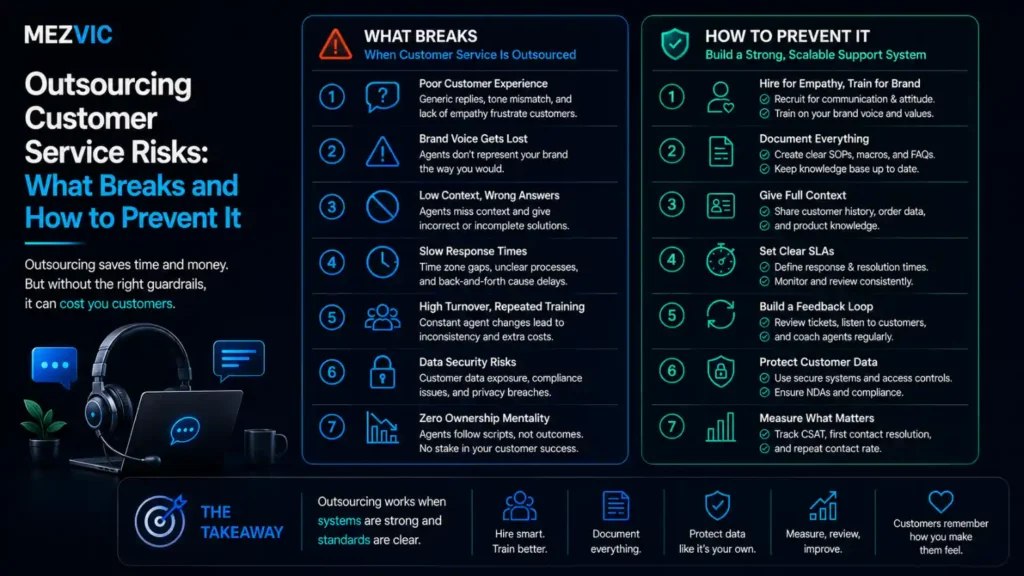
Six categories of cause produce nearly every one of the outsourcing customer service risks, and they compound rather than acting alone.
The six things that feed a failed handover
Rarely one cause. Usually three or four of these arriving together in month three, which is why the failure feels sudden.
Ownership is the one that makes the other five survivable. Without a named internal owner, none of them get caught early.
Knowledge loss is the deepest of the outsourcing customer service risks, and the least recoverable.
This is why outsourcing customer service risks get underestimated. What leaves when your support person leaves is not the documented process. It is knowing that a particular product runs small, that a particular courier is unreliable in one region, and which customers will escalate to a director.
None of that appears in a handover document, because nobody realised it was knowledge. It just felt like doing the job.
Continuity then multiplies it. Agent turnover at outsourcing providers is high by design, so whatever you teach gets partially relearned every few months.

Why Do Support Metrics Improve While Service Gets Worse?
Because almost every dashboard hides outsourcing customer service risks behind an average, and outsourcing changes the shape of the distribution rather than shifting it evenly.
Response times before and after outsourcing
The box is the middle half of all tickets. The line inside is the median. The whiskers are the fastest and slowest.
Both statements in that callout are true at the same time, and only one of them appears in a monthly report.
The easy tickets got faster, which pulls the median down. The hard tickets now bounce between the vendor and your team, which stretches the tail.
And the customers in that tail are not random. They are the ones with complicated, expensive or emotional problems, which is to say the ones who matter most.
Fix this by reporting the 90th percentile alongside the average. One extra column in a spreadsheet exposes the single most common of the outsourcing customer service risks.
What Do Outsourced Support Reports Leave Out?
Reported metrics are a small fraction of what is happening, and most outsourcing customer service risks live below them, and outsourcing widens that gap considerably.
What the dashboard shows against what is happening
Everything above the waterline arrives in your inbox monthly. Everything below it only surfaces if somebody goes looking.
CSAT sits above the line and still misses most of this, because unhappy customers rarely fill in surveys. They just leave.
The second item below the line is the most expensive and the least discussed.
Your support inbox was an early warning system. When forty people asked the same confusing question about a product, somebody noticed and the product page got fixed.
An outsourced team answers those forty questions efficiently and correctly, and nobody tells you the question exists. The symptom is treated forever and the cause never is.
That feedback loop is worth protecting explicitly, because it is the thing most likely to disappear silently. A monthly summary of the top five recurring questions costs the vendor almost nothing and preserves it.
Many of those recurring questions are answerable on the site rather than by a person, which is the deflection argument in our breakdown of what a support ticket really costs.

Which Customer Service Outsourcing Risks Matter Most?
Seven outsourcing customer service risks come up repeatedly. They differ enormously in how likely they are and how much damage they do.
| Risk | How likely | Damage | Earliest warning sign |
|---|---|---|---|
| Brand voice drift | Very high | Slow and cumulative | Replies you would not have sent, found by sampling |
| Product feedback loop lost | Very high | High, invisible | You cannot name the top question this month |
| Long tail of slow cases | High | High on your best customers | 90th percentile rising while the average falls |
| Over escalation | High | Moderate, costs the saving | Your team busier than before the handover |
| Under escalation | Medium | Severe when it happens | Complaints reaching you first through social |
| Refund leakage | Medium | Direct and measurable | Refund rate up without a returns rate change |
| Vendor concentration | Low | Existential for a quarter | No documented process you could run yourself |
The last column is the useful one. Every one of these has a signal that appears weeks before the damage does.
Refund leakage deserves a mention because it is the only one that shows up cleanly in finance.
An agent measured on closing tickets, handling a complaint about a product they do not know, will offer a refund. It resolves the ticket, satisfies the customer and closes the case beautifully.
It also costs you the order, and it happens quietly at scale. Watch refund rate against return rate, because a gap between them is refunds given without goods coming back.
Vendor concentration is the low probability entry that people dismiss entirely. If the relationship ended tomorrow with thirty days notice, could you run support yourself for a month?
If the honest answer is no, that is not a support risk, it is a continuity risk, and it belongs on a different register.
How Do You Prevent Outsourced Support Failures?
Five clauses in the contract prevent the majority of outsourcing customer service risks, and none of them concern price.
- Report the 90th percentile, not the average. Contract it explicitly. This single line surfaces the tail that averages hide.
- A monthly top five recurring questions summary. Preserves your product feedback loop for almost no cost.
- Pay on resolution, not closure. Add repeat contact rate as a measure, so reopening a ticket is visible.
- Define escalation in both directions. What must come to you, and what must never be escalated. Missing the second half causes over escalation.
- Refund authority caps with named approval above them. Removes refund leakage without slowing genuine cases.
The fourth is the one most often written badly. Every contract lists what should be escalated and almost none list what should not.
A vendor unsure of the boundary escalates everything, which is rational self protection and destroys your saving. Write both lists.
Alongside those, keep one habit that no contract can replace: read twenty real conversations a month yourself. Not summaries, the actual threads.
Half an hour of reading will tell you more about brand voice drift than any quality score, because a reply can be accurate, polite, on time and still sound like a stranger wrote it.
How Do You Choose a Customer Service Vendor?
Ask about failure rather than capability. Every vendor demo shows the system working, and the outsourcing customer service risks all live in what happens when it does not.
What is your agent turnover rate? This is the single most predictive number. High turnover means whatever you teach gets relearned every few months, and consistency never arrives.
How many clients does one agent cover? One or two is a partner. Six is a switchboard with your logo on the signature.
Can I speak to a client who left? The reaction matters more than the answer. A vendor comfortable with this question has usually handled an exit well.
What is your 90th percentile response time across all clients? If they only report averages internally, they cannot manage the tail, and the tail is what will hurt you.
Show me a conversation you got wrong and what changed. A vendor with no example either does not sample their own work or is not being straight with you.
Data handling belongs in the same conversation. Once a provider processes customer records on your behalf, the relationship is a formal one, and the ICO publishes guidance on controllers and processors including contracts and liabilities between them.
Agree access levels, processing location and deletion on exit in writing at the start, when you have leverage, rather than during a handover you have already committed to.
How Do You Stop Support Knowledge Walking Out the Door?
Knowledge loss is the least reversible of the outsourcing customer service risks, so write it down before the people who have it leave, because after they go it cannot be reconstructed at any price.
Most handover documents capture process and miss judgement. The process is easy: here is how to issue a refund. The judgement is the valuable part: here is when we do it without asking.
Four categories worth documenting specifically, and none of them appear in a standard runbook.
- Product quirks. What runs small, what arrives looking damaged but is fine, what customers consistently misunderstand.
- Exception precedents. Real cases where you broke policy and why. This teaches judgement far better than a rules document.
- Named accounts. Which customers are large, sensitive, or likely to escalate. Getting this wrong once can cost a relationship.
- Tone examples. Ten real replies you were proud of, and three you would not send. Examples travel better than adjectives.
That last one does more for brand voice than any style guide, because “friendly but professional” means something different to every reader and a real reply does not.
Keep the document living. A knowledge base written once and never revised is out of date within two quarters, and the vendor will quietly stop consulting it.
Much of this is the same discipline as documenting any process before automating it, which is the argument in our guide to what AI handles well and where it fails.
How Should You Structure a Support Handover?
Gradually, because a staged handover removes most outsourcing customer service risks before they compound.
Weeks 1 to 4, document while you still can. This one step removes more outsourcing customer service risks than any contract clause. Your current team writes the answers to the top fifty questions and records why, not just what.
Weeks 5 to 8, one queue only. Give the vendor the highest volume, lowest judgement queue. Order status, delivery timing, returns process.
Weeks 9 to 12, sample hard. Read fifty conversations, not five. This is when brand voice problems are cheap to correct and habits are still forming.
Month 4 onward, expand deliberately. Add a second queue only if the first is genuinely working against the 90th percentile, not the average.
Keeping complaints and anything relationship shaped in-house permanently is a legitimate end state rather than a failure to complete the migration.
That hybrid split by ticket type usually costs less than either extreme, which is the arithmetic we set out on the customer service outsourcing page.

What Does a Healthy Outsourcing Arrangement Look Like?
A healthy arrangement, with the outsourcing customer service risks under control, has a specific shape, and it is not the one most people expect.
Your total ticket volume has fallen. Not just your handling cost. A good partner surfaces recurring problems and you fix the causes, so the queue shrinks.
The 90th percentile is stable or better. The average will look after itself. The tail is the number that reflects what your worst affected customers experienced.
You still know what customers are asking. If you can name this month’s top three questions without opening a report, the feedback loop survived.
Escalations are boring. They arrive with context, they are genuinely appropriate, and there are not many of them.
You could take it back if you had to. Documentation current, systems in your name, and a rough idea of the headcount required.
The first point is the one that separates a partner from a supplier. A supplier answers tickets efficiently forever, and a partner helps you need fewer of them.
If ticket volume is flat after twelve months, nobody is learning anything from the queue, and that is a quiet failure even when every reported metric looks healthy.
Most of the recurring causes sit outside support entirely. Unclear listings, vague delivery timings and checkout friction generate the bulk of avoidable contacts, which is why the fix usually lives with store operations.
Where delivery promises are the cause, that is a fulfilment problem wearing a support costume, and our guide to choosing a 3PL covers the questions that prevent it.
And where the same question arrives dozens of times a week, answering it once on the site beats answering it well forever, which is a job for clearer product content.
When Should You Keep Customer Service In-House?
Four situations where outsourcing customer service risks outweigh any saving, and recognising them early is worth more than managing them later.
Your product is complex or configurable. If answering well requires understanding how the thing works, an agent covering six brands cannot do it, and escalation will swallow the saving.
Support is your differentiator. If customers choose you partly because of how you treat them, outsourcing removes the reason they chose you to save a few dollars a ticket.
You have never documented anything. Outsourcing an undocumented process transfers chaos rather than work. Document first, then decide, and you may find you no longer need to.
Volume is under about 2,000 tickets a year. The vendor management overhead consumes the benefit, and minimum monthly commitments make it worse.
The third one is worth sitting with, because it turns most outsourcing customer service risks into a question you may not need to answer. The documentation exercise frequently reveals that half the queue is caused by four fixable things.
Fix those and the volume drops enough that the original question disappears, which is the cheapest possible outcome.
Where volume is genuinely high and repetitive, an automated first line handles it better than either option, provided handover to a person is fast. That is the case for an AI support layer.
Frequently Asked Questions
What are the main risks of outsourcing customer service?
Brand voice drift, losing the product feedback loop, a growing tail of very slow cases, over or under escalation, refund leakage and vendor concentration. Most surface as a metric improving while the business quietly worsens.
Does outsourcing customer service reduce quality?
Not automatically, but it changes the distribution. Simple tickets usually get faster while complex ones get considerably slower, so averages improve even as your most valuable customers wait longer.
How do I keep brand voice consistent with an outsourced team?
Read twenty real conversations a month yourself and give specific feedback with examples. A written tone guide helps, and sampling actual replies is the only thing that reliably catches drift.
What should be in an outsourcing contract?
Reporting on the 90th percentile rather than averages, a monthly recurring questions summary, payment on resolution rather than closure, escalation rules in both directions, and refund authority caps.
What is a good escalation rate?
Under 25% for a mature arrangement. Above 40% you are paying twice for a large share of tickets, and near zero usually means things that should reach you are being closed instead.
How do I know if outsourcing is going wrong?
Watch the 90th percentile response time, repeat contact rate, refund rate against return rate, and whether you can still name this month’s most common customer question.
Should I outsource complaints?
Generally no. Complaints are where the relationship is decided, and a technically correct reply from someone with no context can resolve the ticket while losing the customer.
How long does an outsourcing handover take?
Twelve weeks done properly: four documenting, four running one simple queue, and four sampling heavily before expanding. Faster handovers usually skip the documentation.
Is offshore support riskier than onshore?
Not inherently. Time zone coverage can help the tail, while cultural and product distance can worsen brand voice. Judge the specific team and their turnover rate rather than the location.
What happens to my data when I outsource support?
Agents need access to customer records, so agree data handling, access levels and deletion on exit in writing before starting, and confirm which country the data is processed in.
How do I avoid losing product feedback?
Contract a monthly summary of the top five recurring questions and read it. Without it, forty people asking the same confusing question gets answered efficiently and never reaches anyone who could fix the cause.
Can I reverse an outsourcing decision?
Yes, and it takes about a quarter to rebuild internal capability. The cost is proportional to how little you documented, which is why keeping your own runbook current matters even while a vendor handles the work.
The Bottom Line
Outsourcing customer service risks are real and almost all of them are manageable, provided you measure the right things from day one.
Three habits keep the outsourcing customer service risks small. Report the 90th percentile beside the average, contract the recurring questions summary, and define escalation in both directions.
Then read twenty real conversations a month. That habit catches more than any dashboard, and it is the only one nobody can do for you.
If you want the handover structured so the feedback loop survives it, tell us what your queue looks like and we will map which parts should stay in-house.