Nearly every platform comparison you will read comes down to the same sentence: WooCommerce is free, Shopify is not.
That sentence is true and almost completely useless as a way to compare Shopify vs WooCommerce cost.
WooCommerce is free the way a puppy is free. The acquisition is the cheapest part of the relationship.
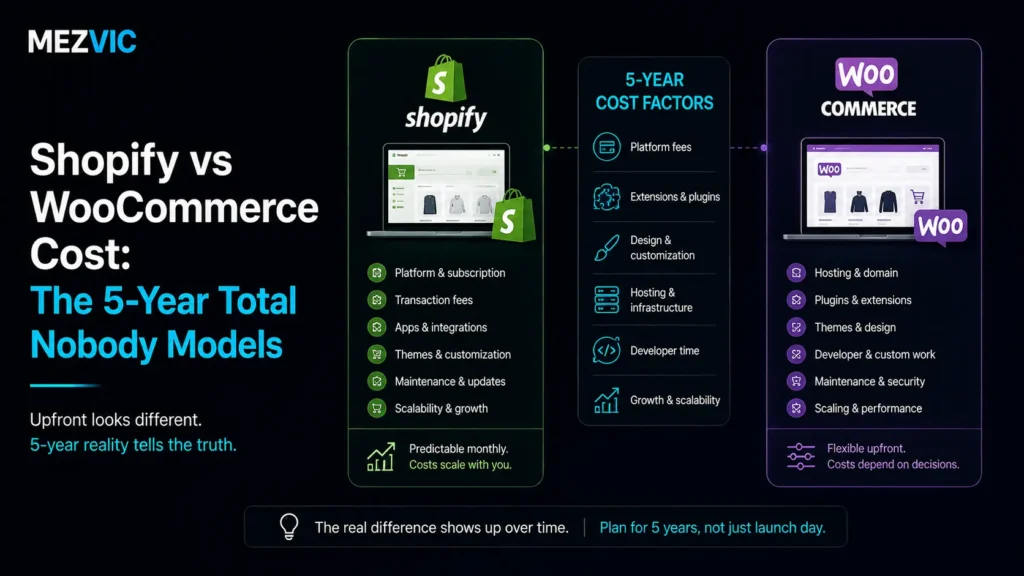
Shopify vs WooCommerce cost only becomes a real question once you model five years, because the answer flips depending on how fast you grow.
Below: the running costs line by line, three growth scenarios modelled to year five, and the point where the cheaper platform stops being the cheaper platform.
Key Takeaways
- At modest revenue, Shopify is usually cheaper overall, despite the monthly fee, because hosting, updates and breakage are somebody else’s problem.
- At high revenue, WooCommerce wins clearly, because Shopify Plus starts at $2,300 a month and WooCommerce hosting simply does not scale like that.
- The crossover is driven by revenue, not by time. A store that stays at $250k never reaches it. A store heading for $4m crosses it in year four.
- Maintenance is the line nobody budgets. On the model below it costs five times more on WooCommerce, and it is the cost people discover rather than plan.
- Apps invert the picture. Shopify app subscriptions are recurring and endless, WooCommerce plugin licences are mostly annual and cheaper.
- The real question is not price, it is who fixes it at 2am. If the honest answer is nobody, the hosted platform is cheaper whatever the spreadsheet says.
The Annual Running Costs, Line by Line
Forget the build for a moment. This is Shopify vs WooCommerce cost stripped to the recurring lines. This is what each platform costs to simply keep operating at around $250,000 a year in sales.
Annual running cost by category
Each row shows the gap between the two platforms on one line item. Neither wins every row, which is the whole point.
Arithmetic, not a study: Shopify totals $3,648 a year, WooCommerce $5,800. Shopify plan is Grow at $49 a month on annual billing.
In a Shopify vs WooCommerce cost comparison, two rows go the way people expect and three do not.
Shopify charges a platform fee and WooCommerce does not. Shopify includes hosting and WooCommerce does not. Those cancel each other out almost exactly.
Then the surprises. WooCommerce plugin licences cost less than Shopify app subscriptions, because most are annual rather than monthly and many are one off.
And maintenance runs five times higher on WooCommerce, because somebody has to apply updates, test that nothing broke, and be available when something does.
That maintenance line is not theoretical. Update related breakage is the single most common reason a store goes down for reasons unrelated to traffic, and it is why WooCommerce maintenance exists as a category at all.

The Five Year Total Under Three Growth Scenarios
This is the Shopify vs WooCommerce cost modelling almost every comparison skips, and it is the only part that answers the question.
Same store, same build, three different growth curves. Watch which side of the line the bar sits on.
Who is cheaper depends entirely on how fast you grow
Bars to the left mean Shopify came out cheaper over five years. Bars to the right mean WooCommerce did.
Arithmetic, not a study: builds of $8,000 and $10,000, then the annual costs above, with Shopify moving to Advanced in year 4 of the middle case and to Plus at $2,300 a month in year 4 of the top case.
The top two bars are close. The bottom one is not close at all, and it reverses the usual Shopify vs WooCommerce cost answer.
Everything hinges on one number: $2,300 a month. That is where Shopify Plus starts, and it is $27,600 a year that WooCommerce never charges.
Good WooCommerce infrastructure at that volume costs perhaps $500 a month. The gap opens fast once you cross into Plus territory.
Which means the honest version of Shopify vs WooCommerce cost is a forecast question rather than a pricing question. You are betting on your own growth rate.
Bet low and pick WooCommerce, and you pay for maintenance you did not need. Bet high and pick Shopify, and you hand over $27,600 a year for features you may never switch on.
If you are genuinely near that threshold, it is worth reading what the higher tier actually unlocks before committing, since Shopify Plus earns its fee through checkout control and multi store rather than through anything most brands touch.

What Each Platform Charges You For
Shopify vs WooCommerce cost structures are not just different sizes, they are different shapes.
| Cost | Shopify | WooCommerce | Which scales badly |
|---|---|---|---|
| Platform | $25 to $399 a month, Plus from $2,300 | Free, forever | Shopify, sharply, at the Plus threshold |
| Hosting | Included, unlimited bandwidth | $25 to $500 a month by traffic | WooCommerce, gently |
| Extensions | Mostly monthly, forever | Mostly annual, often one off | Shopify, quietly |
| Updates and security | Shopify’s problem | Yours, monthly, forever | WooCommerce, with plugin count |
| Third party gateway fee | 2% down to 0.2% by plan | None from the platform | Shopify, if you refuse Shopify Payments |
| Downtime risk | Effectively theirs | Entirely yours | WooCommerce, on your worst day |
Shopify’s costs scale with revenue. WooCommerce’s scale with complexity. That distinction predicts your bill better than any price list.
That last column is the one to read twice.
A WooCommerce store with eight plugins and steady traffic is cheap to run indefinitely. A WooCommerce store with forty plugins is expensive at any revenue, because every update is a small risk multiplied by forty.
Shopify does not care how complex your store is. It cares how much money goes through it, and ongoing Shopify upkeep stays flat as a result.
Those third party gateway rates come from Shopify’s published pricing, stepping from 2% on Basic to 0.2% on Plus. Use Shopify Payments and they do not apply at all.
What Actually Happens at the $2m Threshold
This is the moment the whole comparison turns, so it is worth walking through slowly.
Take a store doing $2.4m a year and run the Shopify vs WooCommerce cost again. On Shopify Advanced it pays $299 a month on annual billing, which is $3,588 a year. Comfortable.
Then one of three things happens. Traffic spikes and the plan limits bite, or the business needs checkout customisation, or a wholesale channel arrives that needs its own storefront.
All three roads lead to Plus, and Plus starts at $2,300 a month. The annual platform bill goes from $3,588 to $27,600 in a single step.
That is a $24,012 increase for a business whose revenue may have grown 20%. Nothing about the store got harder to host. The pricing model simply changed tier.
The same store on WooCommerce needs better infrastructure at that volume, perhaps $400 a month, plus a more serious maintenance retainer. Call it $12,000 a year all in.
So the Shopify vs WooCommerce cost gap at $2.4m is roughly $15,000 a year in WooCommerce’s favour, and it widens every year after.
None of which makes Plus bad value. It makes Plus expensive, which is a different judgement, and the features have to be worth $27,600 to you specifically.
The trap is arriving at that threshold by accident in year four, having modelled nothing, and discovering the decision has already been made by your migration cost.
The Plugin Count Problem
WooCommerce running costs do not really scale with revenue. They scale with how many things you have bolted on.
Each plugin is a small monthly probability of conflict. Eight plugins is a quiet site. Forty plugins is a part time job.
The arithmetic is unkind. If each plugin has a 1% chance of causing a problem in a given month, eight plugins gives you roughly an 8% chance of a bad month. Forty gives you a third of your months.
That is not a precise model, it is a rough shape, and the shape is what matters: risk rises with count, not with sales.
Which gives WooCommerce owners a lever Shopify owners do not have. Cutting plugin count genuinely lowers your Shopify vs WooCommerce cost comparison in WooCommerce’s favour.
Audit the list once a year. Anything replaceable by twenty lines in a child theme usually should be, and anything nobody can name a use for should go.
Shopify has the mirror version of this problem in app subscriptions, where the cost is money rather than risk. Both platforms punish accumulation, they just send different invoices.
Three Situations Where the Answer Is Obvious
Most of this article is nuance. These three are not.
You are launching your first store and learning the market. Shopify, without hesitation. Your constraint is finding out what people will buy, not platform economics, and every hour spent on hosting is an hour not spent on that.
You already run a WordPress site with real content and traffic. WooCommerce, almost always. The infrastructure, the maintenance habit and the editorial workflow already exist, so the marginal cost of adding a shop is small.
You sell B2B with negotiated pricing and account specific catalogues. WooCommerce, unless you are willing to pay for Plus. Complex pricing rules are where hosted platforms start charging for the privilege.
Whoever runs it day to day matters as much as the platform, which is really an operations question. Everything outside those three is a judgement call, and the Shopify vs WooCommerce cost model above is how to make it rather than a rule to follow.
One more note on the second case. Adding a store to an existing WordPress site changes what that site needs from hosting and from search, and both usually get underestimated. Our WooCommerce SEO work almost always starts by undoing the assumption that a shop behaves like a blog.
Which One Should You Actually Pick?
Three questions decide it, and none of them are about the headline Shopify vs WooCommerce cost.
Three questions, in this order
Answer honestly rather than aspirationally. The second question is the one people get wrong about themselves.
Question two is the honest one, and it is where most decisions quietly go wrong.
Everybody intends to keep the site updated. Very few businesses have a named person whose job includes it, and intention is not a maintenance plan.
If nobody owns it, an unmaintained WooCommerce store eventually costs more than any Shopify plan, because the bill arrives as a security incident or a checkout that stopped working two days ago.
Question three catches the opposite mistake. People choose the flexible platform for a requirement they never actually build, then pay maintenance on that flexibility for years.
Name the requirement out loud. If you cannot, you do not have one yet, and a themed Shopify build will do everything you need for a third of the ongoing effort.

The Costs Both Sides Leave Out
Four numbers appear in almost no Shopify vs WooCommerce cost comparison, and they are large enough to change the answer.
Your own time. Two hours a week wrestling a platform is roughly 100 hours a year. Price that at whatever your hour is worth and it dwarfs the platform fee on either side.
Switching cost later. Moving platforms in year three costs $5,000 to $30,000 and a few weeks of ranking turbulence. Choosing the wrong one is not fatal, but it is not free either.
Hiring difficulty. A store we grew on WordPress needed a very different skill set to a themed build. There are more people who can edit a Shopify theme than can safely debug a WooCommerce plugin conflict, and that shows up in what you pay per hour.
Speed work. WooCommerce stores need performance attention as they grow. Shopify handles the infrastructure, though a heavy app stack will still slow you down.
Payment gateway choice. If your market needs a processor Shopify does not own, that third party fee applies to every order and compounds with volume. On WooCommerce the platform takes nothing either way.
At $500,000 of gateway volume, 1% is $5,000 a year. That single line has flipped more than one Shopify vs WooCommerce cost model I have run.
It only applies if you cannot or will not use Shopify Payments, which is why it belongs in a footnote for most stores and in bold for a few.
That last one has a floor and a ceiling. Our guide to fixing a slow WooCommerce site covers what that work involves, and it is a recurring line rather than a one off.
If you have already chosen and want to change your mind, the mechanics matter more than the price, and we set them out in our walkthrough of a platform migration that protects rankings.
Five Numbers to Put in Your Own Model
Do not take my figures. Take the structure and replace every number with yours.
1. Your revenue in year five, honestly. Not the pitch deck number. The one you would bet on. Everything in a Shopify vs WooCommerce cost model hangs off this single figure.
2. The build, quoted for both. Get the same brief priced on each platform rather than assuming one is dearer. Our breakdown of what a store build actually costs explains why the same brief gets wildly different quotes.
3. Your real maintenance appetite in hours per month. Then double it, because everyone underestimates this and the shortfall becomes an emergency invoice.
4. Your app or plugin list, priced annually. Write the actual list. Most people discover two subscriptions they had forgotten and one they no longer use.
5. Your gross margin. A platform fee is a percentage of profit, not of revenue, and on thin margins that changes the picture considerably. Run it through our profit margin calculator before deciding anything.
With those five, the model takes twenty minutes in a spreadsheet and settles an argument that otherwise runs for weeks.
Then get the same brief quoted properly on both sides, because a cheap build on either platform tends to arrive with expensive habits attached. That applies equally to Shopify builds and WooCommerce builds.
Frequently Asked Questions
Is WooCommerce really cheaper than Shopify?
Only at higher revenue. Below roughly $2m a year Shopify usually costs less in total once hosting, updates and maintenance are counted, despite charging a monthly fee.
How much does WooCommerce cost per year to run?
Around $5,800 a year for a modest store: roughly $900 hosting, $700 plugin licences, $1,800 maintenance and $2,400 of developer time. The software itself is free.
How much does Shopify cost per year?
About $3,648 a year on the Grow plan with a typical app stack. Plans run $25 to $399 a month, and Shopify Plus starts at $2,300 a month.
At what revenue does WooCommerce become cheaper?
Around the point you would move to Shopify Plus, commonly $2m to $3m in annual sales. That $27,600 yearly platform fee is what tips the comparison.
Does WooCommerce charge transaction fees?
No platform fee at all. You pay only your payment processor. Shopify adds a third party gateway fee from 2% down to 0.2% by plan unless you use Shopify Payments.
Which is better for a beginner?
Shopify, comfortably. You can be trading in a weekend without touching hosting, updates or security, and the first store is about learning what customers want rather than platform control.
Is WooCommerce harder to maintain?
Yes. You own updates, security patches, backups and plugin conflicts. That work is manageable with a retainer and genuinely risky without one.
Can I move from Shopify to WooCommerce later?
Yes, and it typically costs $5,000 to $30,000 depending on data complexity. Expect a few weeks of ranking movement while the new URLs are recrawled.
Which platform is better for SEO?
Neither meaningfully. WooCommerce gives more control over URLs and markup, Shopify removes technical risk. Content and links decide rankings far more than platform choice does.
Do Shopify apps cost more than WooCommerce plugins?
Usually yes over time, because most Shopify apps bill monthly forever while many WooCommerce plugins are annual or one off. Fourteen apps at $29 a month is $4,872 a year.
What hosting does WooCommerce need?
Managed WordPress hosting built for WooCommerce, typically $25 to $500 a month by traffic. Cheap shared hosting is the most common cause of a slow store.
How should I compare Shopify vs WooCommerce cost properly?
Model five years, not one month. Include build, platform, hosting, extensions, maintenance and developer time, then run it twice at your current revenue and at your target revenue.
The Bottom Line
Neither platform wins on Shopify vs WooCommerce cost outright. One is cheaper for you, and which one depends on a number you have not written down yet.
If you expect to stay under about $2m in sales, Shopify almost certainly costs you less in total, and it costs you far less attention.
If you are heading past that, model the Plus threshold now, because it is the single line that decides the whole comparison.
And whichever way you lean, answer question two first. A store nobody maintains is more expensive than every fee on this page combined.
If you want the five year model run against your own numbers rather than mine, send us your revenue forecast and we will show you where the lines cross.