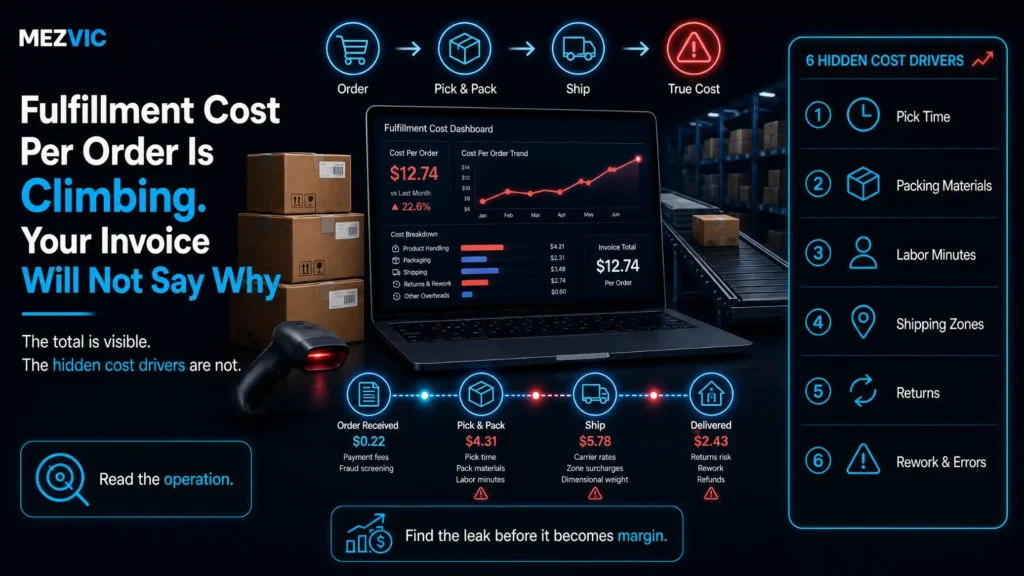
Your 3PL has not raised its rates. Your carrier has not announced an increase. And your fulfillment cost per order is up 19% since March.
Nothing on the invoice explains the change in fulfillment cost per order, because the invoice is a list of charges rather than a list of causes.
Below: what the number is actually made of, the four drivers that move it without anyone deciding to, and how to work out which of your orders are losing money.
Key Takeaways
- Carriers bill on dimensional weight or actual weight, whichever is greater. A 7 lb box can be billed as 19 lb purely because of its size.
- UPS divides cubic inches by a divisor that changes with rate type: 139 for Daily Rates, 166 for Retail. The same box bills differently depending on which card you are on.
- Any fraction is rounded up to the next whole pound, so an 18.13 lb calculation becomes 19 lb.
- Fuel surcharges are a percentage of the base rate, so every base increase raises them again without a separate announcement.
- Your fulfillment cost per order can rise while every single rate stays fixed, purely from a change in what you sell and where it goes.
What Actually Makes Up Fulfillment Cost Per Order?
Fulfillment cost per order has six components, and only two of them are the ones people negotiate.
Most conversations with a 3PL are about the pick fee and the shipping rate. Those are the visible numbers, and they are usually the ones that have not changed.
- Pick and pack. Usually a base fee for the first item plus a smaller fee per additional item.
- Packaging materials. Box, void fill, tape, label. Small per order and large per year.
- Carrier base rate. Driven by billed weight and zone, not by what the item actually weighs.
- Surcharges. Fuel, residential, delivery area, peak season, additional handling.
- Storage. Allocated per order, so it rises when stock moves slowly even though nothing about fulfilment changed. On Amazon this is explicit, as our breakdown of FBA storage fees shows.
- Returns processing. Frequently excluded from the quoted figure and billed separately.
The fourth and fifth items are where a rising fulfillment cost per order usually hides, because neither is a rate anyone agreed to change.
Marketplace sellers carry another layer on top, since channel fees are charged on the delivery you collected as well as the item, as set out in eBay seller fees. Returns deserve a separate mention. If your quoted cost excludes them and your return rate moves from 8% to 14%, your real cost has moved even though the quote has not.
Why Does the Invoice Never Explain the Increase?
Because an invoice reports what you were charged, not what caused the charge. Every line is accurate and none of them is an explanation.
Every line is accurate. None of them is an explanation.
A single order billed out, with the part the document leaves unsaid.
Illustrative invoice using real charge types. Amounts are examples, the structure is not.
Look at the shipping line. It says 19 lb, and it is correct. The box weighs seven.
Nothing on the document tells you that, because the carrier is not hiding anything. It is billing exactly what it said it would bill, on a basis you agreed to and probably did not model.
This is the core problem with monitoring a fulfillment cost per order from invoices. The document is a receipt, and receipts describe outcomes.
To find causes you need the shipment-level export: billed weight against actual weight, zone, surcharge codes, and the order they belong to.
Most 3PLs will provide that if asked directly. If yours will not, that is worth knowing before you renew, and it belongs on the list in our guide to choosing a 3PL.

How Does Dimensional Weight Inflate Your Bill?
Dimensional weight raises fulfillment cost per order by charging for the space a box occupies rather than what is inside it, whenever the space costs more.
FedEx states the rule plainly on its dimensional weight page: for each shipment you are charged on the dimensional weight or the actual weight, whichever is greater.
The arithmetic is public and worth doing on your own best-selling box today.
Take an 18 by 14 by 10 inch carton. That is 2,520 cubic inches. If you sell on Amazon, run the same box through our FBA calculator to see the same effect on their fee bands.
Divide by 139 and you get 18.13, which rounds up to 19 billed pounds. UPS confirms both the method and the rounding on its shipping dimensions page, noting that any fraction increases to the next whole pound.
If the contents weigh 7 lb, you are billed for 19. That is 2.7 times the weight you are actually sending.
Then comes the detail almost nobody models. UPS notes the divisor varies by rate type: 139 for Daily Rates and 166 for Retail Rates.
The same carton at 166 gives 15.18, rounding to 16 lb. Identical box, identical contents, three billed pounds of difference, decided by which rate card you are on.
Two practical consequences follow, and both are cheaper to fix than a rate negotiation.
- One inch matters. Reducing that carton to 16 by 14 by 10 gives 2,240 cubic inches, which is 16.11 and bills at 17 lb. Two pounds saved by changing a box.
- Void fill is not free. Every inch of air you ship is billed at the same rate as product, on every order, forever.
A box audit is the single highest-return hour available on fulfillment cost per order, and it needs no supplier conversation at all.
Why Does the Same Order Cost More to Ship Further?
Because carriers price by zone, and zone quietly sets your fulfillment cost per order, and zone is distance from the warehouse expressed in bands.
This is why your fulfillment cost per order can rise without a single rate changing. If your customer mix shifts outward, your average zone rises, and the bill follows.
The identical parcel, priced by how far it goes
Relative cost index for one unchanged package as it crosses zone bands.
Index is illustrative and relative, not a carrier rate card. Check your own zone table for real figures.
A campaign that performs well on the far coast will raise your shipping cost. Nobody will connect the two, because the campaign is judged on revenue and the shipping is judged on rate.
Three things move average zone without any decision being made about logistics.
- Paid acquisition geography. Broad targeting reaches wherever is cheapest to reach, not wherever is cheapest to serve.
- Marketplace expansion. Selling on a new channel usually means a wider delivery footprint than your own site.
- Warehouse moves and consolidation. Closing a second location saves rent and quietly raises every order’s zone.
Track average zone as a monthly number. It is the earliest warning you will get, and almost nobody reports it.
If a large share of your volume sits in the outer bands, that is the argument for a second location or a distributed provider, well before it is an argument about rates.
Which Orders Are Quietly Unprofitable?
Bulky, cheap orders going a long way carry the worst fulfillment cost per order. They look identical to every other order in your revenue report and they lose money on arrival.
Averages hide those orders completely. A healthy blended fulfillment cost per order can contain a segment running at two thirds of order value.
The order that loses money looks normal in every report
Each line is one order profile traced across the five things that set its cost.
Illustrative profiles built from the drivers above. Run the same five columns on your own export.
Profile B is the one to find in your own data. It is not an unusual order, it is simply a light, bulky product bought at a low price point and shipped to the far zones.
At 65% of order value going to fulfilment, that order is almost certainly losing money once the product cost and payment fees are counted.
You do not need a data team to find these. Sort last month’s orders by fulfilment cost as a percentage of order value and read the worst fifty.
They will share two or three characteristics, and those characteristics are your action list: a specific product, a specific box, or a specific promotion.
Free shipping thresholds are worth testing against this. A threshold set below the true cost of your bulkiest orders converts well and loses money on exactly the orders it attracts, which our profit margin calculator will make obvious in a minute.
Which Surcharges Move Without Anyone Telling You?
The percentage-based ones move fulfillment cost per order on their own, because they recalculate every time the number underneath them changes.
This is the mechanism behind most of a rising fulfillment cost per order, and it is entirely legitimate. It is simply arithmetic nobody announces.
Fuel is the clearest case. It is levied as a percentage of the base rate, so a base rate increase raises the fuel charge in the same breath. One change, two effects, one line item you were watching.
Residential delivery is the most underestimated. Nearly every direct-to-consumer parcel qualifies, so it behaves as a fixed addition to your cost base rather than an occasional extra.
Delivery area surcharges follow your customers. Rural and remote postcodes carry their own addition, so an audience shift changes the total without touching a rate.
Additional handling depends on the box. Length, weight and packaging type can trigger it, which means a packaging change made for protection can quietly create a surcharge.
UPS also publishes hard limits worth knowing before you design packaging: a maximum of 150 lbs per package and a maximum length of 108 inches. Crossing either changes the service entirely rather than adding a fee.
Pull twelve months of invoices and chart each surcharge as a share of total spend. The lines that grew are your answer, and they are usually not the ones discussed in the quarterly review.
One caution on peak season. Those additions are announced with dates, but the mix changes they encourage tend to persist afterwards, so the fulfillment cost per order rarely returns exactly to where it was.
Where the same product keeps triggering handling fees, the fix is usually in the listing and packing spec rather than the contract, which is product data work more than logistics.
How Do You Calculate Fulfillment Cost Per Order Properly?
To calculate fulfillment cost per order, total everything you paid to get orders out of the door in a month, including the parts billed separately, then divide by orders shipped.
The mistake is not the division. It is what gets left out of the numerator.
What belongs in the calculation
| Cost | Usually included? | Why it matters |
|---|---|---|
| Pick and pack fees | Yes | The number everyone negotiates |
| Carrier base rate | Yes | Driven by billed weight, not actual |
| Fuel surcharge | Often | A percentage, so it compounds every base rise |
| Residential and area surcharges | Sometimes | Most consumer orders are residential |
| Packaging materials | Rarely | Small per order, significant per year |
| Storage, allocated monthly | Rarely | Rises when stock stops selling |
| Returns processing and inbound | Almost never | Moves with return rate, not order volume |
| Account management and minimums | Almost never | Fixed, so it punishes quiet months |
The bottom four rows are the difference between the number you quote and the number you pay.
Calculate fulfillment cost per order two ways and keep both. A blended figure for the board, and a per-segment figure for decisions.
Segment by whatever actually varies for you. Usually that is product type, order value band and zone group. Keeping that view current is ordinary store operations rather than a special project.
One more discipline. Record the fulfillment cost per order alongside the average order value in the same table, because the ratio between them is the number that determines whether you have a business.
A cost that rises from $9 to $11 is a problem at a $40 average order value and irrelevant at $180.

What Actually Reduces Fulfillment Cost Per Order?
Changing what you ship and where it ships from cuts fulfillment cost per order fastest. Rate negotiation comes fourth, and it is where most of the effort goes.
In descending order of return, and the first two need nobody’s permission.
- Audit your box sizes against dimensional weight. Right-sizing cartons attacks the billed weight on every order permanently. Start with your top five SKUs by volume.
- Fix what goes in the box. Less void fill, smaller inserts, flatter packaging. Same protection, fewer billed pounds.
- Move stock closer to demand. Either a second location or a provider with distributed warehouses. This attacks zone, which nothing else can.
- Then negotiate. With shipment-level data in hand, showing your actual profile rather than asking for a general discount.
There is a fifth option that is really a commercial decision. Raise the free shipping threshold above the cost of your worst orders, or exclude the bulkiest products from it.
That is unpopular internally and it is frequently the single biggest lever available.
Test it properly rather than assuming, because a threshold change alters conversion as well as cost, which is the balance covered in store conversion fixes.
Whatever you change, keep the listing accurate afterwards. Delivery promises that no longer match your setup generate support tickets, and those cost money too, as our breakdown of support ticket cost shows.
When Should You Change Fulfilment Provider?
When the fulfillment cost per order problem is structural rather than commercial, because a new provider fixes location and capability but rarely fixes physics.
Four situations genuinely justify a move.
- Your volume sits in far zones from a single warehouse. No rate card fixes distance. Distribution does.
- They will not give you shipment-level data. You cannot manage a fulfillment cost per order you are not allowed to see.
- Accuracy is costing more than shipping. Mispicks generate replacements, returns and tickets, and that total often exceeds the rate difference.
- Minimums no longer fit your volume. Either you have outgrown the tier or your quiet months are subsidising theirs.
Notice that a straightforward price increase is not on the list. If the rates are fair and the location is right, switching costs more than it saves once you count the migration.
Run the box audit and the zone analysis before any tender. Providers quote against your profile, so improving the profile first improves every quote you receive.
If inventory accuracy across channels is part of the problem, that is a systems issue rather than a warehouse one, and it is covered in multichannel inventory sync.
Frequently Asked Questions
What is a good fulfillment cost per order?
The useful measure is fulfilment cost as a share of average order value rather than an absolute figure. The same $11 is comfortable at a $180 order value and fatal at $30, so track the ratio and your own trend.
What is dimensional weight?
It is a billed weight based on the space a package occupies. FedEx states you are charged on the dimensional weight or the actual weight, whichever is greater, so a large light box is billed as though it were heavy.
How do I calculate dimensional weight?
Multiply length by width by height in inches, then divide by the carrier’s divisor and round any fraction up to the next whole pound. An 18 by 14 by 10 inch box is 2,520 cubic inches, which divided by 139 gives 18.13 and bills as 19 pounds.
Why is the dimensional divisor different on my account?
UPS notes that the divisor varies by rate type, using 139 for Daily Rates and 166 for Retail Rates. The same carton therefore bills at 19 pounds on one card and 16 on the other, which is worth checking before comparing quotes.
Why did my shipping cost rise when rates did not change?
Almost always because your mix changed. A shift towards bulkier products, lower order values or more distant customers raises the bill while every published rate stays exactly the same.
What are shipping zones?
Zones are distance bands measured from the warehouse the parcel leaves. The further the band, the higher the rate for the same billed weight, which is why average zone is worth tracking monthly.
Should returns be included in fulfillment cost per order?
Yes, if you want the number to be useful. Returns processing moves with return rate rather than order volume, so excluding it hides a cost that can climb sharply without any change in sales.
How much can right-sizing boxes actually save?
Reducing an 18 by 14 by 10 carton to 16 by 14 by 10 takes the cubic size from 2,520 to 2,240, which changes the billed weight from 19 pounds to 17. That saving repeats on every order shipped in that box.
Is a fuel surcharge negotiable?
Rarely the percentage itself, but the base it applies to is. Because the surcharge is calculated as a percentage of the base rate, every reduction in base rate reduces the surcharge automatically.
Does free shipping actually cost me money?
It costs money on the specific orders where fulfilment exceeds the margin, which are usually bulky low-value items going to distant zones. Setting the threshold above that cost, or excluding those products, fixes it without removing the offer.
What data should I ask my 3PL for?
A shipment-level export showing billed weight against actual weight, zone, every surcharge code and the order it belongs to. Without those five fields you cannot tell whether a rise came from rates, boxes or geography.
How often should I review fulfilment costs?
Monthly for the headline figure and average zone, quarterly for the segment analysis. Mix changes gradually, so the damage is usually two quarters old by the time an annual review notices it.
The Bottom Line
The invoice will never tell you why fulfillment cost per order moved. It is a receipt, and you need the shipment-level export instead.
Measure billed weight against actual weight on your top five boxes this week. That single comparison explains more increases than any rate conversation.
Then track average zone monthly, and sort your orders by fulfilment cost as a share of order value. The worst fifty will tell you what to change.
If you want someone to run that analysis on your export and tell you which of the four drivers is moving, send it over and we will read it properly.