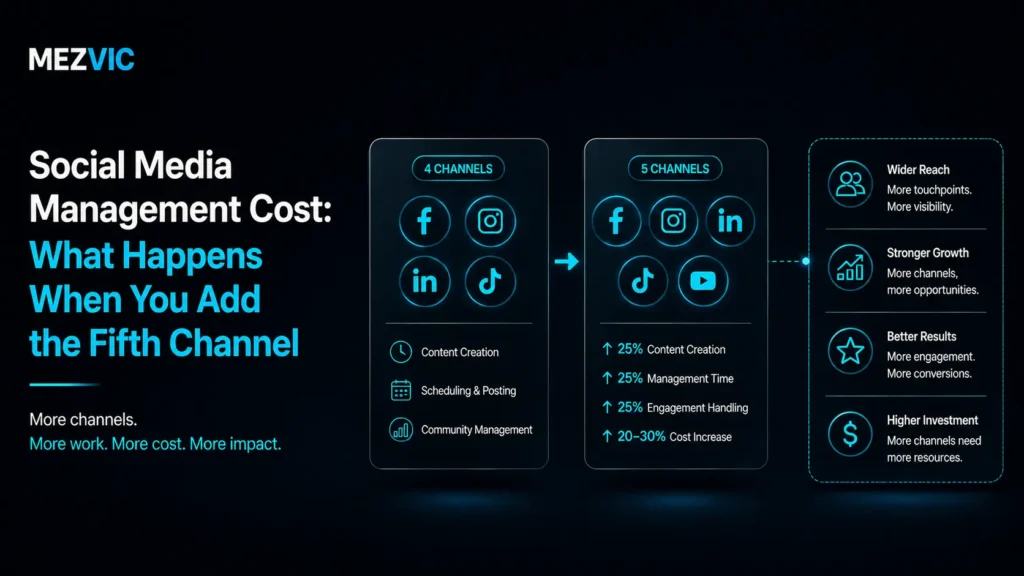
A client asked me to add TikTok to their retainer. They were on Instagram, Facebook, LinkedIn and Pinterest already.
They expected the fifth channel to cost about what the second one did.
It cost three and a half times as much, and the reason has nothing to do with agency greed.
Social media management cost does not rise in a straight line. It rises in steps, and the fifth channel is where the step gets steep.
Below: what each social media management cost tier really buys, why channel five behaves differently to channel two, and the response time standards you should be paying for but probably are not.
Key Takeaways
- Most retainers sit between $1,200 and $6,000 a month, and the number is driven by channel count and native formats far more than by follower count.
- Cost is not linear. On the model below, channel two adds $450 a month and channel five adds $1,650.
- Repurposing is cheap, native adaptation is not. A caption change costs minutes. A vertical video reshoot costs a day.
- Community management is the invisible half of the fee, and the half clients notice immediately when it stops.
- Four channels done properly beat seven done thinly, every time, on every metric that ends in revenue.
- Ask for response time commitments in writing. Most proposals never mention them, and it is the clearest quality signal you can get.
How Much Does Social Media Management Cost?
Social media management cost typically runs from $500 a month for a single channel to $15,000 or more for a full multi channel programme with paid social and community cover.
Most established small and mid sized businesses land between $1,500 and $5,000 for social media management cost.
| Scope | Typical monthly cost | Posting volume | What is usually missing |
|---|---|---|---|
| One channel, scheduled posts | $500 to $1,200 | 8 to 12 posts | Replies, reporting, anything reactive |
| Two to three channels | $1,200 to $3,000 | 16 to 30 posts | Original video, paid management |
| Four to five channels | $3,000 to $6,000 | 40 to 60 posts | Studio production, influencer work |
| Full programme with paid | $6,000 to $15,000 | 60 plus, plus ads | Ad spend itself, which is separate |
| Freelancer, one channel | $400 to $1,500 | Varies wildly | Cover when they are ill or away |
| In-house junior | $2,800 to $4,200 loaded | Everything, badly, or one thing well | Senior direction and design support |
The last column is the useful one. Every social media management cost tier omits something, and the omission is rarely stated.
That in-house row surprises people, because it is rarely compared against a social media management cost properly. A junior on a modest salary costs more than a mid tier agency retainer once you add employer costs, holiday, software and the design help they will need.
It can still be the right call. One person who lives inside your business will always understand it better than an agency does.
What they cannot do is be a designer, a videographer, a copywriter and a paid media buyer at once, which is what most job descriptions quietly ask for. Where that split makes sense is set out on our social media management page.
Why the Fifth Channel Costs More Than the Second
Here is the same social media management cost built up one channel at a time.
What each additional channel adds to the monthly fee
Same brand, same content engine, channels added one at a time. Watch the size of each step rather than the total.
Arithmetic, not a study: $900 + $450 + $600 + $1,100 + $1,650 = $4,700. The fifth channel adds 3.7 times what the second one did.
The second channel is cheap because it borrows. The strategy exists, the content exists, and adapting a square image to a different aspect ratio is a small job.
Channel five is expensive for three reasons that compound.
Selling directly on the platform changes it again, since shop management is a separate discipline to content. It usually needs a native format nothing else produces. It adds another inbox to watch. And it multiplies the number of places a single campaign has to be coordinated, approved and reported on.
That third one is the killer, and it is why the honest answer to “can you just add one more” is usually no.
What You Are Actually Buying Each Month
Most people picture social media management as posting. Posting is the smallest part of any social media management cost.
One content engine, five different outputs
The centre is built once a month. Everything around it has to be made again for each channel, in that channel’s own format.
engine
Community management is the line that gets cut when a client pushes back on social media management cost, because it is the only one with no visible deliverable.
Nobody notices it in month one. They notice it in month four, when a complaint sits unanswered for two days under a post that is doing well. Our guide to building a chatbot that actually sells covers how to triage that first reply without sounding like a machine.
Some of that load can genuinely be lifted with tooling rather than hours, which is what social media automation is for, though it will never handle the conversations that matter.
The Response Times Nobody Puts in the Proposal
Ask any agency what their response times are and watch what happens. Most have never written them down.
These are the bands worth insisting on, and they are the sharpest quality signal in the whole conversation.
What good, acceptable and negligent look like
Business hours, on a normal week. Put these in the contract and the retainer becomes measurable instead of aesthetic.
Band widths are illustrative, not measured. The thresholds are the point, and they belong in your contract.
Google makes the same point about reviews, noting that replies “can show that you’re responsive to your customers” in its guidance on replying to reviews. The same logic applies to every channel.
The direct message row is where money actually leaks.
A DM asking whether you ship to a country, or whether an item is back in stock, is a purchase waiting for an answer. Four hours later it is a purchase from someone else.
If your volume makes that impossible with humans alone, the first hour of triage is exactly the job an AI support layer should be doing before a person picks it up.

Repurposing Versus Native, and Why It Decides the Price
Two words get used interchangeably in proposals, and the difference between them sets most of your social media management cost.
| Job | What it involves | Time per asset | What it looks like to a viewer |
|---|---|---|---|
| Reposting | Same asset, same caption, different account | 2 minutes | Obvious. Performs badly and slowly trains people to scroll past |
| Repurposing | Recrop, rewrite the caption, adjust the hook | 15 to 25 minutes | Fine. Slightly generic but perfectly acceptable |
| Native adaptation | Reshoot or recut for the format, platform specific hook | 1 to 3 hours | Belongs there. This is what actually performs |
| Original per channel | Made only for that platform, nothing shared | Half a day and up | Best possible, and rarely worth it below channel three |
Ask which row your quote assumes. A cheap social media management cost almost always assumes row one or two.
Short form video is why this table now drives social media management cost more than posting volume does.
A still image repurposes across four platforms in under an hour. A vertical video does not repurpose at all, it gets remade, and that is a production cost rather than a social cost.
This is exactly why adding TikTok or Reels to an existing retainer rarely costs what clients expect, and why TikTok work is usually priced on its own rather than folded in.

What Changes Between $800, $2,500 and $6,000 a Month
Social media management cost tiers are easier to judge by what stops being possible, rather than by what gets added.
$800 a month
One channel, roughly seven hours. Posts go out on schedule and look consistent.
What you cannot have at this social media management cost is reactivity. Nobody is watching on a Saturday, nothing gets made in response to something that happened on Tuesday.
It works for a business where social is a proof point rather than a sales channel. A prospective customer checks you exist, sees a tidy recent feed, and moves on to your website.
Judge it on presence, not leads, and it is decent value.
$2,500 a month
Two or three channels, around 23 hours, and the first tier where community management is real rather than aspirational.
Someone reads the comments daily. Content responds to what performed last month. There is enough time for one genuinely native format instead of four repurposed ones.
This is the tier where a social media management cost starts producing traceable enquiries rather than engagement graphs.
What it still cannot absorb is video production at volume. One shoot a quarter, not one a month.
$6,000 a month
Four or five channels, a named team rather than a shared inbox, and same day response as standard.
Native video for the platforms that need it, paid campaigns managed alongside organic, and reporting that connects posts to revenue rather than to reach.
The honest caveat is that this social media management cost only pays back if social is genuinely how your customers find you. Plenty of businesses at this tier would earn more moving half of it into search.
That comparison is worth running properly before you commit a year, and our breakdown of what SEO costs and returns uses the same arithmetic so the two are directly comparable.
How to Choose Which Channels to Drop
Almost every business paying a serious social media management cost is on one channel too many, and it is usually the one nobody wants to admit is dead.
Cutting one channel from a five channel retainer does not save a fifth of the social media management cost. It saves the largest step on that waterfall, which is a much better trade.
Run each channel through four questions, in this order.
- Has it produced a customer in 90 days? Not a follower, not a like. A traceable enquiry or order. If no, it is a brand cost, and brand costs need a separate justification.
- Does it need a format nothing else uses? If yes, it is carrying its own production cost, so the bar for keeping it is higher.
- Would a customer be surprised you are not there? A restaurant with no Instagram looks odd. A B2B manufacturer with no TikTok does not.
- Is anyone actually replying on it? A channel with unanswered comments is worse than no channel. It broadcasts that you are not paying attention.
Two “no” answers and the channel goes into archive mode: profile stays complete and branded, posting stops, replies still monitored weekly.
Archive mode is underrated. It costs almost nothing and it protects the search result for your brand name, which is the same reason a complete Google Business Profile earns its keep, which is the only reason most of those profiles earned their place to begin with.
Where your buyers actually spend their time is a different question by sector, and for anyone selling to businesses it is worth reading our take on B2B social media before adding anything.
Where the Money Goes That Is Not the Retainer
Three costs sit outside the social media management cost and catch people out at the worst moment.
Ad spend is not management. If paid social is in scope, the fee covers building and managing campaigns. The money going to the platform is yours and it is separate, usually a further $500 to $10,000 a month.
Production days are not content. A photo or video shoot is a project, typically $800 to $4,000 a day including editing, and it feeds several months of calendar.
Tooling is small but real. Scheduling, listening and reporting software runs $50 to $400 a month, and someone has to own the subscriptions.
Written assets follow the same pattern, which is why content production is usually cheaper booked in batches than commissioned weekly. The shoot is the one worth planning properly. A single well planned day removes the weekly scramble that quietly inflates every other line, and it is the difference between a calendar and a panic.
If paid sits alongside organic, keep the budgets visibly separate in reporting, or the paid results will quietly take credit for organic work and vice versa.
How to Compare Two Proposals Properly
Two quotes with the same social media management cost can describe completely different amounts of work. Four questions separate them.
- How many hours a month, and who does them? A senior strategist for six hours is a different product to a junior for thirty.
- Which row of the adaptation table applies? Reposting and native adaptation differ by a factor of thirty in time per asset.
- What are the response time commitments? If there are none, community management is not really included whatever the proposal says.
- Who owns the accounts and the content? You should, including the raw video files, and it should be written down.
That last one costs people more than any pricing mistake. Leaving an agency and discovering the raw footage stayed behind is an expensive lesson in contract reading.
The same discipline applies to reporting. Ask to see a real client report with the numbers removed, because a template full of impressions and reach tells you exactly how the agency measures success.
Where that click lands matters as much as the post, so treat landing page work as part of the same budget. Social rarely converts on the first click, so agree upfront how attribution will be handled, the same way you would for any paid social programme.
The Four Numbers a Monthly Report Should Lead With
Most social reports open with reach and impressions, because those numbers are always up and nobody has to explain them.
They tell you almost nothing about whether the social media management cost was worth paying.
Ask for these four instead, and ask for them in this order.
- Enquiries or orders attributed to social. Imperfect, always undercounted, still the only number that matters. Agree the method once and keep it consistent.
- Saves and shares, not likes. A like is a reflex. A save is someone planning to come back, and it predicts revenue far better.
- Median response time, not average. One weekend of silence hides inside an average. The median tells you what a normal customer experienced.
- What changed because of last month. If the plan is identical to last month, nobody read the data, and you are paying for production rather than management.
The fourth one is the real test. Management means decisions, and a report with no decision in it is a receipt.
A useful habit: ask what they stopped doing this month. Good teams always have an answer, because time is fixed and something had to give.
Frequently Asked Questions
How much does social media management cost per month?
Most businesses pay between $1,200 and $6,000 a month. One channel with scheduled posts starts around $500, while a four to five channel programme with community management usually runs $3,000 to $6,000.
Why do agencies charge more for extra channels?
Because each channel needs its own native format, its own inbox monitored, and coordination across everything else. The work multiplies rather than adding, which is why the fifth channel costs far more than the second.
Is a freelancer cheaper than an agency?
Usually yes, at $400 to $1,500 a month for one channel. You trade cost for cover, since a freelancer on holiday means nobody is watching your comments that week.
Should I hire in-house instead?
It makes sense once social is central to how you sell. A loaded junior salary of $2,800 to $4,200 a month buys deep product knowledge but not design, video and paid buying, which you will still need to source.
Does ad spend come out of the management fee?
No. The fee covers building and managing campaigns, and the money paid to the platform is separate. Confirm this in writing, because it is the most common misunderstanding in social proposals.
How many posts per month should I expect?
Roughly 8 to 12 per channel per month at typical budgets. Volume matters far less than consistency and native formatting, and doubling posts on a thin budget usually lowers results.
What is community management and is it included?
It is replying to comments, messages and complaints. It is often listed but rarely defined, so ask for response time commitments in hours or assume it is not really covered.
How long before social media management shows results?
Engagement shifts within 4 to 8 weeks, and traceable revenue usually takes 3 to 6 months. Judge the first quarter on consistency and audience quality rather than sales.
Is it cheaper to be on fewer channels?
Much cheaper, and usually more effective. Dropping one channel from five removes the most expensive step in the whole retainer, not a fifth of the total.
What should be in a social media management contract?
Channels covered, posts per channel, adaptation level, response time commitments, reporting frequency, and ownership of accounts and raw files. Anything missing from that list is a future argument.
Do I need a separate video budget?
If short form video matters to your channels, yes. Production days run $800 to $4,000 including editing, and one planned day typically feeds two or three months of calendar.
What is a realistic social media management cost for a small local business?
Between $600 and $1,500 a month for one or two channels done consistently, with replies handled. That is a better outcome than spreading the same budget across four channels.
The Bottom Line
Social media management cost is decided by channel count, format demands and whether anyone is genuinely answering your customers.
Set it against everything else in your marketing mix before you commit. Adding channels feels like progress and usually is not. Four done properly will beat seven done thinly on every measure that reaches your bank account.
Before you approve any proposal, get the response times in writing and find out which row of the adaptation table you are buying.
If you want a scope that says which channels are worth keeping and which should go into archive mode, tell us where you are posting now and we will tell you what we would cut.