A manufacturing client once showed me their social calendar. Four posts a week on Instagram, beautifully shot, reasonable engagement.
Their average deal was $180,000 and their buyers were procurement managers at engineering firms.
Not one of those buyers had ever seen the Instagram account. Several of them were active in a trade forum nobody at the company had heard of.
That gap is the whole problem with B2B social media strategy. Effort follows what is easy to measure, not where the decision actually happens.
Below: how a B2B social media strategy should follow the buyers rather than the dashboard, where the effort actually goes, how the platforms genuinely compare for business buying, and what to post across a sales cycle that runs for a year.
Key Takeaways
- Effort and audience are usually inverted. Most B2B brands post hardest where their buyers rank lowest.
- One platform done properly beats five done thinly, and for most B2B that platform is LinkedIn plus wherever your industry already argues with itself.
- You are selling to a committee, not a person. Six to ten people research separately and compare notes, so your content has to survive being forwarded.
- Most of the buying cycle happens before contact. Social does its work in months one to eight, and sales attention arrives around month ten.
- Saves and shares beat likes as a signal. A post forwarded into a private channel is worth more than a hundred public reactions.
- Employee accounts outperform the brand account, consistently, and most companies do nothing to support them.
Where the Effort Goes Versus Where the Buyers Are
Any B2B social media strategy should start by ranking the platforms twice. Once by how much most B2B companies post there, and once by where their buyers actually research.
The lines cross badly.
Effort ranking against buyer ranking
Left is where the posting hours go. Right is where a business buyer goes to work out what to buy. Follow each line across.
The red line is the expensive part of most a B2B social media strategy. It is usually also the prettiest account, which is exactly why it survives budget reviews.
Instagram is not useless for B2B. It works for employer brand, recruitment and industries where the product is visual. It rarely works for the purchase itself.
The green line at the bottom is the interesting one. Industry forums, trade communities and the odd Slack group are where buyers ask each other what actually works.
Almost nobody staffs those, because you cannot report on them in a dashboard and you cannot post a carousel into them.
Before rebalancing anything, work out what a channel is currently costing you. Our breakdown of what social media management costs shows why dropping one channel saves more than a fifth of the fee.

How the Platforms Actually Compare
Reach is the wrong axis for a B2B social media strategy. Five things matter more when the purchase takes a year and involves a committee.
LinkedIn against Instagram for business buying
Instagram wins on cost efficiency and nothing else that decides a purchase. That is the trade you are making.
Longevity means how long a post keeps working. Intent signals means whether the platform tells you somebody is in market.
Cost efficiency is the axis that wins arguments internally and loses money quietly.
Reaching a thousand people for a fifth of the price is only good value if any of them can sign a purchase order.
Longevity is the axis nobody scores. A LinkedIn post keeps surfacing for weeks and a thoughtful comment thread can be found months later. A story is gone in a day.
For long consideration purchases, longevity is worth more than reach, because your buyer is not in market on the day you post. They are in market four months later.
That same logic is why search matters so much in B2B, and why a strong B2B SEO programme usually outperforms social on tracked revenue while social does the work nobody attributes.
The Cycle Your Content Has to Cover
B2B purchases run long, and mapping the stages explains why so much of a B2B social media strategy feels like it produces nothing.
Fourteen months from problem to signature
Social does its work on the left. Sales attention lands on the right. The gap between them is why attribution arguments never end.
The overlap between the two shaded bars is zero. That is the entire attribution problem in one picture.
Look at where the two shaded bars sit. They do not touch.
By the time somebody fills in a form, the work that put you on the list happened eight months earlier, and no reporting tool will connect the two.
This is why B2B social gets cut. It is judged on last click, and it never touches the last click.
The practical fix is not better attribution software. It is a single question on every enquiry form: how did you first hear about us? The answers will not be tidy and they will be more honest than your dashboard.

What to Post at Each Stage
A B2B social media strategy has to cover five stages, and each needs different things. Posting the same product content across all fourteen months is why most calendars feel repetitive.
| Stage | What they are doing | What to post | What fails here |
|---|---|---|---|
| Problem unaware | Living with an inefficiency they accept as normal | Name the problem and quantify it | Anything mentioning your product |
| Passive research | Reading, lurking, forming opinions quietly | How it works, honest trade-offs, teardowns | Gated content and demo requests |
| Active evaluation | Comparing three or four options seriously | Comparisons, pricing logic, implementation reality | Vague claims about being different |
| Shortlist | Building an internal case for one option | Proof, case studies, risk answers | Thought leadership. It is far too late |
| Decision | Getting sign off and de-risking the choice | Onboarding detail, support model, references | Anything that adds a new consideration |
The fourth column is the useful one. Right content at the wrong stage reads as noise, however good it is.
The shortlist row catches most companies out.
By that point your champion is not trying to be convinced. They are trying to convince a finance director who has never heard of you, using whatever material they can forward.
Give them something forwardable. A one page cost comparison beats a beautiful video, because the video cannot be pasted into an internal email with “thoughts?” above it.
That is the single most useful reframing in B2B social media strategy: you are not writing to persuade a reader, you are arming an advocate you will never meet.

Why Employee Accounts Beat the Brand Account
This is the least controversial finding in any B2B social media strategy, and the least acted upon.
People follow people. A post from your head of engineering explaining why a common approach fails will outperform the same point from the company page, every time.
Three reasons, and only one of them is about the algorithm.
- A person can have an opinion. Brand accounts are edited into neutrality, and neutral content is unmemorable by construction.
- A person can reply as themselves. The comment thread under an individual’s post is a conversation. Under a brand post it is a support queue.
- Buyers check the person, not the page. Before a first call they look up who they are meeting, not the company’s follower count.
Most companies respond to this by writing posts for executives to publish, which produces the neutrality problem again in a different font.
What works better is removing friction rather than adding ghostwriting. Give people the data, the screenshots and the permission to be specific, then let them write badly in their own voice.
Badly and specifically beats polished and vague in this market. It always has.
Where automation genuinely helps is the drafting and scheduling around that, not the voice itself, and we set out that line in our guide to automation that does not sound automated.
The Two Channels Rule
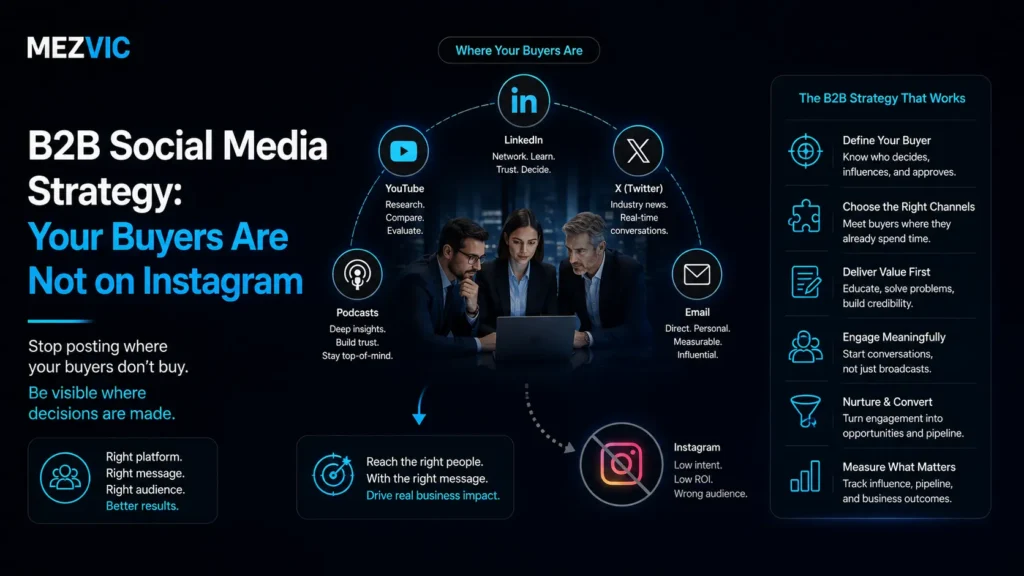
A B2B social media strategy needs exactly two channels. One where your buyers are professionally, one where they are honestly.
The professional channel is almost always LinkedIn, which describes itself as “the world’s largest professional network with more than 1 billion members”. Scale is not the reason to use it, though. Job titles are.
No other platform lets you know that the person reading is a plant manager at a company with 400 staff. That single fact is what makes a B2B social media strategy targetable at all.
The honest channel is harder to find and worth more. It is wherever your buyers complain to each other without a supplier listening.
A subreddit, a trade association forum, a WhatsApp group, an industry Slack, a conference mailing list that never quite died. Every sector has one.
You cannot market in that second channel, and attempting to will end badly. You can be useful in it, under a real name, answering questions with no link attached.
That sounds inefficient until a shortlist forms and someone says “ask the person from X, they know about this”. That sentence is worth more than a quarter of posting.
Everything else goes into archive mode: profile complete, branded, monitored weekly, not posted to. It costs almost nothing and keeps your brand search results tidy.
What a Written Strategy Should Actually Say
Most documents called a B2B social media strategy are a posting schedule with a mission statement stapled to the front.
A useful one answers six questions on a single page.
- Who signs, who influences, who blocks. Three different people with three different fears. Most content only addresses the first.
- The two channels, and why. Named, with the evidence from customer conversations rather than from a benchmark report.
- What we will say that competitors will not. If every line could appear on a competitor’s page, the strategy has no content in it.
- Who posts personally, and what support they get. Named individuals, not “the team”.
- What we measure, given a twelve month cycle. Decide this before results arrive, or last click will decide it for you.
- What we have stopped doing. A strategy with no subtraction in it is a wish list.
The third question is the one that separates real work from filler. “We help businesses grow through innovative solutions” is a sentence any competitor could publish, which makes it worthless.
Specific beats safe. Publishing your pricing logic, naming the situations where you are the wrong choice, or explaining a failure honestly all outperform generic authority content.
A good B2B social media strategy document fits on one page and makes at least one person in the room slightly uncomfortable.
Content that answers a real buying question also tends to rank, which is why the same document usually feeds a content programme rather than sitting alongside one.
Three Objections Worth Answering
These come up whenever a B2B social media strategy gets rebalanced, and all three have honest answers.
“Our competitors are all on Instagram.” They are, and most of them cannot attribute a single order to it either. Copying a competitor’s channel mix copies their assumptions, not their results.
“Our engagement rate is good.” Engagement rate measures whether the people who already follow you enjoy your posts. It says nothing about whether any of them can buy.
“Leadership wants to see growth.” Then give them a number that moves and matters: profile visits from target companies, or enquiries citing social in the source question.
That third one is worth solving properly rather than arguing about. Agreeing the measure before the quarter starts removes the annual fight about whether social is working.
If the honest answer turns out to be that your buyers found you through search, that is useful information rather than a defeat, and it should move budget accordingly. Our comparison of what SEO costs and returns uses the same arithmetic so the two are directly comparable.
Where social does justify paid support, keep it targeted at named accounts rather than broad audiences, which is closer to paid media discipline than to organic posting.
And make sure enquiries from either route land somewhere accountable. A CRM with a source field answers the attribution question better than any social dashboard will.
How to Rebalance Without Blowing Everything Up
Rebalancing a B2B social media strategy does not mean deleting the Instagram account. You need to move hours, and to move them in a way you can defend in a meeting.
Ask twenty customers where they looked. Not a survey, twenty conversations. This takes a week and produces better channel data than any tool.
Put the weakest channel into archive mode. Profile stays branded and complete, posting stops, replies still monitored weekly. It costs almost nothing and protects your brand search results.
Move those hours into one place your buyers named. Usually LinkedIn, occasionally a forum, sometimes a newsletter that is not social at all.
Support three employees properly for one quarter. Data, permission, and fifteen minutes a week of help. Compare their combined reach to the brand account after ninety days.
That last experiment is the one that changes minds internally, because the numbers are usually not close.
Where a channel genuinely earns paid support, treat it as its own line with its own targets rather than folding it into organic. That is the argument on our paid social page.
And if the answer to “where did you look” turns out to be Google rather than any social platform, believe them. It frequently is, which is why a B2B social programme works best alongside search rather than instead of it.
Where Social Hands Off
Social rarely closes anything in B2B. It gets you onto a list, and then something else has to catch the interest.
That handoff is where most programmes leak, and it is usually nobody’s job to fix.
A buyer who reads three of your posts and then visits the site lands on a page written for a different audience entirely. Getting that page right is conversion work, not social work, and it decides whether any of the posting mattered.
Then there is the gap between interest and readiness. Someone in month four is not going to book a call, but they will read something useful if you send it, which is what a slow nurture sequence is for.
The same triggered logic applies as anywhere else, and our guide to the nine workflows worth building covers how to set that up without it feeling automated.
Capturing the enquiry properly matters more than capturing it quickly. A form that asks how they first heard about you is worth more to a B2B social media strategy than any dashboard, and routing it automatically means nobody has to remember to check.
For a sense of what this looks like end to end on a considered purchase, the Vessel International case study covers a long cycle B2B build and the search work around it.
And where you do want to reach a named account directly rather than wait, that is a job for paid search against the terms they use when the problem finally becomes urgent.
Frequently Asked Questions
Which platform is best for B2B social media?
LinkedIn for most businesses, plus whichever industry community your buyers already use. The second one is usually a forum or trade group nobody in marketing has heard of.
Is Instagram useless for B2B?
Not useless, just misapplied. It works for employer brand, recruitment and visually distinctive products, and it rarely influences a considered purchase with a buying committee.
How often should a B2B company post?
Two to three times a week on one platform, done properly, beats daily posting spread thin. Consistency matters more than volume when the buying cycle runs for a year.
How do you measure B2B social media?
Saves, shares and profile visits from target companies, plus a self reported source question on your enquiry form. Last click attribution will always undercount social in long cycles.
Should employees post instead of the company page?
Both, but weight the effort towards employees. Individual accounts get more reach and more genuine replies, and buyers check the person before the company.
How long before B2B social produces leads?
Six to twelve months for traceable enquiries, because that is how long the buying cycle takes. Judge the first two quarters on the right people engaging, not on form fills.
What should a B2B social media strategy actually contain?
Named buyer roles, the two channels they use, content mapped to each buying stage, who posts personally, and how you will measure influence rather than last click.
Does thought leadership content work?
Early in the cycle, yes. At shortlist stage it actively hurts, because your champion needs proof and pricing to forward internally, not opinion.
Should B2B companies use TikTok?
Only for recruitment or if your buyers are genuinely younger operators rather than procurement. For most B2B it is a production cost with no path to the buying committee.
How many people are involved in a B2B purchase?
Typically six to ten for a significant purchase, researching separately and comparing notes. Your content has to make sense to a technical evaluator and a finance approver.
Is paid social worth it for B2B?
Yes for targeting precision, no as a lead machine. Use it to put specific content in front of named accounts rather than to generate form fills at volume.
What is the biggest mistake in B2B social media strategy?
Posting where measurement is easy rather than where buyers are, then judging the result on last click and cutting the channel that was actually working.
The Bottom Line
Build your B2B social media strategy by ranking channels twice, once by effort and once by where buyers told you they looked. If the lines cross, you have your answer.
Then write for the committee rather than the reader, and make everything forwardable enough to survive an internal email.
Support three people to post as themselves for a quarter, and compare the result to the brand page. That single experiment settles more debates than any framework.
If you want the channel audit done properly against your real customers rather than assumptions, tell us who you sell to and we will start with the twenty conversations.