You spent $4,800 on leads last month and closed two deals.
Your CRM says 61 of those leads were contacted once and never again.
Nobody decided to abandon them. They arrived at 11pm, or during a showing, or on the Saturday somebody was off, and the moment passed.
We build these systems for agents and brokerages, and the pattern barely varies. The problem is almost never the script. It is that the follow-up depends on a human being free at a moment nobody can schedule.
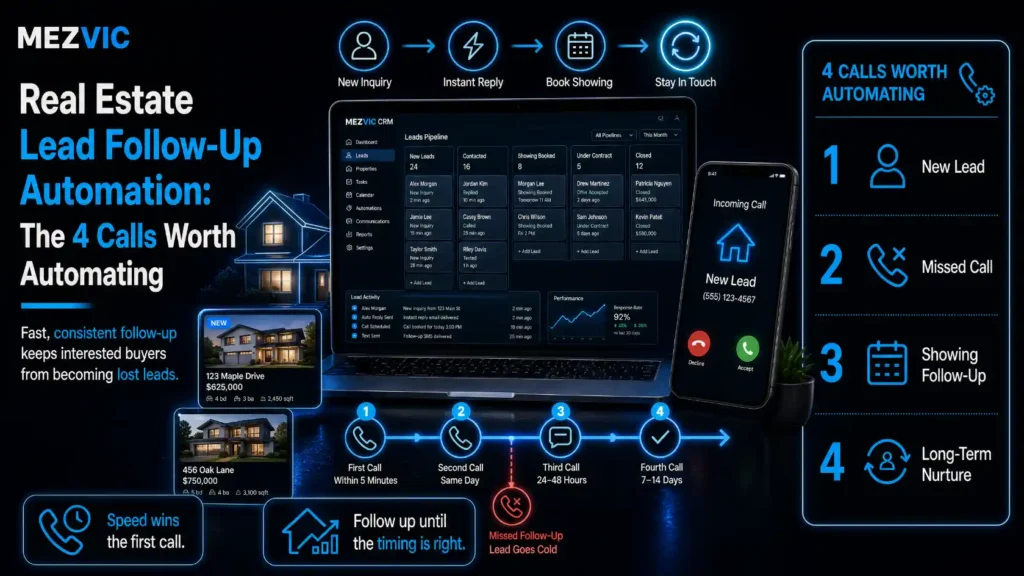
Four touches are worth automating. There is also a legal line running straight through the middle of them, and it moves the moment a machine does the contacting. If you are still choosing the system underneath, start with the CRM comparison.
Key Takeaways
- Real estate lead follow-up fails on timing and persistence, not on wording. Most leads are lost to a moment nobody was free for.
- The FTC treats calling before 8am or after 9pm as an abusive practice. That leaves a 13-hour legal window, so 45.8% of the day is closed to calling.
- An inbound enquiry creates an established business relationship lasting three months, which lets you call a prospect whose number is on the National Do Not Call Registry.
- A past client relationship lasts 18 months from the last payment or transaction.
- You must scrub against the Registry and update your lists at least every 31 days. Making covered calls without accessing the Registry is itself a violation.
- Penalties run to $53,088 per violation, which is per call, not per campaign.
- Automating changes the legal category. A prerecorded or AI-voice telemarketing call needs prior written consent under FCC rules.
- Autodialed or prerecorded calls and texts to a wireless number need oral or written consent. Commercial texts need written consent.
- Those FCC text rules apply even if the number is not on the Do Not Call Registry.
- So automate the scheduling and the drafting. Keep a human on the dial unless you hold documented consent.
- Leads arriving overnight face an average 5.5-hour forced wait before a call is legal. Email covers that gap; a queued call closes it at 8am.
- Hold every downstream rate constant and doubling the contact rate doubles the deals, which halves cost per deal from $1,600 to $800.
- The 90-day touch exists because the enquiry-based relationship has expired by then, so that message needs a different basis to send.
Why Do Most Real Estate Leads Never Get a Second Contact?
Because the second contact is nobody’s job at a specific time.
The first one usually happens. A lead lands, somebody sees the notification, they call. That part works.
The second contact is supposed to happen two days later, when the agent is at an inspection and the lead has already spoken to two other people.
So it does not happen, and nobody notices, because there is no report for work that was never scheduled. This is the same failure that breaks agency workflows at around ten clients, and it has the same fix.
Then there is the part of the day you are not allowed to use.
What Does the Law Actually Let You Automate?
Less than most follow-up software implies, and the line moves depending on who is doing the dialling.
Start with the hours. The FTC’s Telemarketing Sales Rule treats calling outside a fixed window as an abusive practice.
Nearly half the day is closed to calling
The 8am to 9pm restriction, drawn on a 24-hour dial.
Hours from the FTC Telemarketing Sales Rule. State rules can be narrower, never wider.
That is the shape of the constraint. Thirteen hours open, eleven closed.
Which matters more than it sounds, because leads do not arrive politely inside business hours. Somebody browsing listings at 11pm is often the most motivated person in your pipeline that week.
The second rule is the one that catches people out, and it is genuinely good news.
So the inbound lead who filled in your form is callable, even if they are registered. That is the legal basis for almost everything in real estate lead follow-up, and it is worth confirming with your own counsel before you build on it.
It expires, though, and the expiry date is the reason the fourth touch in this sequence is built differently from the first three.
You still have to scrub. Sellers must delete registered numbers from their lists at least every 31 days, and making covered calls without having accessed the Registry is itself a violation.
Now the part that most follow-up articles skip entirely.
Automating a call does not just make it faster. It changes what kind of call it is.
Read that against the phrase “AI voice agent” and the implication is immediate. A recorded or synthetic voice making a telemarketing call needs written consent first. Regulated industries face a stricter version of the same problem, which we covered in the HIPAA rules for voice agents.
The rules for wireless numbers and texts are tighter again.
What each kind of contact needs before it goes out
| Contact | What the rules require | Practical reading |
|---|---|---|
| Human dials, live conversation | Enquiry or past-transaction relationship, inside 8am to 9pm | The safest touch you have. Automate the reminder, not the dial |
| Prerecorded or AI-voice call | Prior written consent | Do not run this on bought leads |
| Autodialed call to a mobile | Oral or written consent | Most real estate leads are mobile numbers |
| Commercial text | Written consent | Applies even if the number is not on the Registry |
| Informational text | Consent may be oral | An appointment confirmation is not an advert |
| Outside these telephone rules | Which is why it carries the overnight gap |
Rules summarised from the FTC and FCC pages linked at the end. This is an operational guide, not legal advice, and state rules can be stricter.
The bottom row is doing most of the work in the design that follows.
Call #1: The Instant Acknowledgement
Automate this one completely. It is email, and it goes out in under a minute.
Not because email is better than a phone call. Because at 11:40pm it is the only thing you are allowed to send, and the alternative is silence until morning.
It has one job: confirm a human is now involved and name the time they will call. The same sequencing principles apply here as anywhere else, and we set them out in full in our email sequence guide.
Naming the time is the part people leave out, and it is the part that works. “Someone will be in touch shortly” commits to nothing. “I will call you at 8:15am” is a promise the lead can hold you to, which is exactly why it stops them filling in the next form.
Three things belong in it and nothing else.
- The specific property or search they enquired about, quoted back. This proves it is not a blast.
- A named person and a stated call time, inside the legal window.
- One question they can reply to. A reply turns a cold lead into a conversation before anyone has dialled.

Call #2: The Morning Callback
This is a real phone call, made by a person, and the automation’s only job is to make sure it happens.
The system creates the task, attaches the enquiry, sets the time inside the legal window, and escalates if it is not completed. That is all. A connector platform handles this comfortably, and our Zapier automation examples cover the task-creation pattern.
Do not put a synthetic voice on this call. A prerecorded or AI voice making a telemarketing call needs prior written consent, and an inbound lead form is not that unless you built it to be.
The overnight arithmetic decides when it fires.
Where the night shift piles up
Eight arrival times against the four touches, with the legal window applied.
Offsets used: email at 2 minutes, callback at 30 minutes, day-three call shifted 6 hours to vary the hour, day-90 email. Times computed, not illustrative.
Notice what the grid does to the night arrivals. Everything between 9pm and 8am collapses onto the same 8am slot.
That is a queue, and if you take fifty leads a week it is a queue with a rush hour. Staff the first hour of the day accordingly, because that is where your most motivated leads are waiting.

Call #3: The Day-Three Check-In
The touch that almost nobody makes, which is why it works.
By day three the lead has spoken to other agents, or to nobody, and either way the situation has changed since your first conversation. That is the honest reason to make contact, and it should be the actual content of the message.
Automate the trigger and the draft. Keep the send manual, because this message needs to reference whatever happened on the first call.
A useful rule: if the first call connected, this one is about the specific thing they said. If it did not connect, it is a second attempt at a different hour of the day. Branching this cleanly is where a visual builder earns its place, which is what our Make.com scenarios guide is about.
Different hour matters. Calling at 10am on Tuesday and 10am on Thursday is one attempt made twice. Somebody unreachable at 10am is often reachable at 6pm, and the legal window runs to 9pm.
Call #4: The Ninety-Day Re-Engagement
This one is built differently, and the reason is legal rather than editorial.
The relationship created by their enquiry lasts three months. At ninety days it has expired, so if that person is on the Do Not Call Registry, the exemption you were relying on is gone.
Which leaves two honest options.
- Make it an email touch, which sits outside the telephone rules entirely and needs no exemption.
- Get consent before day ninety, in writing, and log where and when it was given.
Most teams should pick the first and stop worrying about it. Our roundup of nine email automation workflows includes a re-engagement sequence you can lift for this.
Ninety days is also roughly when a buyer who was not ready becomes a buyer who is, so the message writes itself: their search, what has changed in it, and an offer to pick it back up.

What Does Better Follow-Up Actually Change?
The contact rate, and nothing else. That is the whole mechanism, and it is worth being precise about it.
Follow-up automation does not make your pitch better or your leads warmer. It reaches more of the real estate leads you already paid for, which is the same argument we make for automation across a business.
Only one number changed, and deals doubled
The same 100 paid leads at two different contact rates.
Illustrative model with the downstream rates deliberately fixed. Run it with your own contact rate before believing the size of the gap.
The assumption doing the work in that diagram is deliberately conservative: every downstream rate is held identical between the two scenarios.
Same appointment rate per contact. Same close rate per appointment. The only thing that moved is how many of the hundred leads were reached at all.
Double the contact rate, double the deals, halve the cost per deal. No cleverness required.
The honest caveat is that contact rate has a ceiling. Some numbers are wrong, some people filled the form by accident, and some were never going to answer.
Eighty percent is a realistic contact rate target for inbound enquiries. Chasing the last twenty costs more than it returns, and it is also where the compliance risk lives. If your lead volume comes from a calculator or quote tool, the gating decision changes these numbers too.
Which Follow-Up Should You Never Automate?
Anything where being wrong is worse than being slow.
Automate the scheduling, not the judgment
| Moment | Automate | Why |
|---|---|---|
| Acknowledging a new enquiry | Fully | Speed is the entire value and the content is predictable |
| Scheduling the callback | Fully | A task with a time is exactly what software is for |
| Appointment confirmations and reminders | Fully | Informational rather than promotional, and reduces no-shows |
| Drafting the day-three message | Draft only | It must reference the first conversation |
| An offer, a counter, or anything about price | Never | The stakes are the largest purchase of their life |
| Anything after a complaint | Never | An automated cheerful follow-up after a bad experience is worse than silence |
| Contacting somebody who asked you to stop | Never, and suppress everywhere | Interfering with a do-not-call request is itself a violation |
The last row needs to propagate across every system you own, not just the one that received the request.
That final row is where multi-tool setups fail.
Somebody unsubscribes in the email platform, and the dialler never hears about it. Nine days later they get a call. The opt-out has to be a single record every system reads, not a flag in whichever tool happened to receive it. Whichever platform you pick from n8n, Zapier or Make, this is the piece to build first.
How Do You Know Your Real Estate Lead Follow-Up Is Working?
Four numbers, and none of them is open rate.
- Contact rate. Share of leads reached by a human at least once. This is the number the whole system exists to move.
- Time to first human contact. Measured from enquiry, not from the start of business hours, or you will hide the overnight queue from yourself.
- Attempts per lead before contact. If it is one, you do not have a sequence, you have a notification.
- Suppression accuracy. Count of contacts sent to anyone on the suppression list. The only acceptable value is zero.
Review the first three monthly. Alert on the fourth immediately, because it is the one that is not a performance problem. Costing the work per lead rather than per hour makes the case obvious, in the same way cost per support ticket does for service teams.
Frequently Asked Questions
What is real estate lead follow-up automation?
It is using software to guarantee that each planned contact with a lead actually happens on time. In practice that means automating the acknowledgement, the scheduling and the drafting, while a person still makes the calls that require judgment.
What hours can you legally call a real estate lead?
The FTC treats calling before 8am or after 9pm as an abusive practice under the Telemarketing Sales Rule, which leaves a 13-hour window. Some states impose narrower hours, so check your own before setting the schedule.
Can you call a lead whose number is on the Do Not Call Registry?
Yes, if you have an established business relationship. An enquiry or application creates one lasting three months from the date of the enquiry, and a purchase or transaction creates one lasting 18 months from the last payment.
How often do you have to scrub against the Do Not Call Registry?
At least every 31 days. Sellers and telemarketers must delete all numbers in the National Do Not Call Registry from their lists on that cycle, and making covered calls without having accessed the Registry is itself a violation.
What is the penalty for a Do Not Call violation?
Civil penalties run up to $53,088 for each violation, plus injunctive remedies. Because it is assessed per call rather than per campaign, a single misconfigured sequence can produce a very large number quickly.
Can you use an AI voice agent to call real estate leads?
Only with prior written consent. FCC rules require written consent, on paper or electronically, before a prerecorded or artificial-voice telemarketing call is made to a home or wireless number, and a standard lead form does not provide that unless it was written to.
Do you need consent to text a real estate lead?
For commercial texts sent with an autodialer, yes, and it must be written consent. Informational texts such as an appointment confirmation can rely on oral consent. These rules apply even if the number is not on the Do Not Call Registry.
How fast should you respond to a new property enquiry?
Immediately by email, then by phone at the first legal opportunity. Leads arriving overnight face an average forced wait of about five and a half hours before a call is permitted, so the email is what holds the lead until 8am.
How many follow-up attempts should a real estate lead get?
Enough to vary the hour of day, which usually means four to six across the first two weeks. One attempt is a notification rather than a sequence, and repeating the same time slot is one attempt made repeatedly.
Does follow-up automation improve conversion rates?
It improves contact rate, which produces more deals from the same spend even when conversion rates stay identical. Hold every downstream rate constant and doubling contact rate doubles closings, halving cost per deal.
What should never be automated in real estate lead follow-up?
Anything involving price, an offer, or a response after a complaint, plus any contact with someone who asked you to stop. Automate scheduling, acknowledgements and reminders, and keep judgment with a person.
Why does the ninety-day follow-up need different handling?
Because the relationship created by their enquiry lasts three months. Once it expires, a registered number can no longer be called on that basis, so the ninety-day touch should be email unless you captured written consent earlier.
Next Steps
Three things, and the first one is not the sequence.
First, build the single suppression list and make every channel check it. Do this before you automate anything that sends.
Second, measure your real contact rate for last month. Not response rate. The share of paid leads a human actually spoke to.
Third, automate the acknowledgement email and the morning callback task. Those two alone close most of the overnight gap, and they are the cheapest real estate lead follow-up improvement available. If the CRM itself is the obstacle, our GoHighLevel setup guide walks through the configuration.
Both source documents are worth reading before you configure anything: the FTC’s guide to complying with the Telemarketing Sales Rule and the FCC’s page on robocalls and texts.
If you want the sequence built and the suppression logic done properly, tell us which CRM you are on and we will map it against these rules.