Your best new customer just called your business. No one picked up.
So they called your competitor instead, booked with them, and that sale is gone for good. You never even knew it happened.
Missed calls are one of the quietest profit leaks in small business. AI voice agents for small business exist to plug that leak, answering every call in a natural voice, day or night.
This guide covers how AI voice agents work, what they actually replace, what they cost, and how to tell whether one fits your business in 2026.
Key Takeaways
- AI voice agents for small business answer every call in a natural voice, 24/7, so no lead goes to voicemail.
- They replace repetitive phone work: booking, qualifying, FAQs, and after hours calls.
- They do not replace empathy, negotiation, or judgment, so keep a human handoff.
- Cost is usually a low monthly fee, recovered by a single saved booking a week.
- The build and integrations matter more than the platform brand.

What Are AI Voice Agents for Small Business?
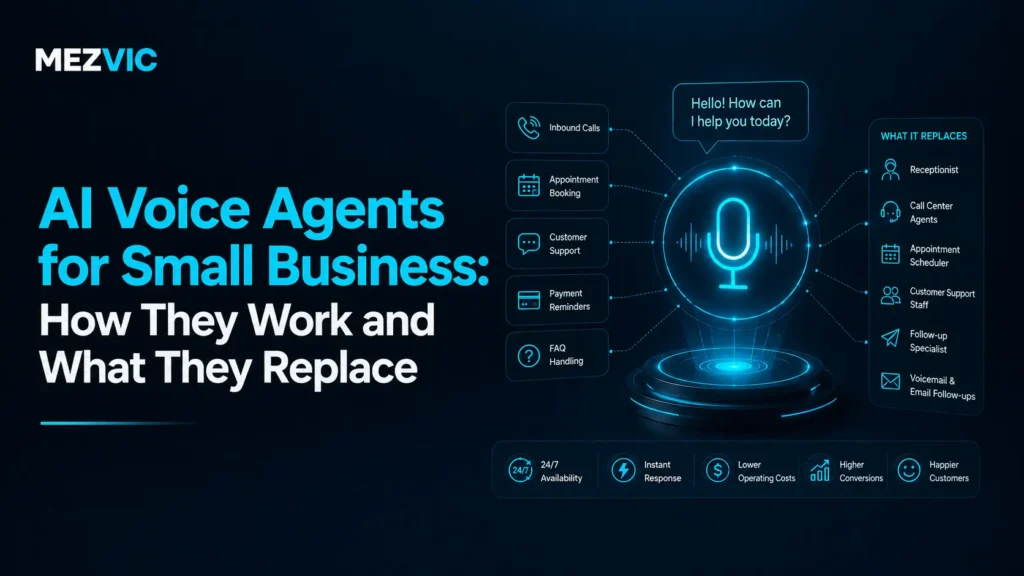
An AI voice agent is software that answers phone calls and holds a natural, spoken conversation with the caller. It listens, understands, replies, and takes action like booking an appointment or capturing a lead.
Think of it as a receptionist that never sleeps, never calls in sick, and picks up on the first ring every time.
Unlike the clunky phone menus you hate (“press 1 for sales”), a modern AI voice agent talks like a person. Callers can just say what they need in plain language.
How AI Voice Agents Work
AI voice agents work by turning speech into text, using an AI model to understand and respond, then turning that response back into a natural voice, all in real time. The whole loop happens in under a second.
Under the hood, four things happen on every call:
- Speech to text. The agent transcribes what the caller says as they say it.
- Understanding. A language model works out the caller’s intent and pulls the right information.
- Action. It books the slot, answers the question, or logs the lead in your CRM.
- Text to speech. It replies in a warm, human sounding voice.
The best systems connect straight to your calendar, your CRM, and your knowledge base. That is where an AI automation partner earns their keep, wiring the agent into the tools you already run.
What AI Voice Agents Actually Replace
AI voice agents replace the repetitive, high volume phone work that eats your team’s day, not the skilled or sensitive conversations that need a human.
Here is what they take off your plate:
- Missed and after hours calls. Every ring gets answered, including nights and weekends.
- Appointment booking. The agent checks your calendar and books the caller in.
- Lead qualification. It asks your qualifying questions and routes hot leads to you.
- FAQ answering. Hours, pricing, location, and services, handled instantly.
- Overflow reception. It catches calls when your team is already on the line.
What they do not replace: empathy, negotiation, and judgment. A voice agent should never handle a grieving client, a tricky complaint, or a high stakes sale on its own.
Hours your phone is actually answered each week
A receptionist covers business hours. An agent covers the whole week, including the evenings and weekends when people call and give up.
Straight arithmetic, not a study: 168 is every hour in a week, 40 is a standard business week. The gap is where most missed calls live.
AI Voice Agents vs. Human Receptionists vs. Chatbots
An AI voice agent handles spoken phone calls at scale for a flat cost, a human excels at nuance, and a chatbot only helps the people already on your website. Most small businesses end up using a mix.
| Factor | AI voice agent | Human receptionist | Chatbot |
|---|---|---|---|
| Channel | Phone calls | Phone and in person | Website and text |
| Availability | 24/7 | Business hours | 24/7 |
| Handles call volume | Unlimited at once | One at a time | Not phone based |
| Monthly cost | Low and flat | Highest | Low |
| Best at | Booking and qualifying | Empathy and nuance | On site questions |
If most of your leads come through the phone, a voice agent wins. If they come through your site, pair it with an AI chatbot so no channel goes unanswered.

Where AI Voice Agents for Small Business Work Best
AI voice agents shine in any business where a missed call means a missed booking. A few clear winners stand out.
Real estate
Buyers call about a listing the moment they see it. An agent qualifies them and books a viewing before they move on. This is why AI voice agents for real estate convert so well.
Clinics and healthcare
Front desks drown in scheduling and reminder calls. Purpose built AI voice agents for healthcare handle intake and appointments so staff can focus on patients.
Home services and trades
Plumbers, electricians, and HVAC crews are on a job with their hands full. The agent captures the emergency call they would have missed and books it in.
Salons, spas, and local services
When your hands are literally busy with a client, the phone still rings. A voice agent keeps the calendar full without interrupting the work in front of you.
How Much Do AI Voice Agents Cost?
Most small business AI voice agents cost a setup fee plus a monthly plan or a per minute usage rate. Real world budgets usually land in the low hundreds per month, far below a part time receptionist.
Pricing usually breaks down like this:
| Cost component | What it covers | Typical range |
|---|---|---|
| One time setup | Build, script, and integrations | Modest one off fee |
| Monthly platform | The agent running 24/7 | Low monthly retainer |
| Usage | Per minute of talk time | Cents per minute |
Compare that to a receptionist salary, and the math gets obvious fast. One saved booking a week usually covers the whole cost.
Are AI Voice Agents for Small Business Worth It?
For most call driven small businesses, yes. The value is simple to model with one number: the cost of a missed call.
Run your own quick math:
- Take your average customer value.
- Multiply by the calls you miss each week.
- Multiply by your close rate.
That number is what you lose every week to an unanswered phone. For most owners it is uncomfortably large, and it is exactly what an AI voice agent recovers.

What to Look For in an AI Voice Agent
Not all voice agents are equal. Before you commit, check for these five things.
- Natural voice and low latency. If it sounds robotic or lags, callers hang up.
- Real integrations. It should write to your calendar and CRM, not just talk.
- A clean human handoff. Complex calls need to reach a person smoothly.
- Call transcripts and analytics. You should see what every caller asked.
- Custom scripting. It must speak in your brand’s voice and rules.
The platform matters less than the build. A voice agent wired into a well run GoHighLevel CRM will outperform a fancier one that lives in a silo.
How to Get Started With an AI Voice Agent
Getting started is faster than most owners expect. A focused build goes live in one to two weeks.
- Map your top five call types and what each caller wants.
- Write the script and qualifying questions for those calls.
- Connect the agent to your calendar and CRM.
- Test it against real call recordings, then launch on your overflow line first.
If that sounds like a project you do not have time for, our AI voice agent services handle it end to end, from script to launch.
Will an AI Voice Agent Use My Existing Business Number?
Yes. In most setups your existing business number stays exactly as it is.
You forward calls to the AI voice agent, either all of them or only the ones you miss. Nothing changes for your callers, and you keep the number they already know.
You can also route by time of day. The agent covers nights, weekends, and lunch breaks, while your team takes the calls during business hours.
That is why AI voice agents slot into a small business so easily. No new hardware, and no number to reprint on your van or storefront.
Inbound and Outbound: What AI Voice Agents Can Do
Most businesses start with inbound, answering the calls that come to them. That is where the fastest wins are.
But AI voice agents can also run outbound calls, within the rules. Appointment reminders, review requests, and lead follow ups all work well.
Outbound is where a voice agent quietly compounds. A reminder call the night before can save a slot that would otherwise sit empty.
Just keep it compliant. Respect calling hours and consent rules, and let the agent focus on genuinely helpful calls, not spam.
What Happens When the Agent Cannot Help?
A good AI voice agent knows its limits. When a call gets complex or emotional, it hands off cleanly.
That handoff can be a warm transfer to your mobile, a scheduled callback, or a detailed message with the full transcript so you have context before you call back.
The goal is simple. The caller never feels stuck in a loop with a machine, and anything the agent cannot solve reaches a human fast.
Getting the Voice and Script Right
The technology is rarely what makes an AI voice agent succeed or fail. The script does.
A great agent has a tight, natural script for your top call types, clear qualifying questions, and a graceful way to escalate anything unusual.
This is the part worth a specialist. A well built agent feels like your best receptionist on their best day, on every single call.
It is also where a broader business process automation plan pays off, connecting the appointments the agent books to the rest of your workflow.
Common Myths About AI Voice Agents
Voice AI moved fast, and a few outdated ideas are still floating around. Here are the ones worth clearing up.
Myth: Callers can always tell it is a robot
Modern AI voice agents sound natural enough that most callers assume they are speaking to a person on routine calls. The stiff phone menu is a different, older technology.
Myth: It will annoy my customers
What annoys customers is a phone that rings out or dumps them into voicemail. A friendly voice that answers instantly and books them in is the opposite of annoying.
Myth: Setup takes months
A focused AI voice agent goes live in one to two weeks, not months. The work is scripting and integration, both quick when the scope is tight.
Myth: It replaces my whole team
It does not. It removes the repetitive call volume so your team spends time on the work only humans can do. Think reinforcements, not replacement.
A Real Example: The 7pm Call You Would Have Missed
Picture a typical evening at a dental clinic. The front desk closed at 5pm.
At 7:12pm a nervous new patient with a chipped tooth calls, ready to book. Without an agent, that call hits voicemail.
By morning they have booked with the clinic down the road, and the front desk never even knew they called.
With an AI voice agent, the call is answered on the first ring. The agent asks a few questions, checks the calendar, and books the patient for 9am.
The clinic wakes up to a booked appointment instead of a missed one. Multiply that by a handful of after hours calls a week, and the pattern is obvious.
How Does an AI Voice Agent Learn About My Business?
An AI voice agent learns from the information you give it, not from guesswork. You feed it your services, prices, hours, policies, and FAQs.
That knowledge base is what lets it answer accurately. If a caller asks whether you offer weekend appointments, it knows, because you told it.
The better the source material, the sharper the agent. A clear list of your top questions and answers is usually enough to start.
From there it improves. You review call transcripts, spot the gaps, and refine the script, and the agent gets better every week.
Do AI Voice Agents Support Multiple Languages?
Many do. Modern voice AI can greet and serve callers in several languages, which matters if your customer base is not all English speaking.
For a local business, even offering Spanish alongside English can open up a whole segment of callers you were quietly losing before.
Ask any provider which languages they support and how natural each one sounds. Quality varies more between languages than most demos admit.
How AI Voice Agents Connect to Your CRM
The real magic is not the call itself. It is what happens after.
A connected AI voice agent writes every lead, booking, and note straight into your CRM. Nothing gets lost on a sticky note or forgotten by morning.
That means your follow up can run itself. A new lead can trigger a text, an email sequence, or a task for your sales team.
Pair the agent with CRM automation and the phone stops being a dead end. Every call becomes a tracked, followed up opportunity.
What Happens After the Call Ends
Answering the call is the easy half of what AI voice agents for small business do. The value shows up in what happens in the ninety seconds afterwards.
A good setup writes the caller into your CRM, tags what they wanted, and starts the follow up before anyone on your team has opened a laptop.
That handoff is ordinary workflow automation. The agent produces structured data, and the automation decides what to do with it.
For most small businesses that means three things. A record created. A confirmation sent by email automation. A task assigned to whoever handles that kind of job.
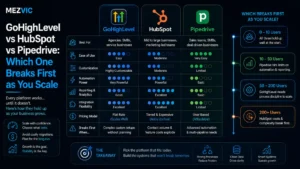
If you already run GoHighLevel, the routing usually lives there. That is covered in our GoHighLevel setup work and in the step by step CRM setup guide.
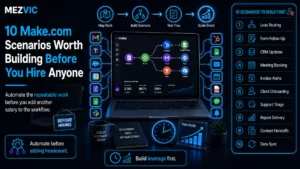
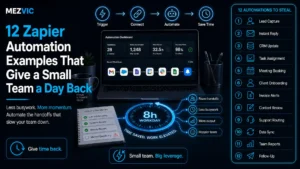
If you do not, the connection is normally built in a tool like n8n, Zapier or Make. We compared all three in this breakdown.
The mistake to avoid is treating the phone as a closed loop. A call that ends with a summary nobody reads is just a faster version of the voicemail you were already ignoring.
nnnnDecide up front which calls deserve a human callback the same day, and which ones the system can close on its own. Writing that rule down takes ten minutes and saves a fortnight of second guessing later.
Where the volume justifies it, lead generation automation can take the qualified calls and push them straight into a nurture sequence.
Voice, Chat, or Both?
Plenty of owners weighing up AI voice agents for small business ask whether they need voice, chat, or both. The honest answer depends on where your enquiries actually arrive.
Phone-heavy trades like clinics, salons, garages and property firms lose most of their revenue on unanswered calls, which is where AI voice agents for small business pay back fastest. Voice first, without much debate.
Businesses whose customers arrive through a website usually leak more on the page than on the phone. There, an AI customer service chatbot removes the repetitive questions first.
If the goal is filtering rather than answering, a lead qualification chatbot does the same job as the voice agent, in text.
Retail and eCommerce brands often start with chat for exactly that reason, which we covered in the guide to AI chatbots for eCommerce.
Running both is normal once either one proves itself. At that point the sensible step is a single AI agent sharing one set of business rules across every channel.
Not sure which leak is bigger? Our free business automation audit walks through it, and the case studies show what the work looks like once it is running.
Frequently Asked Questions
What is an AI voice agent?
An AI voice agent is software that answers phone calls and holds a natural spoken conversation. It can understand what a caller wants, answer questions, qualify leads, and book appointments without a human on the line.
How much do AI voice agents cost for a small business?
Most small businesses pay a modest one time setup fee plus a low monthly plan, often a few hundred dollars a month or less.
That is well below the cost of a part time receptionist, and a single recovered booking usually covers it.
Do AI voice agents sound robotic?
Modern AI voice agents sound remarkably human, with natural pacing and tone. Many callers cannot tell they are speaking to software, especially on routine booking and FAQ calls.
Can an AI voice agent book appointments?
Yes. When connected to your calendar, an AI voice agent checks availability and books the caller in during the call, then logs the details in your CRM.
What is the difference between an AI voice agent and a chatbot?
An AI voice agent handles spoken phone calls, while a chatbot handles typed messages on your website or apps. Businesses that get leads by phone need a voice agent, and many use both to cover every channel.
Are AI voice agents secure and private?
Reputable providers encrypt call data and follow privacy rules for your industry. For regulated fields like healthcare, ask specifically about compliance and where call recordings are stored.
Will callers know they are talking to an AI?
Most work it out within a sentence or two, and that is fine provided the agent is useful. What annoys people is not the automation, it is being trapped by it. Say plainly that it is an assistant, keep the route to a human obvious, and the reaction is usually neutral or positive rather than resentful.
What happens if the agent cannot answer something?
It should take a message and hand off, not guess. The failure mode that damages trust is an agent confidently inventing an answer about price, availability or a policy. Define the boundaries at build time: what it may answer, what it must escalate, and what it should never attempt.
Can an AI voice agent book directly into my calendar?
Yes, and this is where most of the value sits for service businesses. The agent checks live availability and writes the appointment straight in, which removes the back and forth entirely. The setup detail that matters is buffer time and travel gaps, because an agent that books back to back creates a scheduling problem rather than solving one.
How much does an AI voice agent cost to run?
Pricing is usually a monthly platform fee plus a per-minute rate for calls answered. That structure means cost rises with usage, which is the right way round, but it also means a spike in spam calls costs you money. Ask how the provider handles nuisance calls before you sign, since that line is rarely mentioned in the demo.
The Bottom Line
Every unanswered call is a customer handing money to your competitor. AI voice agents make sure that call gets answered, qualified, and booked, around the clock.
For a call driven small business, that is not a nice to have anymore. It is the difference between a full calendar and a quiet one.
Want to see what an AI voice agent would sound like for your business? Book a free strategy call and we will map your top call types and show you the setup live.
Learn more about the technology behind it in this overview of virtual assistants.