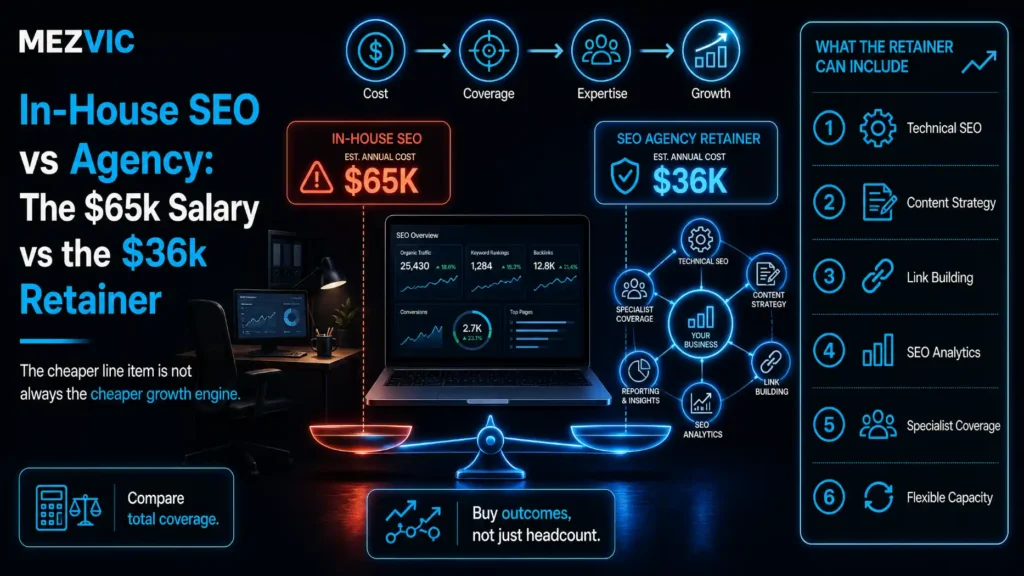
Every in-house SEO vs agency comparison starts the same way. The spreadsheet says $65,000 against $36,000 and the decision looks obvious. Both numbers are wrong, and not by a little.
One of them is missing about two thirds of its real cost. The other is missing the question of whether you can use what it buys.
Below: what in-house SEO vs agency actually costs once employment overheads are counted, when the hire becomes cheaper per hour, and which single assumption decides the whole thing.
Key Takeaways
- Salary is only 69.9% of what an employee costs an employer, according to BLS data. A $65,000 salary is roughly $92,990 in compensation before tools or recruitment.
- Year one lands near $108,840 against $36,000, a gap of $72,840. The hire never becomes cheaper in total, only per hour.
- Per hour it crosses over around month three, once ramp-up ends, at roughly $58 an hour against $94.
- The real question is capacity, not price. A hire gives you about 1,750 hours a year and a $3,000 retainer gives you around 380.
- Median tenure for workers aged 25 to 34 is 2.7 years, so budget for doing the recruitment again sooner than you expect.
What Does an In-House SEO Actually Cost?
The in-house SEO vs agency gap starts here: about 67% more than the salary, and the multiplier is published rather than estimated.
The Bureau of Labor Statistics tracks employer costs for employee compensation and reports that private industry compensation averaged $46.60 per hour worked, of which wages and salaries were $32.60.
That puts wages at 69.9% of total compensation, with benefits making up the other 30.1%.
Apply it. A $65,000 salary divided by 0.699 gives $92,990 in total employer compensation cost, of which $27,990 never appears in the job advert.
What $65,000 really means
First-year employer cost, with everything that is not salary broken out.
Benefits derived from BLS employer cost data. Recruitment at 15%, tools and equipment are typical figures.
Recruitment is the line most often left out of in-house SEO vs agency entirely. At a typical 15% fee on salary that is $9,750, and it recurs every time the role turns over.
Tools are the line most often underestimated. A rank tracker, a crawler and a backlink index run to a few hundred a month, and an agency’s fee already includes them. You can check the basics free with our SEO audit tool.
None of this makes hiring wrong. It makes the honest in-house SEO vs agency comparison $108,840 against $36,000 rather than $65,000 against $36,000. Run your own version before the budget meeting, because the version in most business cases understates the hire by roughly two thirds and nobody notices until year two.
If you want the market context for that retainer figure, our breakdown of what SEO costs covers what different budgets buy.

What Does a $3,000 Retainer Actually Buy?
Roughly 30 to 35 hours a month of senior time, the other half of in-house SEO vs agency, and that is the number nobody puts in the proposal.
Divide the retainer by a realistic blended rate and the answer falls out. At $95 an hour, $3,000 is about 32 hours, or roughly 380 hours a year.
A full-time hire delivers around 1,750 productive hours once holiday, sickness and ramp-up are removed from 2,080.
So the in-house SEO vs agency comparison is not three times the cost for the same thing. It is three times the cost for roughly four and a half times the hours.
Which reframes in-house SEO vs agency entirely. The question is not which is cheaper, it is whether you have 1,750 hours of useful SEO work a year.
For a single site in a stable niche, you very likely do not. For a large catalogue, several markets or constant development, you very likely do, and link acquisition alone can absorb the difference, as our breakdown of link building cost shows.
Ask any agency for the hours behind the number before comparing. A retainer that cannot be expressed in hours is a retainer you cannot evaluate, and it makes in-house SEO vs agency impossible to judge on anything except gut feeling.
When Does an In-House Hire Become Cheaper Per Hour?
Around month three, once ramp-up finishes, in-house SEO vs agency flips on cost per hour. Before that the hire is the most expensive hour you can buy.
Nobody arrives productive. A new SEO spends the first weeks learning your products, your platform, your history and your politics.
Cheaper per hour from month 3, not from day one
In-house cost per productive hour during ramp-up, against a flat agency rate.
Monthly cost of $8,432 including amortised recruitment, divided by hours actually delivered.
The shaded band is the period where the agency is genuinely cheaper per hour of work delivered. It is short, but it is real, and it is why three-month trials of a new hire prove nothing.
After the crossover the hire settles near $58 an hour against roughly $94 for agency time.
That is a real advantage and it compounds, provided two conditions hold.
You keep them. Every departure resets the curve to month one and adds the recruitment fee again.
You fill their week. Cheaper per hour only matters if the hours produce something. An underused hire is expensive at any rate.
The second condition is where most in-house SEO vs agency decisions go wrong. The role is justified on cost per hour and then filled with meetings, reporting and requests from other departments, until the SEO work itself gets perhaps two days a week.
Which Assumption Actually Changes the Answer?
In the in-house SEO vs agency arithmetic, salary and retainer size dominate by a wide margin. Everything else is rounding.
It is worth testing which inputs move the gap before arguing about any of them, because most debates focus on the smallest lines.
Two assumptions decide it, and three do not
Each bar is one input moved across a realistic range, holding everything else fixed.
Arithmetic on the figures above. Salary swings hardest because employment costs scale with it.
Read the bar lengths as how much each assumption can move the $72,840 gap.
Salary swings it by nearly $43,000 across a realistic range, because every extra pound of salary drags 43% more in employment costs behind it.
Retainer size swings it by $36,000, which is the more actionable of the two. Moving from $3,000 to $5,000 a month buys roughly 21 hours more per month and closes a third of the gap.
Notice how little the bottom three matter. Tools and equipment are worth about $16,000 of swing combined, which is not where the decision lives.
So if the in-house SEO vs agency choice is close, stop arguing about software budgets and test two things: what you would genuinely have to pay to hire well, and what a larger retainer would deliver.

What Does Each Option Fail At?
In-house SEO vs agency both fail in predictable ways, and neither failure is about competence.
Where each one reliably lets you down
| Failure mode | In-house | Agency |
|---|---|---|
| Breadth of skills | One person cannot be strong at technical, content and links | Usually covered by different specialists |
| Depth of context | Knows your products, customers and constraints | Learns a version of it, never all of it |
| Continuity | Everything leaves when they do | Survives staff changes, if documented |
| Priority conflicts | Pulled onto whatever is urgent this week | Protected by scope, sometimes rigidly |
| Getting work shipped | Can chase developers in person | Recommendations sit in a queue |
| Being challenged | Rarely, once they are part of the furniture | Replaceable, so incentives stay sharp |
| Cost when it is not working | Months and a difficult conversation | Thirty days notice |
The fifth row decides more outcomes than the first four combined.
Row five is the one to weigh heavily. SEO recommendations only pay when they are implemented, and implementation is a queue problem inside your business, which is why the engagement model matters as much as the skill.
An excellent agency producing work nobody ships returns nothing. A mediocre in-house hire who gets things live can outperform them easily.
Before choosing either, ask how the last three site changes actually got deployed, and how long they took.
If the honest answer is months, fix that before spending anything, because it is the constraint that makes both options fail. Our guide to pages that are indexed but not ranking covers what happens when nothing ships.
How Long Will an In-House Hire Actually Stay?
Less time than the in-house SEO vs agency business case assumes, and there is national data on exactly this.
The Bureau of Labor Statistics reports median employee tenure of 3.9 years in January 2024, down from 4.1 years two years earlier and the lowest since 2002.
Private-sector tenure is lower still at 3.5 years, and for workers aged 25 to 34 the median is 2.7 years. The same knowledge-loss problem appears whenever a function is handed over, as covered in outsourcing customer service risks.
That last figure is the relevant one, because it describes the age band most SEO hires sit in.
Two consequences follow, and both are usually missing from the business case. Neither is an argument against hiring, but both belong in the arithmetic alongside the split of technical and on-page work the role will actually cover.
Amortise recruitment over 2.7 years, not five. That $9,750 fee is roughly $300 a month rather than $160, and it recurs.
Plan for the handover you will not get. Most departures give a month, and undocumented knowledge leaves with the person.
The mitigation is cheap and almost nobody does it. Require documentation as part of the role from week one: what was changed, why, and what the result was.
An in-house SEO vs agency decision made without that requirement is really a decision to rebuild the knowledge every few years.
Which Should You Choose at Your Stage?
Settle in-house SEO vs agency by matching the option to how much work exists and how fast you can ship it, not to which looks cheaper on a spreadsheet.
Four situations cover most businesses.
- One site, stable catalogue, under $2m. Agency. You cannot fill 1,750 hours and you need breadth more than availability.
- Large catalogue or several markets. In-house, or in-house plus specialist support. The volume of work justifies the capacity.
- Active development team shipping weekly. In-house, because the value is in being in the room when decisions are made.
- Nothing has shipped in six months. Neither yet. Fix implementation first, then buy the cheaper option.
There is a fifth answer that suits more businesses than either pure option, and it rarely gets proposed because it suits nobody selling.
Hire a competent generalist and buy specialist hours. A mid-level in-house marketer who owns implementation, plus a smaller retainer for technical audits, migrations and link strategy.
That combination fixes the two failures at once. The in-house person makes work happen, and the specialists supply the depth one person cannot hold.
It also costs less than a senior hire, because you are buying seniority only where seniority is needed. Most in-house SEO vs agency debates never consider it, since neither a recruiter nor an agency has any reason to suggest it.
Where the specialist work is a defined project rather than an ongoing need, scope it as one, which is what our audit pricing breakdown is really describing.

What Should the Job Advert Actually Ask For?
One deep skill, one shippable habit, and a willingness to write things down. Adverts that ask for all of SEO attract people who are adequate at all of it.
This matters to the in-house SEO vs agency decision, because a badly specified role produces the outcome that makes hiring look like a mistake.
Decide which of the three areas your site actually needs most, then hire for that and buy the rest.
- Technical. Large catalogues, migrations, JavaScript rendering, crawl and index problems. The hardest to buy occasionally, because it needs context.
- Content. Topic planning, briefs, editing, subject expertise. The easiest to scale up and down with freelancers.
- Digital PR and links. Relationships and outreach. Genuinely specialist, and the least suited to a generalist hire.
In-house SEO vs agency also turns on which skill you are short of. Most sites need technical depth in year one and content volume afterwards, which argues for a technical hire supported by content freelancers rather than the reverse.
Then there is the requirement almost no advert includes and every business regrets omitting.
Ask for evidence of shipping. Not strategies produced, changes actually deployed, and how they got the developer time to do it.
An SEO who can navigate an engineering backlog is worth more than one with better theory, because the backlog is where most SEO value is lost. The same applies to a store team, where merchandising changes queue behind everything else, as our store operations work keeps running into.
Ask the same question of any agency. How do their recommendations usually get implemented, and what happens when a client cannot ship them.
The good ones will have a clear answer, because they have lost enough retainers to have thought about it. Ours starts by scoping technical work against what your team can realistically deploy.
One last practical note on timing. Recruitment takes eight to twelve weeks from advert to first day, and an agency starts in two.
If the work is urgent, that difference is worth more than the hourly rate, and it is a legitimate reason to start with an agency and hire later once the workload is proven.
How Do You Judge Either One Fairly?
Judge in-house SEO vs agency on leading indicators for the first two quarters, because rankings and revenue lag far behind the work that causes them.
Judging an SEO hire or an agency on traffic at ninety days is the most common way to cancel something that was working.
- Months 1 to 3, count shipped changes. Pages improved, issues fixed, content published. Output is the only honest early measure.
- Months 3 to 6, watch impressions and indexed pages. These move before positions do, and they show whether the work registered.
- Months 6 to 12, judge on positions and non-branded clicks. This is the first point at which cancelling is a reasoned decision.
- Year two onward, judge on revenue from organic. Anything earlier confuses SEO with the rest of your marketing.
Apply the same schedule to both options. Agencies are routinely judged at three months while employees are given a year, and that asymmetry has nothing to do with performance. Holding in-house SEO vs agency to the same clock is the single fairest thing you can do.
One more fairness point. Whoever you choose inherits whatever technical debt already exists, and cleaning it up produces no visible result for months.
Budget for that period explicitly rather than treating it as underperformance, particularly if crawling and indexing need work first, as covered in crawl budget optimization.
Frequently Asked Questions
Is an in-house SEO cheaper than an agency?
Not in total, but usually cheaper per hour after ramp-up. A $65,000 salary costs about $108,840 in year one against $36,000 for a $3,000 monthly retainer, while delivering roughly four and a half times the hours.
How much does an employee really cost above salary?
BLS data puts wages and salaries at 69.9% of total employer compensation costs for private industry workers, with benefits making up the rest. Dividing salary by 0.699 gives a realistic compensation figure before tools or recruitment.
How many hours does a $3,000 SEO retainer buy?
Around 30 to 35 hours a month at typical senior blended rates, so roughly 380 hours a year. Always ask an agency to express the retainer in hours, because a fee that cannot be converted to hours cannot be compared.
When does hiring in-house make more sense?
When you genuinely have enough work to fill the week, typically a large catalogue, several markets, or a development team shipping continuously. Below that threshold you are paying for capacity you cannot consume.
How long before a new SEO hire is productive?
Two to three months for most roles, because they need to learn your products, platform and internal processes first. During that period the cost per hour of work delivered is higher than agency time.
What is the average tenure of a marketing employee?
BLS reports median tenure of 3.9 years across all workers and 3.5 years in the private sector, falling to 2.7 years for those aged 25 to 34. Recruitment costs should be amortised over that shorter period.
Can one person cover all of SEO?
Rarely at a senior level across technical, content and links simultaneously. Most in-house hires are strong in one area and adequate in the others, which is the main structural argument for supplementing with specialists.
What is the hybrid model?
A capable in-house generalist who owns implementation, combined with a smaller specialist retainer for audits, migrations and link strategy. It usually costs less than a senior hire and fixes the two most common failure modes at once.
How should I judge an agency in the first six months?
On shipped changes for the first quarter, then impressions and indexed pages, then positions and non-branded clicks from month six. Judging on revenue before a year confuses SEO with the rest of your marketing.
What happens if my in-house SEO leaves?
The ramp-up curve restarts and the recruitment fee recurs, and any undocumented reasoning leaves with them. Requiring a written record of what changed and why, from week one, is the only cheap mitigation.
Which assumption matters most in the comparison?
The salary you would actually have to pay, followed by the size of the retainer. Together they move the gap by far more than tools, equipment and training combined, so debating software budgets is wasted effort.
Should I hire if nothing gets implemented?
No, because implementation is the binding constraint and neither option solves it. Find out how the last three site changes were deployed and how long they took, then fix that before spending on either.
The Bottom Line
Rebuild the in-house SEO vs agency comparison honestly first. Divide the salary by 0.699, add recruitment and tools, and put the agency retainer next to it in hours rather than pounds.
Then answer the only question that matters: do you have 1,750 hours of useful SEO work a year, and can you ship what comes out of it?
If yes, hire and document from week one. If no, buy specialist hours and spend the difference on getting changes live.
If you want the arithmetic run against your own numbers before committing to either, send us the salary you would offer and we will show you both sides properly.