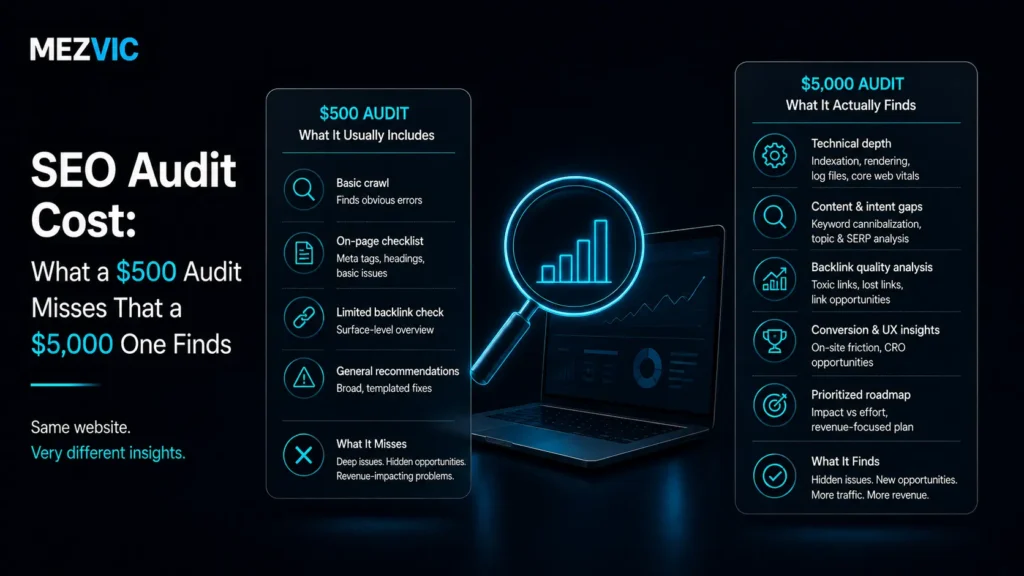
I once read two audits of the same website, commissioned three weeks apart.
The $500 one ran to 94 pages. The $4,800 one ran to 19.
The long one listed 1,847 problems. The short one listed 23, in order, with the reason each mattered and roughly how long it would take.
Only one of them had noticed that two of the site’s most important pages were competing for the same search.
SEO audit cost is not really about how much gets checked. It is about who does the checking, and whether anyone decides what to ignore.
Key Takeaways
- Audits run from free to about $15,000, with most useful ones between $1,500 and $5,000 depending on site size and how much strategy is included.
- Every tier finds the mechanical problems. Broken links, missing meta and slow pages are found identically by a $500 tool export and a $5,000 engagement.
- Cheap audits find zero judgement problems. Cannibalisation, intent mismatch and architecture faults need a person, and tools report none of them.
- Page count is an inverse quality signal. A 94 page audit usually means nobody filtered it.
- The prioritisation is the product. Findings without an order of work is a list, not an audit.
- Run the free version first. If a free crawl surfaces problems you have not fixed yet, you do not need a paid audit this quarter.
How Much Does an SEO Audit Cost?
SEO audit cost ranges from nothing for an automated crawl to around $15,000 for an enterprise engagement, with most businesses paying between $1,500 and $5,000.
The SEO audit cost spread comes almost entirely from human hours. Software licences cost the agency the same whether they charge you $500 or $5,000.
| Type | Typical price | Human hours | What you receive |
|---|---|---|---|
| Free tool report | $0 | 0 | A score and a list of technical flags |
| Automated audit | $300 to $800 | 1 to 3 | A tool export with a cover page and light commentary |
| Hybrid audit | $1,500 to $3,000 | 14 to 27 | Tool data plus manual review of key templates and a plan |
| Senior manual audit | $3,500 to $8,000 | 32 to 73 | Strategy, intent, architecture, competitors, prioritised roadmap |
| Enterprise or migration audit | $8,000 to $15,000 | 73 to 136 | Log files, multi market, engineering liaison, risk modelling |
| Content only audit | $1,000 to $4,000 | 9 to 36 | Page by page keep, merge, rewrite or remove decisions |
Hours use a $110 blended rate. Any SEO audit cost divided by that number tells you how much thinking you actually bought.
One to three hours is the tell on that second row, and it is the lowest SEO audit cost worth paying.
Nobody can review a site in three hours. What they can do is run a crawl, export it, and write an introduction. That is a real service, it is just not analysis.
Before paying for any of it, run the free version yourself. Our free SEO audit tool covers the same mechanical ground the $500 tier does, and it costs you a coffee break.

What Each Price Tier Actually Covers
Here is the same checklist run against three SEO audit cost levels. The pattern in the bottom half is the whole argument.
What gets checked at each SEO audit cost
Green is genuinely covered, amber is partial or template level only, red is not looked at.
Read that grid top to bottom and SEO audit cost stops looking arbitrary.
The first five rows are things software does perfectly at any SEO audit cost. Paying a senior consultant to tell you about 46 missing meta descriptions is paying a surgeon to apply a plaster.
The bottom six need somebody to hold two pages side by side and form an opinion. There is no export for that, which is why the price moves.
Where those judgement calls turn into actual work is on the technical SEO and on-page side, and they are usually two different queues.
The Same Site, Audited Twice
This is the comparison that made the point for me. One site, one week apart, two very different SEO audit cost levels.
Issues surfaced by a $500 audit versus a $5,000 audit
Identical on the mechanical rows. The gap only opens where a person has to make a judgement.
Arithmetic, not a study: counts from two audits of one site. The red stubs are zeroes, drawn so they do not vanish.
The top three pairs are identical, because both audits ran the same crawler.
The bottom three are the reason the second invoice was ten times larger. Seven cannibalised pairs, eleven pages answering a question nobody asked, sixteen topics competitors covered and this site did not.
None of those appear in any tool, at any price, because each one requires reading two things and deciding which should win.
Cannibalisation in particular is worth understanding before you buy anything, because it is quietly the most common cause of a site that ranks on page two for everything.

The Part Worth Paying For Is the Order
A list of 1,847 problems is not actionable, whatever the SEO audit cost was. It is a way of transferring the hard decision back to you.
Every finding sits somewhere on two axes: how much it will move, and how much work it needs. Plot them and the plan writes itself.
Where typical audit findings actually sit
This is the deliverable you are buying at the higher tiers. Any audit can produce the dots. Placing them is the job.
The green quadrant is where a good audit sends you first. Most cheap audits fill the amber one and call it a roadmap.
Notice where the mechanical findings landed.
Broken links, missing meta and image weight all sit in “batch it”. They are real, they are worth doing, and they belong in one afternoon rather than at the top of a roadmap.
An audit that opens with those three has sorted your problems by how easy they were to detect, which is not the same as how much they matter.
The bottom right corner deserves its own warning. A full URL restructure is enormous effort for modest gain on most sites, and it is exactly the recommendation that appears when nobody has weighed the cost. If you genuinely need one, treat it as an SEO migration project with its own budget.

The Six Findings a Cheap Audit Never Reports
These six separate the SEO audit cost tiers. Each one needs a person, and each one is worth more than every broken link on your site combined.
1. Two of your pages are competing
You wrote a service page in 2023 and a blog post about the same thing in 2025. Google cannot decide which to show, so it half ranks both.
No crawler flags this, because neither page is broken. Someone has to notice they answer the same question.
2. The page ranks but answers the wrong question
You rank position four for a term, and nobody clicks, or they leave immediately.
The searcher wanted a comparison and you wrote a sales page. Every technical box is ticked and the page still fails, which no score will ever tell you.
3. Your most important page is buried
Internal linking decides what your site considers important. A page four clicks from the homepage with two internal links is being described as minor.
Tools count internal links. They do not know which page you need to sell.
4. Competitors cover topics you have not touched
Gap analysis is not a list of keywords you rank lower for. It is the set of questions your market asks that your site simply does not address.
Finding those means reading competitor sites, which costs hours and produces the highest value output in any audit.
5. Googlebot is spending its time badly
Server logs show what Google actually crawled, rather than what a crawler simulated.
On large sites it routinely reveals that most crawl activity is going to filtered URLs and paginated archives while new products wait days to be seen. Google’s own Page Indexing report hints at this, and log files confirm it.
6. Nobody has said what to skip
The sixth is not a site problem. It is the missing half of the report.
A senior SEO audit cost buys someone willing to write “ignore these 1,400 items” and put their name on it. That sentence is the product.
Cannibalisation and intent problems are usually fixed with content decisions rather than code, so the fix queue runs through content work rather than the development backlog.
How to Brief an Audit So You Get the Right One
Most people brief an audit by asking for a price. That guarantees three quotes for three different jobs.
Give every provider these five things and the responses become comparable.
- The decision you are trying to make. “Should we rebuild or optimise?” produces a different audit to “why did traffic drop in March?”
- Page count and template count. Templates matter more than pages, because that is the unit of work.
- Who will implement, and how much time they have. An audit sized for a team of four is wasted on a founder with two hours a week.
- Read access to analytics and Search Console. An audit without your real data is guesswork with a nice cover.
- Your three main competitors, named. Otherwise they will pick, and they will pick the obvious ones rather than the ones taking your customers.
The fourth point is the one that changes the SEO audit cost most, and it changes it downward.
With real data, an analyst starts from what is already ranking and what already converts. Without it, they have to assess everything equally, which is slower and less useful.
If you are running a store, say so at this point. Faceted navigation and product variants make catalogue sites their own discipline, which is why eCommerce SEO audits are scoped differently from brochure sites.
When You Do Not Need a Paid Audit
This is the section most agencies leave out of the SEO audit cost conversation, so here it is plainly.
Three situations where paying for an audit is the wrong move this quarter.
- You have an unfixed list already. If a previous audit is still sitting in a folder, buying a second one is procrastination with an invoice attached.
- Nobody can implement it. An audit with no developer time behind it is a document. Budget the fixing before the finding.
- The site is under 30 pages and six months old. There is not enough there to audit. You need pages, not analysis.
There is a fourth, softer case. If your traffic fell off a cliff on a specific date, you do not need a general audit, you need someone to look at that date.
That is a two hour job, not a four thousand dollar one, and any honest consultant will tell you so before quoting.
Speed problems are similar. If the complaint is that the site feels slow, a pagespeed check across your key templates will tell you more in ten minutes than a general audit will in ten days.
What a Good Audit Deliverable Looks Like
Whatever the SEO audit cost, ask to see a redacted example before you buy. Every serious provider has one, and the format tells you almost everything.
| Signal | Weak audit | Strong audit |
|---|---|---|
| Length | 60 to 100 pages, mostly tool screenshots | 15 to 30 pages, plus a data appendix |
| Ordering | Grouped by tool category | Ordered by impact, with effort estimates |
| Issue count | Hundreds, undifferentiated | Under 30, each with a reason it matters |
| Business context | None. Could be any website | Names your products, competitors and margins |
| Who implements | Unspecified | Each item tagged developer, content or marketing |
| What to ignore | Nothing, everything is a priority | An explicit list of findings not worth fixing |
The last row is the fastest quality test. Only a confident analyst tells you which of their own findings to skip.
That final row separates the field more reliably than SEO audit cost does.
Anyone can find problems. Telling a client that 1,400 of the 1,847 findings are noise takes both judgement and a willingness to make the deliverable look smaller.
Ask one more question before signing: what happens after delivery? An audit handed over with no walkthrough loses most of its value in translation, which is why we build ours to hand straight into ongoing SEO work rather than to sit alone.
What Moves the Price Up
Four things genuinely justify a higher SEO audit cost, and it is worth knowing which apply to you before you brief.
Site size, but not in the way you expect. A 50,000 URL site is not ten times harder than a 5,000 one, because the work is template level. It does add sampling and log analysis time.
Multiple markets or languages. Each locale multiplies the checks, and hreflang problems are silent until they are enormous. This is where international SEO expertise stops being optional.
A recent migration or redesign. Something specific went wrong, and finding it means comparing before and after states rather than assessing the present one.
Competitive analysis included. Properly comparing four competitors is close to four more audits, and it is the single biggest add-on to any quote.
If none of those apply, your SEO audit cost sits in the $1,500 to $3,000 band, and paying more buys thoroughness you will not have time to use.
What to Do With It in the First 90 Days
An SEO audit cost is wasted in the gap between delivery and action. Split it into three waves and the gap closes.
Days 1 to 14, the batch job. Everything from the amber quadrant in one sitting. Broken links, meta gaps, oversized images. Low value individually, but they stop cluttering every future conversation.
Speed items belong here too, and they usually need a developer rather than a marketer, so book the time before you start. Sustained gains normally need Core Web Vitals work rather than a plugin.
Days 15 to 45, the judgement calls. Merge or separate the cannibalised pairs, rewrite the pages that answer the wrong question, and fix the internal linking so your commercial pages stop looking minor.
This wave is where the SEO audit cost actually pays back, and it is the one that gets postponed because none of it is urgent.
Days 46 to 90, the gaps. Start producing the pages your competitors have and you do not, in the order the audit ranked them.
Only after all three waves does authority work make sense. Buying links to a site with cannibalised pages is paying to strengthen a fight between your own URLs, which is why link acquisition belongs last rather than first.
One addition worth making to any 2026 audit: check how your pages read to an AI answer engine, not just to a crawler. Our guide to generative engine optimization covers what changes.
Platform matters for the first wave. A WordPress site and a Shopify store fail in different places, and a good auditor knows the difference before they open the crawler. If you are on WordPress, most of wave one lives in theme and plugin configuration.
Frequently Asked Questions
How much does an SEO audit cost?
Most SEO audits cost between $1,500 and $5,000. Automated reports run $300 to $800, and enterprise or migration audits reach $8,000 to $15,000.
Are free SEO audits worth anything?
Yes, for mechanical problems. A free crawl finds broken links, missing meta data and slow pages just as well as a paid tool, because it is the same technology.
What is the difference between a $500 and a $5,000 audit?
Human hours. Both find the technical faults, but only the expensive one covers cannibalisation, search intent, internal architecture, competitor gaps and a prioritised plan.
How long does an SEO audit take?
An automated report arrives in a day or two. A hybrid audit takes one to two weeks, and a senior manual audit two to four weeks including the walkthrough.
How often should I get an SEO audit?
A full audit every 18 to 24 months is plenty for most sites. Run a light technical crawl quarterly, and audit immediately after any migration or redesign.
Is a longer audit report better?
Usually the opposite. Length normally means nobody filtered the tool output, and a 15 to 30 page audit with 20 prioritised findings is worth more than 90 pages of screenshots.
Does the audit include fixing the problems?
Almost never. Audits are diagnosis, and implementation is quoted separately, so budget for the fixing before you commission the finding.
Can I do an SEO audit myself?
You can do the technical half with free tools. The judgement half, deciding which of two similar pages should rank and whether a page matches intent, is where most self-audits stop.
What should an SEO audit include?
Crawl and indexation, on-page elements, speed, content quality, internal linking, cannibalisation, intent alignment, competitor gaps, and a prioritised action plan with effort estimates.
Why do audit quotes vary so much for the same site?
Because each provider assumed a different depth. Divide the quote by roughly $110 an hour and compare the resulting hours, which makes two very different proposals suddenly comparable.
Should I get an audit before hiring an SEO agency?
An independent audit gives you a baseline and a way to judge proposals. Just be aware that most agencies will want to run their own before committing to a plan.
What is a realistic SEO audit cost for a small business site?
Between $1,200 and $2,500 for a site under 500 pages with one market. That buys genuine manual review of your main templates plus a plan you can actually work through.
The Bottom Line
Run the free crawl before you pay any SEO audit cost. If it surfaces work you have not done, do that work and save your money.
When you do buy, buy the judgement half. The mechanical findings are the same at every price, and you can get them for nothing.
Judge the deliverable on how short it is, how it is ordered, and whether anyone was brave enough to tell you what to ignore.
If you want an audit that arrives as a ranked plan rather than a spreadsheet, see how we scope ours or send us the URL and we will tell you which tier you actually need.