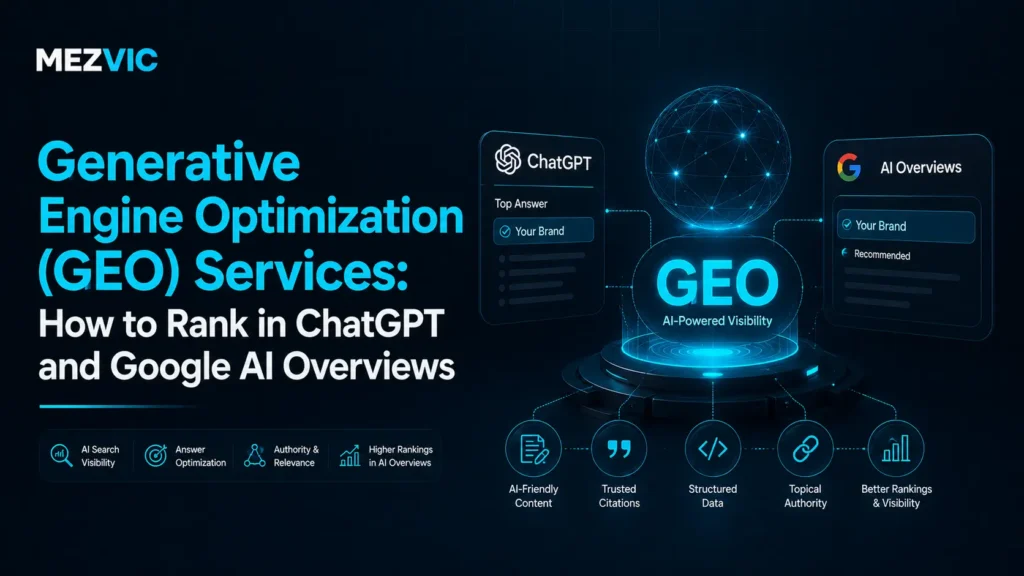
Your customers are starting to skip Google. Instead of scrolling ten blue links, they ask ChatGPT, Perplexity, or Google’s AI Overview and take the answer it hands them.
If your brand is not in that answer, you are invisible, no matter how well you rank in classic search.
Generative engine optimization is how you fix that. It is the practice of getting your business cited inside AI generated answers.
This guide covers what generative engine optimization is, how it differs from SEO, and exactly how to get cited by ChatGPT and Google AI Overviews in 2026.
Key Takeaways
- Generative engine optimization gets your brand cited inside AI answers, not just ranked in search.
- Generative engine optimization builds on SEO, it does not replace it. You need both.
- AI engines cite clear, structured, fact backed content with strong schema.
- The framework is simple: answer first, structure for extraction, prove with specifics, mark up, build authority.
- You can measure GEO by tracking brand mentions, citations, and share of answer.
What Is Generative Engine Optimization (GEO)?
Generative engine optimization (GEO) is the practice of optimizing your content so AI answer engines cite it in their responses. Where SEO aims for a ranking, GEO aims for a mention inside the answer itself.
Think of it as SEO for a world where the search result is a paragraph, not a list of links.
The engines that matter most are ChatGPT, Google AI Overviews, Perplexity, and Microsoft Copilot. Each reads the web, writes an answer, and names its sources.
Generative engine optimization is about becoming one of those named sources.
GEO vs SEO: What Is the Difference?
GEO and SEO share the same foundation but optimize for different outcomes. SEO wins you a position on a results page. GEO wins you a sentence inside an AI answer.
| Factor | SEO | GEO |
|---|---|---|
| Goal | Rank in the results | Get cited in the answer |
| The unit that wins | A page position | A quoted sentence or stat |
| Where it plays out | Google and Bing results | ChatGPT, AI Overviews, Perplexity |
| Wins with | Keywords, links, authority | Clear answers, structure, citable facts |
| Success looks like | Position one | “According to Mezvic…” |
Here is the good news. Strong SEO still helps, because GEO builds on a solid technical SEO foundation rather than replacing it.
Why GEO Matters Now
AI answers are eating clicks. When an AI Overview answers the question at the top of the page, most users never scroll to the links below it. Buyers increasingly start in an assistant rather than a search box, which is why AI search optimization has become its own workstream.
That shift is already reshaping how people find businesses. The brands cited in AI answers capture the attention, and everyone else fights over the leftovers.
These answers are written by large language models that pull from across the web, so the way you present information now decides whether you get quoted.
Ignoring generative engine optimization in 2026 is a lot like ignoring Google in 2005. The channel is new. The stakes are not.
How AI Answer Engines Decide What to Cite
AI answer engines cite sources that are clear, credible, well structured, and easy to extract. They favor content that answers the question directly and backs it up with specific facts. Crawlability and site health still gate all of this, which remains technical SEO work.
From what we see across hundreds of AI answers, five things make a page citable:
- A direct answer in the first sentence of each section.
- Specific, quotable facts and numbers, not vague claims.
- Clean structure: clear headings, short lists, and tables.
- Topical authority, so the engine trusts you on the subject.
- Schema markup that spells out exactly what the page is.

The GEO Framework: How to Get Cited by ChatGPT and AI Overviews
Getting cited is not luck. It follows a repeatable framework: answer, structure, prove, mark up, and build authority.
1. Answer the question first
Open every section with a one or two sentence answer an engine can lift word for word. Save the buildup for after the answer, not before it.
2. Structure for extraction
Use literal, question style headings that match how people ask. Break information into lists, tables, and short paragraphs the model can parse cleanly.
3. Prove it with specifics
Generic claims do not get quoted. Numbers, benchmarks, dates, and named sources do. Give the engine a fact it can repeat with confidence.
4. Mark it up and build authority
Add FAQ, Article, and HowTo schema so machines understand your page. Then earn depth on the topic, because engines cite brands they see as experts.
This is the core of both getting cited by ChatGPT and winning placement through Google AI Overview optimization.
The same answer, written two ways
Answer engines lift sentences. One of these can be quoted on its own, the other cannot.
“How much does a 3PL cost?”
Pricing is one of the most common questions we get asked, and the honest answer is that it depends on a lot of moving parts, which we will walk through below.
“How much does a 3PL cost?”
Most 3PLs charge three things separately: a per-order pick and pack fee, storage by space and time, and shipping at their discounted carrier rate.
Both passages contain the same information. Only the second one survives being pulled out of context.
On-Page GEO Tactics That Work
The tactics that improve generative engine optimization are practical and repeatable. Most of them also make your content better for human readers. Explicit structured data removes ambiguity about what a page is, which is handled by schema markup.
- Add real FAQ sections that mirror how people phrase questions to AI.
- Write definition sentences a model can quote standalone.
- Use comparison tables for “X vs Y” questions.
- Cite specific data and attribute it clearly.
- Be consistent about your brand and entities across the whole site.
Do not skip the machine readable layer. Clean schema markup tells AI engines what your page is before they even read the words.
How Do You Measure GEO Success?
You measure GEO by tracking how often AI engines mention your brand and cite your pages. It is newer and messier than a ranking report, but it is measurable.
Watch these four signals:
- Brand mentions inside AI answers for your key questions.
- Citations where an engine links directly to your pages.
- Referral traffic arriving from ChatGPT, Perplexity, and Copilot.
- Share of answer, how often you appear versus competitors.
Run your top ten buyer questions through the major engines each month. If your name is missing, that is your roadmap.

What GEO Services Actually Include
A generative engine optimization service, sometimes called AI search optimization, audits how AI engines currently see your brand and then closes the gaps.
A complete engagement usually includes:
- An AI visibility audit across ChatGPT, Perplexity, and AI Overviews.
- Content restructured to be quotable and extractable.
- Schema and entity work so machines understand your brand.
- Ongoing tracking of citations and share of answer.
If that sounds like a lot to run in house, our AI search optimization team handles the whole process end to end.
Which AI Engines Should You Optimize For?
Not every AI engine works the same way. Your priorities depend on where your customers already are. ChatGPT and Google AI Overviews behave differently enough to warrant separate attention, covered on ChatGPT SEO and AI Overview optimization.
ChatGPT
The biggest by usage. It draws on its training and, increasingly, live web results. Being a clear, authoritative source on your topic is what earns a mention.
Google AI Overviews
These sit on top of normal Google results, so your existing SEO strength feeds straight into them. Structured, quotable content wins the citation.
Perplexity
Built around citations from day one. It names sources on almost every answer, which makes it the easiest place to check whether your GEO is working.
Microsoft Copilot
Tied to Bing and the Microsoft ecosystem. If your audience is business or enterprise, it is worth watching closely.
Start with the engine your buyers actually use, then expand from there.
Common GEO Mistakes to Avoid
Most generative engine optimization failures come from a handful of repeatable mistakes. Skip these and you are already ahead of most competitors.
- Burying the answer. If your key point is not near the top of a section, engines skip it.
- Vague, unsourced claims. AI engines quote specifics, not marketing fluff.
- No schema. You leave the machine guessing what your page even is.
- Thin topical coverage. One article rarely earns trust. A cluster does.
- Ignoring your entity. Inconsistent brand names and details confuse the model.
GEO Is Built on E-E-A-T
AI engines are careful about what they repeat, because a wrong answer damages their credibility. So they lean toward sources that signal experience, expertise, authority, and trust.
In practice that means real author names, credentials, citations, and a visible track record on the topic. Faceless, anonymous content struggles to get cited.
If you want to be the source an AI trusts, look like a source worth trusting. Show who is behind the content and why they know the subject.
A Real Example: From Invisible to Cited
Picture a niche B2B software company. Ask ChatGPT to recommend a tool in their category, and their name never comes up.
They dig in and find the problem. Their content is salesy, thin, and light on specifics. There is nothing quotable for an engine to lift.
So they rebuild. Clear definitions, honest comparison tables, real numbers, and proper schema on every key page.
Three months later, that same ChatGPT question lists them by name. Nothing about the product changed. The way they presented it did.
GEO for Local and Small Businesses
GEO is not just for big brands. Ask an AI engine for the best plumber in a city, and it will happily name a few based on what it can read about them. Assistants lean heavily on local signals for these queries, which is ordinary local SEO groundwork.
For a local business, clear service pages, consistent details, and genuine reviews all feed your AI visibility.
It pairs naturally with local SEO. The same signals that win the map pack also help an engine recommend you by name.
How Long Does GEO Take to Work?
Generative engine optimization usually starts showing results in a few weeks to a few months, depending on your existing authority. Sites that already rank well tend to get cited faster.
The engines recrawl and re evaluate constantly, so improvements compound. A page restructured today can start appearing in answers within weeks.
Brand new sites take longer, because trust has to be built first. That part is classic SEO, and it is exactly why the two disciplines belong together.
The Rise of Zero-Click Answers
For years, SEO chased the click. GEO accepts a new reality: often there is no click at all.
When an AI answer resolves the question on the spot, the payoff is not a visit. It is being the brand named in that answer.
That is influence, even without traffic. The businesses that adapt fastest treat a citation as the new number one ranking.
This does not mean clicks vanish. High intent buyers still click through to compare and buy. But the first impression now happens inside the answer.
How to Track Your AI Citations
You cannot improve what you do not measure, and generative engine optimization is no exception. The good news is that tracking it is getting easier. Check readability while you are there, since dense prose is harder to lift: our readability checker is free.
Start simple and manual. Each month, ask the major engines your top buyer questions and record whether your brand appears.
Then layer in tooling. A growing set of platforms now monitor AI mentions and citations the way rank trackers monitor keywords.
Also watch your analytics for referral traffic from ChatGPT, Perplexity, and Copilot. It is small today, but the trend line is what matters.
Do You Need Backlinks for GEO?
Backlinks still matter, but indirectly. They build the authority that makes an engine trust you enough to cite you in the first place. Authority still comes from being referenced elsewhere, which is link building by another name.
GEO shifts some weight from raw link count toward clarity and structure. A well organized page from a credible site can out cite a messier page with more links.
The winning formula is both. Earn authority the classic way, then present it in a format AI engines can actually lift.
GEO and Your Wider Content Strategy
The biggest generative engine optimization shift is not technical. It is editorial. The writing side of that sits with SEO content writing, where extractability is now part of the brief.
Every article should answer a real question completely, with the answer up front and the proof right behind it. That single habit lifts your GEO across the whole site.
Build topical clusters, not one off posts. Depth on a subject is what convinces an engine you are the authority worth quoting.
Done well, GEO and content marketing become the same job. You write to be genuinely useful, and being useful is exactly what gets you cited.
Does GEO Replace SEO Teams and Budgets?
Generative engine optimization does not kill SEO. It expands it. For most brands it becomes one line inside a broader digital marketing plan rather than a replacement for it.
The skills overlap heavily: research, structure, authority, and technical hygiene. Most teams already doing good SEO are closer to GEO than they realize.
What changes is the scorecard. Alongside rankings and traffic, you start reporting on citations and share of answer. Budgets follow attention, and attention is moving toward AI answers.
Getting Started With Generative Engine Optimization
You do not need to overhaul your whole site to begin. Generative engine optimization rewards focus, not scale.
Pick your ten most important buyer questions. Check how the AI engines answer them today, and note where your brand is missing.
Then rewrite the pages that should own those answers. Lead with the answer, add the proof, and mark it up cleanly.
Do that for your top pages first, measure the shift, and expand from there. Generative engine optimization compounds, so early wins make the next ones easier.
The businesses winning at generative engine optimization are rarely the biggest. They are the clearest.
Start there, and a trend that sounds intimidating becomes a simple, repeatable habit. The engines already answer questions about your industry every day, and generative engine optimization makes sure your name is in those answers.
Frequently Asked Questions
What is generative engine optimization?
Generative engine optimization (GEO) is the practice of optimizing content so AI answer engines like ChatGPT and Google AI Overviews cite it in their responses.
The goal is to be mentioned inside the AI answer, not just to rank in search results.
Is GEO the same as SEO?
No. SEO optimizes for rankings on a results page, while GEO optimizes for citations inside AI generated answers. They share a foundation, and the best strategies do both together.
How do I get my business cited by ChatGPT?
Answer common questions directly, structure content with clear headings and lists, back claims with specific facts, and add schema markup. Strong topical authority on the subject makes citation much more likely.
Does GEO replace SEO?
No. GEO builds on top of SEO. A page still needs to be crawlable, fast, and authoritative, and those are classic SEO jobs. GEO adds the structure and clarity that AI engines reward.
Can you measure GEO results?
Yes. You can track how often AI engines mention your brand, whether they cite your pages, referral traffic from AI tools, and your share of answer against competitors for key questions.
How is GEO different from answer engine optimization?
They describe the same work under different names. Generative engine optimization and answer engine optimization both mean structuring content so AI systems can extract, trust and cite it. GEO is the term that has stuck in most industry writing, and you will also see AEO and AI SEO used interchangeably. The tactics do not change with the label.
Does schema markup help with AI citations?
It helps indirectly rather than as a ranking switch. Structured data makes the meaning of a page explicit, which reduces the chance an engine misreads what you sell or who wrote it. FAQ and HowTo markup in particular mirror the question-and-answer shape these systems are looking for. Treat it as removing ambiguity, not as a guarantee of being quoted.
Do AI engines prefer new content or established pages?
Established pages with a clear topic and visible authorship tend to be cited more often, but freshness matters for anything time-sensitive such as pricing, fees or platform rules. The practical approach is to keep a smaller number of genuinely authoritative pages current rather than publishing a large volume of thin content that no engine has a reason to trust.
Can I stop doing traditional SEO if I focus on GEO?
No, and the two are more connected than they look. AI answer engines largely draw on pages that already rank and are already crawlable, so technical health, internal linking and genuine authority remain prerequisites. GEO changes how you write and structure a page. It does not replace the reasons a page was findable in the first place.
How do I know if AI engines are citing my competitors?
Ask the engines directly, using the questions your customers actually type, and record which brands appear in the answers. Do it on a fixed schedule rather than occasionally, because answers shift as models update. Pay attention to which specific page gets cited, since that usually reveals the format the engine finds easiest to lift.
The Bottom Line
Search is splitting into two games. One is the classic race for rankings. The other is the race to be cited inside AI answers, and that one is only getting bigger.
Generative engine optimization is how you win the second game. Get it right and your brand becomes the answer, not just a link buried under it.
Want to know how ChatGPT and Google’s AI answers describe your business today? It is usually eye opening. Book it into your wider digital marketing plan, or book a free strategy call and we will run your top questions live.