Introduction
A 2026 FreightWaves analysis found that U.S. import tariffs introduced in early 2025 added an average of 12–18% to landed costs for Asia-sourced goods — costs that have flowed directly into fulfillment overhead for thousands of online sellers. At the same time, average warehouse storage rates climbed 9% year-over-year (CBRE Industrial Market Report, Q1 2026), squeezing margins that were already thin.
Ecommerce fulfillment services are no longer a back-office detail. In 2026, the 3PL partner you choose directly determines whether your unit economics work or don’t. Pick wrong and you’re eating $4–7 in fulfillment costs on a $25 product. Pick right and you free up capital, cut transit times, and let your operations team focus on growth instead of warehouse headaches.
This guide covers everything you need to make that choice well: what to look for in a 3PL, how different platforms (Shopify, WooCommerce, Amazon FBA) connect to fulfillment networks, a side-by-side comparison of the top providers, and the questions you should ask before signing any contract.
Why 2026 Is a Turning Point for Fulfillment Strategy
The tariff environment changed the math for almost every category of physical goods. Sellers who sourced from China, Vietnam, or Bangladesh in 2024 are now running landed cost models that look nothing like their original projections. That pressure doesn’t evaporate at the warehouse door — it compounds.
The Tariff Ripple Effect
When your landed cost goes up, every fulfillment inefficiency gets amplified. A 3PL charging $0.50 more per pick-and-pack than its competitor used to be a rounding error. In 2026, on a product with 8% net margin, it’s the difference between profitability and a loss.
Beyond tariffs, two structural shifts are reshaping what sellers need from fulfillment partners:
Inventory positioning matters more than ever. With longer, more volatile supply chains, sellers need 3PLs with distributed warehouse networks — not a single Midwest hub — so stock can be positioned close to demand clusters and delivery SLAs can hold.
Returns volume is rising. Average return rates for ecommerce hit 17.6% in 2025 (National Retail Federation). A 3PL that handles returns poorly burns customer lifetime value just as fast as slow shipping does.
What This Means for You
You need a fulfillment partner that can absorb supply chain variability, give you real-time visibility into inventory, and price their services transparently enough that you can actually model your unit economics. That rules out a surprising number of providers.
What Ecommerce Fulfillment Services Actually Include
“Fulfillment” is one of those words that gets used to mean everything and nothing. Before you compare providers, get clear on which services you actually need.
Core Fulfillment Functions
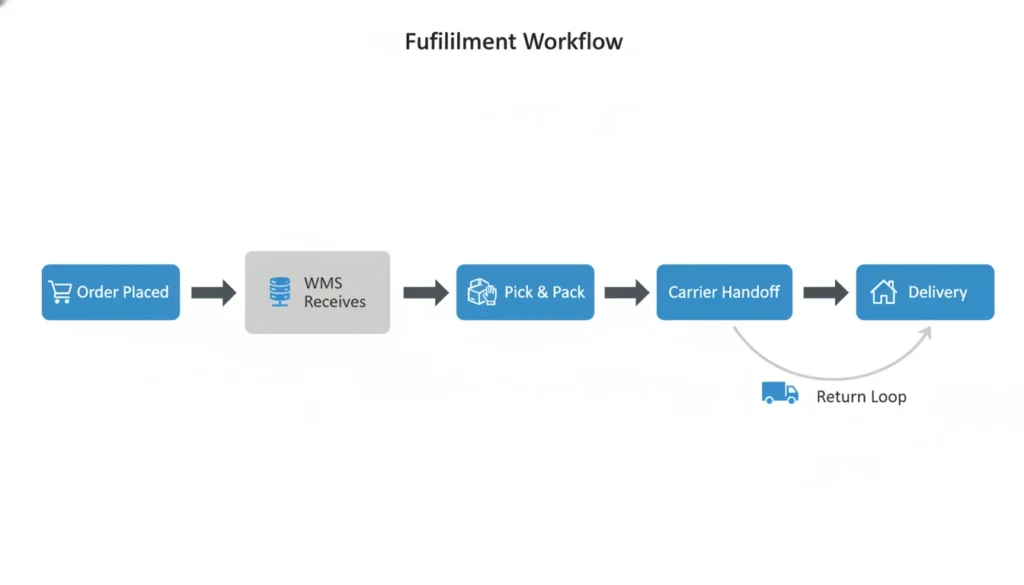
- Receiving: Unloading, inspecting, and logging inbound inventory. Errors here cascade through your entire operation.
- Storage: Per-unit or per-pallet pricing for holding inventory in the 3PL’s warehouse.
- Pick and pack: Selecting the right items per order, packing them, and applying labeling.
- Shipping: Carrier selection, label generation, and handoff. Good 3PLs have negotiated rates well below what you’d get directly.
- Returns processing (reverse logistics): Receiving, inspecting, restocking, or disposing of returned items.
Value-Added Services (VAS)
Some 3PLs offer kitting, custom packaging, product inserts, quality control inspections, and even light assembly. These matter if you’re running bundles or subscription boxes. Not every provider does them well — ask for throughput data and error rates.
Technology Integration
This is where best ecommerce fulfillment services separate from average ones. You want a 3PL whose warehouse management system (WMS) integrates natively or via API with your storefront. Manual order imports are a liability at scale.
How to Evaluate a 3PL Partner: 8 Key Criteria
1. Pricing Transparency
Get a full rate card — receiving fees, storage fees (monthly and long-term), per-pick fees, packing material costs, and carrier rate sheets. If a 3PL is vague about any of these, that’s the answer.
2. Warehouse Network and Location
Where are their facilities? If 90% of your customers are on the East Coast but your 3PL only has a Nevada warehouse, you’re paying for 4-day ground shipping where 2-day is available. Multi-node networks reduce both transit time and carrier cost.
3. Technology Stack and Integrations
Does their WMS integrate with Shopify, WooCommerce, Amazon Seller Central, TikTok Shop, or wherever you sell? Look for pre-built connectors — not promises that their tech team “can build something.” Ask about order sync latency (how quickly does an order placed on your store appear in their system?).
4. Accuracy and SLA Track Record
Ask for documented order accuracy rates and on-time ship rates. Industry baseline is 99.5% accuracy. Anything below that at meaningful volume costs real money in reshipments and refunds.
5. Returns Handling
Ask how returns are processed — what’s the turnaround from carrier delivery to restocked inventory? How do they handle damaged goods? What’s the per-unit returns processing fee?
6. Scalability
Can they handle a 5× volume spike during Q4 without your orders falling behind? Get specifics on staffing and capacity commitments, not marketing language.
7. Customer Service and Account Management
Will you have a dedicated account manager or a ticket queue? For growing sellers, a real human who knows your account is worth paying a premium for.
8. Contract Terms
Watch for long-term lock-ins, minimum monthly fees, and fee escalation clauses. Some 3PLs have aggressive termination penalties. Read the SLA section carefully — understand what remedies exist if they miss their commitments.
3PL Comparison: Top Ecommerce Fulfillment Services in 2026
This table reflects publicly available pricing and capabilities as of Q1 2026. Actual quotes will vary based on volume, SKU count, and location.
| Provider | Best For | Warehouse Nodes | Avg. Pick & Pack Fee | Shopify Integration | WooCommerce Integration | Returns Handling | Minimum Volume |
|---|---|---|---|---|---|---|---|
| Amazon FBA | Amazon-first sellers | 100+ (US) | Bundled in FBA fee | Limited (MCF) | Via MCF API | Strong (AtoZ) | None |
| ShipBob | DTC brands, multi-channel | 40+ (global) | $2.73–$3.50/order | Native | Native | Good | None |
| Deliverr (Flexport) | Fast badges, multi-marketplace | 80+ (US) | $3.50–$5.00/order | Native | Plugin | Moderate | None |
| ShipMonk | Subscription boxes, kitting | 12 (US/EU/CA) | $2.50–$4.00/order | Native | Native | Good | 250 orders/mo |
| Red Stag Fulfillment | Heavy/oversized goods | 2 (US) | $3.00–$6.00/order | Native | Plugin | Excellent | None |
| Whiplash | Fashion, apparel, B2C | 8 (US) | $2.80–$4.50/order | Native | Native | Good | 500 orders/mo |
| Regional/boutique 3PLs | High-touch, specific verticals | 1–3 | $2.00–$3.50/order | Varies | Varies | Varies | Varies |
Note: Amazon Multi-Channel Fulfillment (MCF) lets FBA inventory fulfill non-Amazon orders, but delivery speed and branding control are limited. For sellers focused on DTC brand experience, a dedicated 3PL is usually a better fit.
Platform-Specific Fulfillment Considerations
Your storefront isn’t just where you sell — it determines which fulfillment integrations are available, how inventory syncs, and how returns flow back.
Shopify Fulfillment
Shopify fulfillment services have expanded significantly. The native Shopify Fulfillment Network (SFN), powered by Flexport, is an option for US sellers, but it comes with inventory restrictions and onboarding requirements. Most growing Shopify merchants choose a third-party 3PL with a Shopify app — ShipBob, ShipMonk, and Whiplash all have well-maintained native apps with real-time order sync.
Key things to check for Shopify sellers: Does the 3PL app support Shopify Markets for international orders? Does it sync back tracking numbers within the SLA required for Shopify’s on-time shipping metrics?
WooCommerce Fulfillment
The 3PL service for WooCommerce landscape is more fragmented. WooCommerce doesn’t have a centralized app store equivalent to Shopify’s, so integration quality varies. ShipBob and ShipMonk both offer WooCommerce plugins. For custom setups, some sellers use n8n or Zapier to bridge their WooCommerce order webhook to a 3PL API — which works but requires maintenance.
If you’re running WooCommerce with custom checkout flows or multi-vendor configurations, test the 3PL integration in a staging environment before going live. Order sync failures are much harder to catch post-launch.
Amazon FBA
Amazon FBA remains the strongest fulfillment option if you’re primarily selling on Amazon. The logistics network, Prime badge, and returns handling are difficult to replicate. The risk is dependency — fee increases (which happened twice between 2023 and 2025) directly cut your margin with no warning.
Many Amazon sellers now run a hybrid model: FBA for Amazon orders, a separate 3PL for DTC and other marketplaces. This hedges against FBA fee changes and gives you brand-owned fulfillment for your Shopify or WooCommerce store.
eBay and TikTok Shop
For eBay fulfillment services, most sellers use a 3PL that also integrates with eBay’s shipping label system. eBay’s own fulfillment program is limited by geography and category. TikTok Shop has its own fulfillment requirements — particularly around shipping speed for TikTok Shop badges — so confirm your 3PL can meet those SLAs before committing inventory.
Common Mistakes That Kill Your Margin
Choosing on Price Alone
The cheapest pick-and-pack fee is meaningless if the 3PL has a 98.5% accuracy rate. At 10,000 orders a month, that’s 150 wrong shipments — each costing you a replacement, return shipping, and a customer service interaction. Do the math before chasing the lowest rate card.
Ignoring Dimensional Weight
Carriers charge based on whichever is higher — actual weight or dimensional weight. If your 3PL isn’t advising on optimal packaging dimensions, you may be paying carrier surcharges on every single shipment. Ask prospective 3PLs whether they do packaging audits.
Not Auditing Storage Fees
Long-term storage fees compound fast. A client in the home goods space came to Mezvic paying $11,000/month in storage overage fees at their previous 3PL because their slow-moving SKUs had accumulated for two quarters. An inventory velocity audit reduced that by 70% within 60 days — partly by liquidating dead stock and partly by switching to a 3PL with better long-term storage tiering.
Underestimating Integration Risk
Moving to a new 3PL mid-season is operationally complex. You’re transferring physical inventory, reconfiguring order routing, and retraining your ops team — all while orders keep flowing. Plan transitions during low-volume periods and build a 2–4 week overlap where both systems run in parallel.
Skipping the Reference Check
Ask for two or three references in your vertical and actually call them. Ask about what went wrong and how the 3PL handled it. A 3PL that handled a Q4 spike well in 2025 is a very different partner than one that promised capacity and couldn’t deliver it.
How Mezvic Approaches Fulfillment Strategy
At Mezvic, fulfillment strategy isn’t a standalone conversation — it sits inside the broader picture of how your ecommerce operation works. When we work with a new client, we start by mapping current fulfillment costs per order against the channel mix: Amazon orders vs. Shopify DTC vs. marketplace orders often have dramatically different cost profiles, and conflating them makes it impossible to make good decisions.
We use tools like Inventory Planner and ShipBob Analytics (where the client is already on ShipBob) alongside manual audit processes to surface where margin is leaking. In most cases, the biggest wins aren’t in negotiating a lower pick-and-pack rate — they’re in inventory positioning, packaging optimization, and fixing the integration so order data flows cleanly without manual touchpoints.
Our team has hands-on experience across the major 3PL platforms and has managed fulfillment transitions for clients across fashion, home goods, supplements, and consumer electronics. We know which providers perform well in which verticals, and we’re not affiliated with any of them — so our recommendations are based on fit, not referral fees.
If you’re evaluating ecommerce fulfilment services and want a second opinion on your current setup or a cost model for a transition, that’s exactly the kind of work we do.
Key Takeaways
- Tariff pressure and rising storage rates in 2026 make 3PL selection a direct margin lever — not an operational afterthought.
- Evaluate 3PLs on accuracy rate, tech integration, warehouse network, and transparency of pricing — not headline pick-and-pack fee alone.
- WooCommerce sellers need to verify integration quality independently; it’s more variable than the Shopify ecosystem.
- A hybrid fulfillment model (FBA for Amazon + 3PL for DTC) is increasingly the right answer for multi-channel sellers.
- Inventory velocity audits typically surface the biggest hidden cost savings before you even change providers.
- Plan 3PL transitions during low-volume windows with a parallel-run period — mid-season transitions carry serious operational risk.
- Always call references. Ask specifically about what went wrong and how the 3PL responded.
Frequently Asked Questions
What are the best ecommerce fulfillment services for small businesses?
For small businesses, ShipBob and ShipMonk are typically the strongest starting points — both have no hard minimums, native Shopify and WooCommerce integrations, and transparent rate cards. If you’re selling primarily on Amazon, FBA remains the most cost-effective option at low volumes because the infrastructure is already built. The “best” option depends on your average order weight, SKU count, and where your customers are located.
How much do ecommerce fulfillment services cost?
Costs vary significantly by provider and volume, but a rough benchmark for a standard 3PL: $0.20–$0.50/unit for receiving, $0.50–$1.50/cubic foot/month for storage, and $2.50–$5.00 per order for pick and pack (including one item). Shipping is billed at carrier rates, which most 3PLs discount by 15–40% due to volume. At meaningful scale, fulfillment typically runs 8–15% of revenue.
What is a 3PL service for WooCommerce, and how does it work?
A 3PL service for WooCommerce is a third-party logistics provider that integrates with your WooCommerce store to automatically receive orders, pick and pack them from their warehouse, and ship them to your customers. The integration works via a plugin or API — when an order is placed in WooCommerce, it’s transmitted to the 3PL’s warehouse management system in real time. Tracking numbers are then synced back to WooCommerce and the customer is notified automatically.
How do I choose between Amazon FBA and a third-party fulfillment service?
Use FBA if the majority of your sales volume is on Amazon and you want the Prime badge without managing your own logistics. Use a third-party 3PL if you’re building a DTC brand, selling across multiple marketplaces, or want more control over packaging and the unboxing experience. Many sellers in 2026 run both — FBA for Amazon orders, a 3PL for everything else — as a hedge against FBA fee changes.
What are ecommerce fulfilment services versus fulfillment services?
The difference is spelling only — “fulfilment” is the standard British English spelling used in the UK, Australia, and much of Europe, while “fulfillment” is the American English spelling. The services themselves are identical: warehousing, picking, packing, shipping, and returns handling for ecommerce orders.
How long does it take to transition to a new ecommerce fulfillment provider?
A typical 3PL transition takes 4–8 weeks end-to-end: 1–2 weeks for contract and onboarding, 1–2 weeks for integration setup and testing, 1 week for inventory transfer, and a 1–2 week parallel-run period. The timeline extends if you have complex SKU configurations, kitting requirements, or a large number of active marketplace channels. Never transition during Q4 or a major promotional period.
What should I ask a 3PL during the vetting process?
The six questions that matter most: (1) What is your documented order accuracy rate? (2) What is your average ship time from order receipt to carrier handoff? (3) How do you handle inventory discrepancies? (4) What does your SLA look like during peak season? (5) What are your termination terms and transition support if I need to leave? (6) Can you provide two references in my product category?
Conclusion
Choosing the right ecommerce fulfillment services in 2026 is a financial decision as much as an operational one. With tariff pressures compressing margins and storage costs climbing, every dollar of fulfillment inefficiency has more impact than it did two years ago. The providers and frameworks in this guide give you a starting point — but the right answer for your business depends on your volume, your channels, and what your unit economics can actually support.
If you want a clear-eyed look at what your fulfillment is actually costing you — and what it could cost — Mezvic can build that model with you.
Get a Free Fulfillment Cost Estimate.